


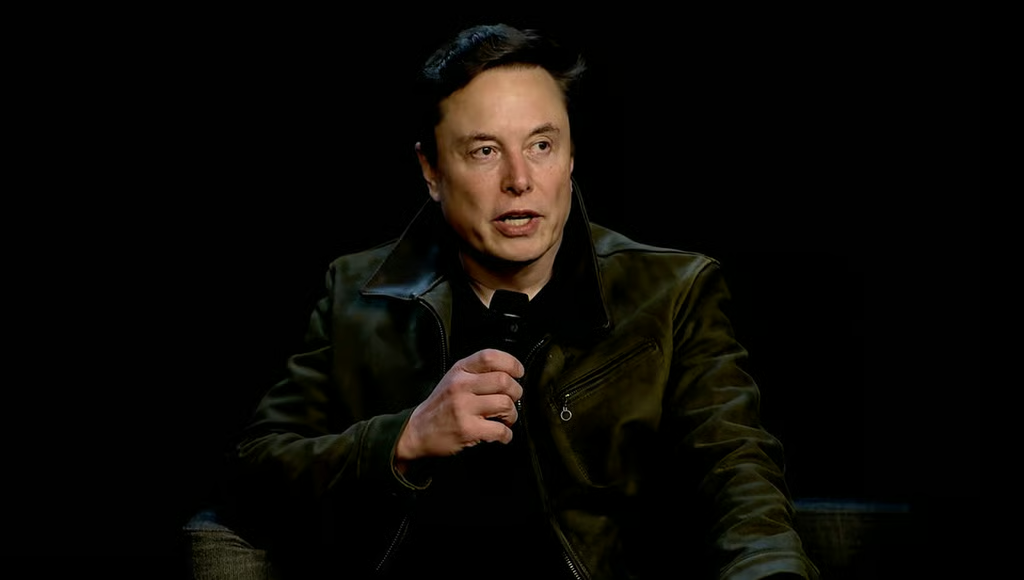
Elon Musk and Sam Altman are two of the biggest names in generative AI today, and they have a history of public rivalry.
After co-founding OpenAI with CTO Greg Brockman, research director Ilya Sutskever, and others, Musk and Altman had a public falling out, with Musk creating xAI as a competitor. Their relationship is inextricably linked with the rapidly changing face of OpenAI, which is undergoing a rocky transition to a for-profit structure.
Here is a timeline of key events in the Musk/Altman business relationship, which has evolved into a rivalry centered around OpenAI.
Timeline of OpenAI, xAI, and the Musk/Altman split
- Dec. 11, 2015: OpenAI launched as a nonprofit intended to “advance digital intelligence in the way that is most likely to benefit humanity as a whole” and to expand the “narrow capabilities” of AI at the time. The company sought to safely create AI with human-level intelligence. Altman was among the public faces of the effort, with Musk as a co-founder and donor.
- Fall 2017: Musk requested majority equity, initial board control, and the CEO position as part of a transition to a for-profit company, OpenAI alleged.
- Feb. 2018: Musk suggested OpenAI should “attach to Tesla as its cash cow,” according to correspondence released by OpenAI.
- Feb. 21, 2018: Musk resigned from OpenAI’s board to avoid conflicts with Tesla’s AI initiatives, while pledging to keep advising and donating.
- Mar. 11, 2019: OpenAI introduced a capped-profit structure with a for-profit subsidiary to raise far more capital and compute, watched over by the nonprofit.
- July 12, 2023: Musk formally unveiled his company xAI, recruiting talent from leading AI labs and positioning it as a competitor to OpenAI. The company’s purpose was to “understand reality,” Musk said on X.
- Nov. 3, 2023: xAI debuted Grok.
- Mar. 17, 2024: xAI released the base model weights and architecture for Grok-1.
- Mar. 2024: Musk sued OpenAI and Altman in California, alleging a departure from the nonprofit mission to protect humanity. OpenAI responded by publishing emails and context disputing his claims.
- June 11–12, 2024: Musk withdrew the lawsuit without publicly stating a reason. The court dismissed the case.
- November 2024: Musk amended his original lawsuit and filed a revised complaint to stop OpenAI from becoming a for-profit company. Musk added Altman’s backer, Microsoft, as a defendant.
- Feb. 14, 2025: Musk attempted to buy OpenAI for $97.4 billion. OpenAI’s board of directors rejected his bid.
- Mar. 4, 2025: A judge blocked Musk’s attempt to block OpenAI’s shift to a for-profit structure.
- April 9, 2025: OpenAI countersued, accusing Musk of harassment and saying he wants to “slow down OpenAI for his personal benefit.”
- Sept. 24, 2025: xAI filed a lawsuit in California against OpenAI claiming theft of trade secrets, in part by hiring former employees to gain confidential information. The next day, Musk posted on X, “We sent them many warning letters, but they continued to cheat. Lawsuit was the only option after exhausting all others.”
- Upcoming: In March 2026, a jury trial will begin in the matter of OpenAI transitioning to a for-profit structure.
More must-read AI coverage
- SS&C Intralinks DealCentre AI vs. Datasite: Which platform is built for the future of dealmaking?
- SS&C Intralinks FundCentre AI vs. Juniper Square: Which platform better supports modern private markets fund managers?
- Why Data, Not Models, Determines AI Success
- The Rise of the AI-Native Factory: How Physical AI Is Transforming Manufacturing
Musk says OpenAI should stick to its principles; OpenAI says Musk wants personal control
The correspondence between Musk and OpenAI that the company released on March 5, 2024 suggests Musk wanted more control of OpenAI and left the company in part because he could not gain it. OpenAI also quoted Musk endorsing the idea of attaching OpenAI to Tesla as a funding base —“attach to Tesla as its cash cow”— amid discussions in early 2018 about moving to a for-profit structure. The company said it rejected any structure that would give an individual “full control.”
Musk has argued in court filings and public posts that OpenAI veered from its founding principles and became too closely aligned with Microsoft. While the case was withdrawn in June 2024, those criticisms continue to shape his public narrative and xAI’s positioning.
Why this Musk/Altman rivalry matters for developers and IT leaders
For tech professionals, the split between Altman and Musk represents different philosophies of how to scale frontier models.
OpenAI’s capped-profit structure and deep cloud alignment (notably with Microsoft) have enabled rapid scaling of training runs, safety reviews, and productization.
xAI’s approach has emphasized openness around base model artifacts — for example, making Grok-1’s weights available — plus tight integration with X for realtime data. For developers, these strategies translate to distinct ecosystems: OpenAI’s more managed platform with steady API evolution and safety constraints versus xAI’s experiments with open-weights releases that invite self-hosting and custom pipelines.
The Musk/Altman rivalry also shapes expectations about transparency. Open-weights releases can accelerate reproducibility, benchmarking, and fine-tuning, but they shift operational burden to engineering teams (hardware, inference optimization, guardrails). Managed APIs reduce integration friction but place governance and customization behind vendor boundaries. Technical leaders building AI features into products should weigh those trade-offs against their compliance posture, latency targets and cost envelopes.
That volatility heightens lock-in risk and magnifies the value of portability strategies — ONNX/MLX conversions, RAG layers decoupled from a single model family, and data governance that outlives a vendor relationship. The core lesson from other competing products still applies: avoid single-point dependency for critical workloads and keep an exit ramp available.