


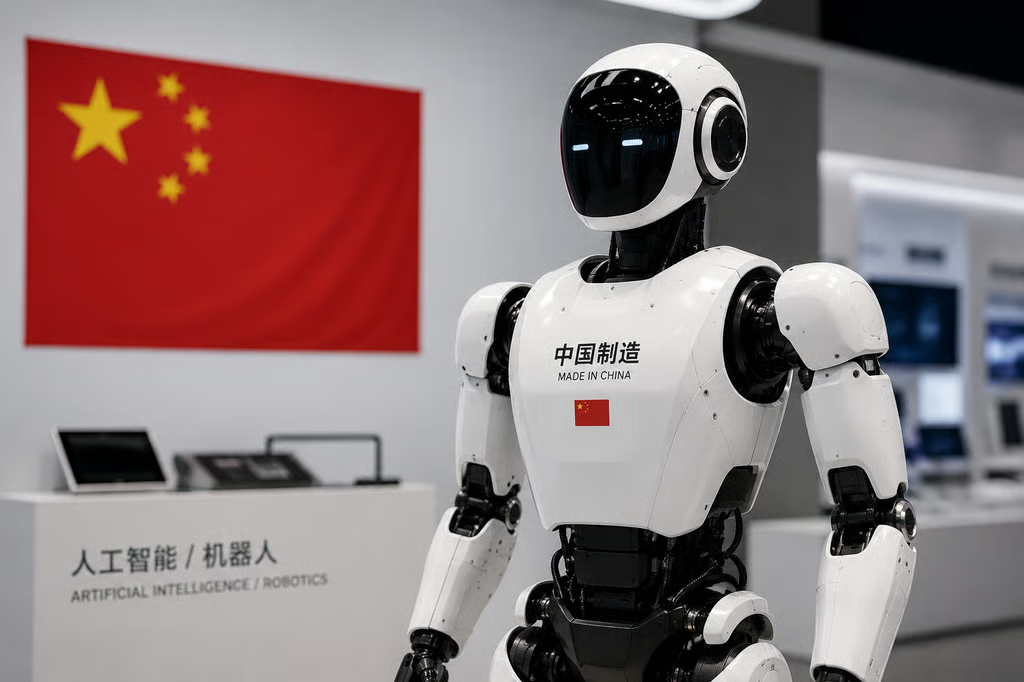
America wants more robots built at home. The problem is that many of the parts U.S. startups need to build them still come from overseas.
The Federal Communications Commission has added certain foreign-made advanced robotic devices to its Covered List as Washington raises national-security concerns around connected robotics. The move could create new hurdles for U.S. startups that rely on foreign components for prototyping and production.
That creates an uncomfortable trade-off: policies designed to strengthen America’s robotics industry could make it harder for some of its youngest robotics companies to compete.
The restrictions came with requirements, though, with Rest of World noting that a robot must be assembled in the U.S. with at least 65% of its components made in the U.S.
That’s exactly where the catch is, as 65% can be especially difficult for startups operating with limited capital and supplier options. At the moment, China is likely to be among the countries most affected, given its dominant role in robotics manufacturing and the broader pattern of U.S. technology restrictions targeting Chinese suppliers.
Why startups could feel the impact most
The same policy that could give U.S. robotics companies more protection from foreign competition may also raise the cost of getting a new robotics company off the ground.
Startups typically have less capital, fewer supplier relationships, and less manufacturing flexibility than established companies. Replacing foreign components can therefore mean higher costs, longer lead times, hardware redesigns, and slower prototyping.
Rest of World founders raised similar concerns.
Elizabeth Williams, founder of cosmetics-robotics startup Gemma, said it would have been impossible to prototype her company’s robots in the U.S. at the same pace. At the same time, Michael Perry of Persona AI argued that Washington needs to “provide the carrot as well as the stick” by building the domestic suppliers startups are being asked to use.
That concern echoes the argument made by nearly 200 U.S. startups that recently opposed broad restrictions on Chinese open-weight AI models.
Their case was not that Chinese technology should remain unrestricted, but that smaller companies often need access to affordable, capable tools because they cannot match the resources of the largest U.S. technology companies. Cutting off those options too early could raise costs and concentrate more power among better-funded firms.
An unintended opportunity
Rest of World cited several ways the U.S. could ease the pressure on startups while still reducing its reliance on Chinese robotics.
Per Kyle Chan, a fellow at the Brookings Institution, a more gradual use of tariffs would give American manufacturers time to catch up rather than immediately cutting off foreign supply.
There is also a case for investing more in the companies that make the parts themselves. More U.S. R&D, manufacturing incentives and demand could help create suppliers for motors, actuators, sensors and other components that startups currently struggle to source domestically.
And that may be the more interesting consequence for startups. If Washington succeeds in pushing robotics production to the U.S., it could create an entirely new market for startups that do not build robots at all but instead supply the components American robotics companies need to build them.
Other News: Apple reportedly developed a China-specific AI model with Alibaba’s help as it prepares to bring Apple Intelligence to the country.