


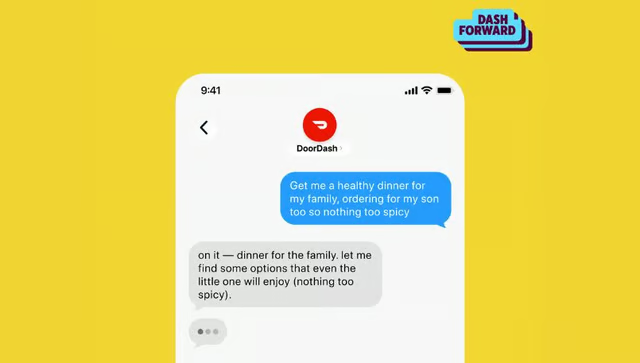
“Order my usual” can be surprisingly complicated, and DoorDash is now asking AI to handle it.
The company is testing a text-based AI agent that can receive that kind of request through Apple Messages and turn it into an actual DoorDash order. By linking the user’s phone number to their DoorDash account, the system can draw on previous purchases and preferences, find the relevant restaurant and items, assemble a cart, and use the user’s saved card at checkout.
The important part is what happens between the message and the transaction. The company’s AI system uses consumer memory and connected tools to interpret the request and retrieve the information needed to act on it. That means a vague instruction such as “my usual” can trigger several underlying operations that previously required the customer to perform manually.
DoorDash is testing whether its app can disappear from the ordering process
DoorDash describes the experience as something closer to messaging a friend who already knows what you like: send a request, and let the agent work out the details.
The system can use account history and connected tools to interpret vague instructions, identify likely items and assemble an order. DoorDash says that could be useful when opening the app and browsing is inconvenient or unnecessary, particularly for repeat purchases.
The company also says the agent can act proactively, using past behavior to suggest an order at a relevant time, such as asking whether a user wants coffee.
An extension of Ask DoorDash
The text-based agent is not a completely new system for DoorDash. It builds on Ask DoorDash, the conversational assistant the company introduced in June, which lets users describe what they want in natural language.
The new text experience essentially moves that capability from a DoorDash search bar into a messaging thread. That matters because the company appears to be betting that by putting its agents where users already send messages and make requests, ordering can become something they simply ask for rather than something they have to work through actively.
What else is coming to DoorDash
The text-ordering agent is just one piece of DoorDash’s latest push. The company also introduced DashOS, a platform that connects restaurant tools for ordering, reservations, loyalty, guest management, and marketing.
Then, there is DashBuddy, an AI assistant that helps Dashers get answers and personalized guidance through text and the Dasher app.
On the delivery side, DoorDash Air is preparing to pilot drone deliveries in Northern California, with its own aircraft and the infrastructure needed to move orders from restaurants to customers.
Together, the announcements push DoorDash beyond simply an app for ordering food: AI is being added to the consumer, restaurant, and delivery sides of the platform.
More must-read AI coverage
- SS&C Intralinks DealCentre AI vs. Datasite: Which platform is built for the future of dealmaking?
- SS&C Intralinks FundCentre AI vs. Juniper Square: Which platform better supports modern private markets fund managers?
- Why Data, Not Models, Determines AI Success
- The Rise of the AI-Native Factory: How Physical AI Is Transforming Manufacturing
What does this mean for users?
For customers, the biggest change is that ordering food can become less tied to the DoorDash app itself. Instead of opening the app, searching, comparing options, and building a cart, users can just send a routine text message and let DoorDash handle the steps in between.
But the shift will not happen everywhere at once. The text-ordering agent is currently limited to the U.S., and per DoorDash’s demo, it appears to be available only to iPhone users, further narrowing access.
The experiment is still early, but the direction is notable: DoorDash is testing whether its most convenient interface might eventually be no interface at all — just a request and an order.
Other news: Google will begin replacing Gemini Gems with Skills on Nov. 17, automatically migrating personal-account workflows while changing age requirements, activity settings, file support, sharing, and available tools.