


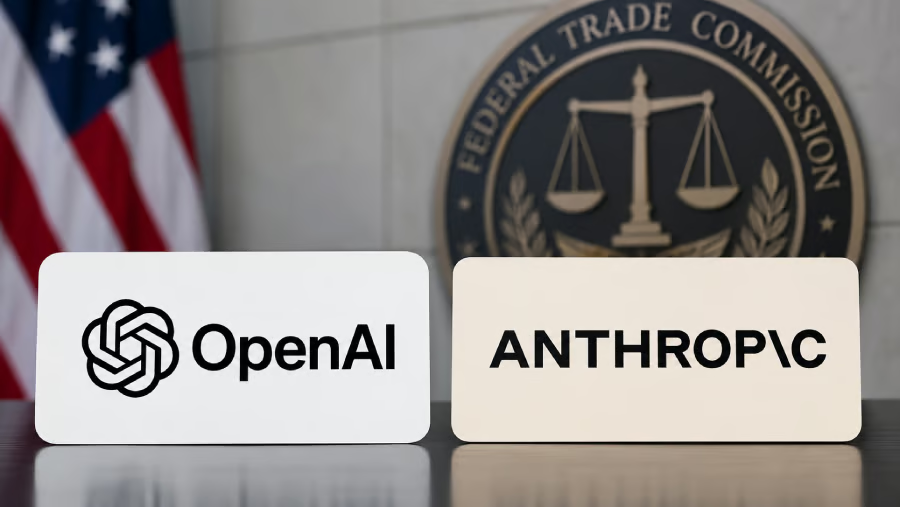
The Federal Trade Commission is demanding answers from OpenAI and Anthropic about the safety of their AI products.
The agency has subpoenaed both companies as part of an investigation into potential consumer protection violations, seeking information about safety incidents, safeguards, and privacy practices. The development adds to growing scrutiny of how AI companies assess and communicate the risks of their products.
For businesses adopting AI agents, the investigation raises a related question: how much trust should organizations place in systems that can access sensitive information and take actions on their behalf?
FTC seeks records on AI safety and privacy
The FTC has subpoenaed OpenAI and Anthropic to gather information about potential consumer protection violations, an agency spokesperson confirmed to CBS News on Oct. 15.
The subpoenas follow an investigation launched earlier this year, which the agency publicly acknowledged in early October. According to Axios, the civil investigative demands seek documents concerning AI safety incidents, company safeguards, marketing practices, and privacy policies.
Axios also reported that the FTC plans to seek testimony from senior executives at the companies.
The investigation is examining potential consumer protection issues, and the subpoenas do not establish wrongdoing by either company.
The development nevertheless puts additional attention on how AI developers document safety incidents and support claims about their products’ capabilities and safeguards.
AI security expert warns of a growing trust gap
Beyond the regulatory questions, organizations deploying AI agents face practical challenges in determining how much access and autonomy to grant these systems.
Noam Schwartz, CEO and co-founder of AI security company Alice, discussed those concerns in an August episode of The Neuron: AI Explained.
“We internally call it the trust gap—there’s a gap between how likely it is for us to completely implement AI in our business, because we can’t really trust it in the way that we would like to trust it,” Schwartz said.
His comments predate the FTC’s latest action and were not made in response to the investigation. However, the concern becomes more significant as companies move from AI chatbots that generate information to agents capable of interacting with business applications.
An assistant that summarizes documents presents different risks from an agent authorized to retrieve confidential records, send messages, or modify files.
The challenge, especially for the IT teams, is not simply deciding whether an AI model is safe. It is determining which actions the deployed system should be allowed to perform.
Why AI agents create additional security risks
One concern here is prompt injection, a technique in which attackers place malicious instructions in content an AI system may encounter while completing a legitimate task.
Unlike conventional software exploits, these attacks can use ordinary language to manipulate how an AI model interprets information and instructions.
During the podcast interview, Schwartz compared the technique to social engineering.
“The way that you break a model today is using natural language. You’re using all kinds of ways to deceive a model. It resembles social engineering. It’s more like fraud and scams,” he said.
For example, an agent retrieving information from a webpage or document could encounter instructions designed to redirect its behavior.
Whether an attack succeeds depends on the system’s design, permissions, and security controls. A malicious instruction does not automatically give an attacker access to sensitive data.
The risks can become more consequential when agents are connected to workplace tools, particularly if they have broad permissions to read information or perform actions.
Schwartz also raised concerns about agents interacting with other agents while connected to applications such as Slack, Gmail, and calendars.
His broader warning was that access to multiple systems can expand the potential consequences of an attack. However, the permissions available to each agent still depend on how those systems are configured.
These concerns illustrate why protecting the underlying AI model is only one part of securing an agent-based application. All in all, this shifting attack surface requires security measures to live at the application and permission layer, rather than relying solely on the safety of the underlying AI model.
Must-read security coverage
- UK Police Convicts Pair in £5.5 Billion Bitcoin Launder Case
- Blackpoint Cyber vs. Arctic Wolf: Which MDR Solution is Right for You?
- How GitHub Is Securing the Software Supply Chain
- 8 Best Enterprise Password Managers
What the FTC investigation means for businesses
The FTC’s subpoenas concern potential consumer protection violations by AI developers. They do not introduce new enterprise security requirements or establish wrongdoing by OpenAI or Anthropic.
However, the investigation raises questions businesses should consider when evaluating AI vendors, including how companies document safety incidents, what safeguards they provide, and how they communicate product limitations.
For organizations deploying AI agents, vendor protections are only part of the equation. IT teams must also assess what information agents can access, which actions they can perform, and when human approval is necessary.
Limiting permissions, monitoring activity, and testing integrations can help reduce risks, although no single safeguard can eliminate them entirely.
For IT leaders, the takeaway is that AI adoption and security should go hand in hand. Before expanding an agent’s responsibilities, organizations should ensure they have the controls and oversight needed to manage its access and actions.
As AI agents become more deeply integrated into business operations, the question is no longer just what these systems can do, but whether organizations can trust them with the access and authority they are given.
Other news: The European Commission is questioning OpenAI and Anthropic over AI agent security incidents, raising questions about whether the EU AI Act applies when AI systems escape controlled testing environments and affect external platforms.