


Google Maps users on opposite sides of the US-Canada border can now look at the same lake and see two different names.
Google has begun displaying Lake Ontario as “Lake America” to users in the United States after President Donald Trump signed an executive order directing the federal government to rename Lake Ontario and update the US Geographic Names Information System. Canadian users will continue to see “Lake Ontario,” while users elsewhere will see both names.
The unusual update puts one of the world’s biggest mapping platforms in the middle of a political dispute between two longtime allies and highlights something easy to forget about digital maps: The names they display are not always universal.
Why Google Maps now says ‘Lake America’
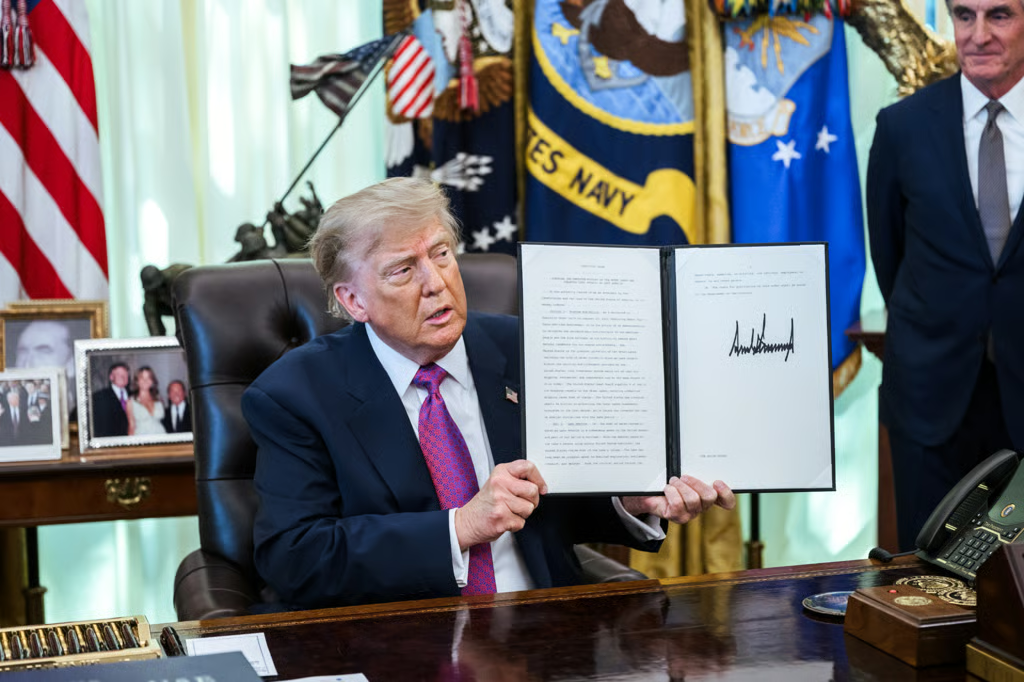
Trump signed the executive order on Aug. 27 amid heightened trade tensions between the US and Canada.
The order directed the Interior secretary, in coordination with the US Board on Geographic Names, to take the necessary steps within 30 days to rename Lake Ontario “Lake America” for federal purposes. The secretary and board were also directed to subsequently update the Geographic Names Information System, or GNIS.
GNIS was subsequently updated to list the lake as “Lake America” in the United States, prompting Google to update Maps for US users.
Google said in an Aug. 29 statement that it updates Maps when names change in official government sources such as GNIS.
As a result:
- Users in the United States see Lake America.
- Users in Canada continue to see Lake Ontario.
- Users elsewhere see both names.
The order directs the Board on Geographic Names to provide guidance to ensure that federal references, including agency maps, contracts, documents, and communications, reflect the new name.
Google characterized the Maps update as an application of its existing mapping policy rather than a new policy created specifically in response to Trump.
The approach is similar to the one Google took after the administration changed the US federal designation of the Gulf of Mexico to the Gulf of America in 2025.
The political dispute behind the Maps change
The renaming comes amid a broader US-Canada trade dispute.
Trump has repeatedly criticized Canada’s economic relationship with the United States. The executive order separately cites US contributions to Great Lakes security, shipping and environmental protection as part of its rationale for renaming the lake.
The administration’s order directs federal agencies and the US geographic naming system to use “Lake America.” It does not compel Canada to adopt the same terminology.
Canadian officials have strongly rejected the new name. Prime Minister Mark Carney has emphasized the Indigenous origins of the Lake Ontario name and noted that it predates both Canadian Confederation and the US Declaration of Independence.
Ontario Premier Doug Ford has likewise insisted that Canadians will continue calling the body of water Lake Ontario. He reinforced the point by unveiling a large billboard near the Canadian shore defending the Lake Ontario name, with a French-language version also displayed.
That leaves the two governments using different terminology for the same shared body of water.
Google isn’t the only mapmaker making a choice
Google’s decision also shows how government policy can quickly filter into the technology people use every day.
Apple Maps was still displaying Lake Ontario as of Aug. 31, when Interior Secretary Doug Burgum said Trump had personally asked Apple to adopt “Lake America.” MapQuest, meanwhile, has said it will continue using Lake Ontario. The stance also gave the mapping service an unexpected boost, helping propel it to No. 4 among free US App Store downloads and No. 1 in Canada, according to Business Insider.
The executive order directs federal government references to use the new name but does not itself direct private mapping services to change their labels. Google has instead pointed to its longstanding practice of relying on official geographic databases.
The change can also spill into third-party websites that rely on Google Maps. Axios found “Lake America” appearing on some Ontario government agency sites that embed Google Maps, despite Google’s Canada-specific naming policy. Google said developers can choose a region for embedded maps, which helps determine how geographic names are displayed.
That distinction matters because Google Maps increasingly does much more than provide directions.
Google has been steadily adding intelligence and automation to the service. TechRepublic recently examined how Ask Maps can perform tasks involving restaurants, hotels, events and other destinations while still requiring users to approve transactions.
The company has also tested a Gemini-powered editing system that allows people to suggest changes to locations in a conversational way. And previous Maps updates have incorporated Gemini recommendations and other AI-generated information into the experience.
That makes the accuracy and presentation of Google’s underlying geographic data increasingly consequential. A place name can surface not only on a map but potentially across search results, directions, recommendations, third-party websites and AI-generated answers.
Why the same map can show different realities
Location-dependent labels are not unique to this dispute.
Mapping services regularly have to navigate places with competing names, disputed borders, territorial claims, or different official terminology across countries. The result can be a map that changes depending on the viewer’s location.
The Lake Ontario dispute provides an especially visible example because the geographic feature itself is shared by the United States and Canada.
Google’s solution effectively treats the name as regional metadata: Americans receive the US government’s designation, Canadians receive Canada’s established designation, and everyone else gets both.
The approach allows Google to avoid declaring a single term universally correct, but it also means Maps can present users with different labels for the same physical feature.
The Associated Press noted that the US order cannot force Canada or international organizations to adopt the same name.
What Google Maps users should know
For most people, the change will be more noticeable than disruptive. US users may see “Lake America,” while Canadian users continue to see “Lake Ontario,” meaning travelers, businesses and teams operating across the border could encounter different labels for the same place.
That could create some confusion when sharing directions, screenshots or location links with people in another country. In this case, seeing a different name does not necessarily mean someone is using outdated map data. Google is intentionally displaying different labels based on the user’s location.
The practical takeaway is that the geography has not changed. Routes, borders, and the lake’s physical location remain the same. What has changed is the label, offering a clear example of how government naming decisions can filter into everyday digital tools.
Also read: Apple Maps ads are now rolling out in the US and Canada, bringing another notable change to how major mapping platforms shape what users see.