


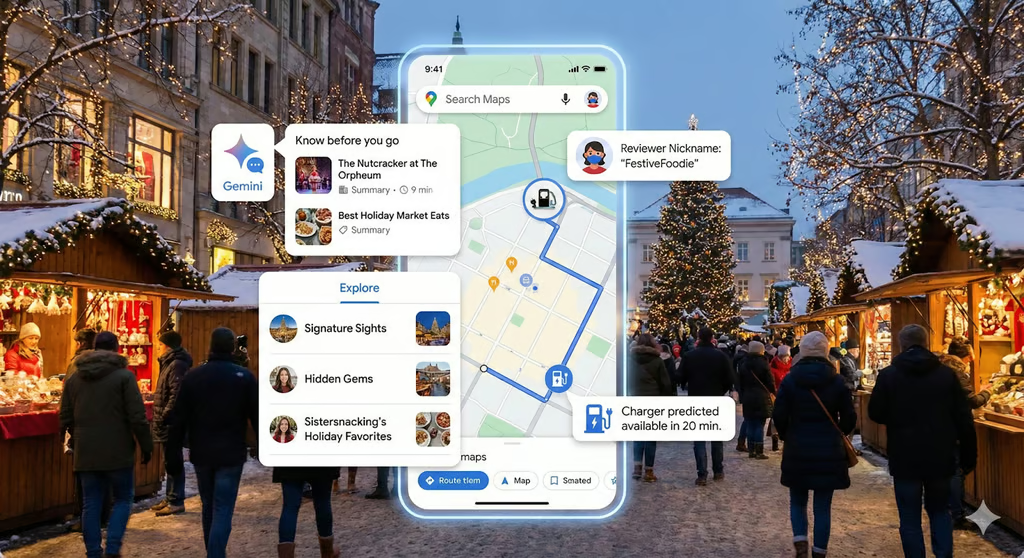
Google Maps is rolling out four new features to help people navigate the holiday season chaos a little more smoothly this year.
The update centers on enriching the Maps experience through AI and socially powered intelligence. Gemini, the company’s AI model, has been embedded in Maps through a “Know before you go” overview for restaurants, hotels, and concert venues, providing tips on booking a reservation, the best menu items, and the closest parking.
Users can ask Gemini questions, and the chatbot will search for reviews on Maps and other online sources to find an answer. This will be available to users in the United States on both iOS and Android.
A beefed-up social layer
While Google hasn’t pushed back on the social element of Maps, it also hasn’t really leaned into it. This holiday season, it is beefing up the Explore tab to give shoppers more to do when they’re in the city, offering inspiration through signature sights and hidden gems.
Alongside its own lists, Google will also integrate recommendations from third-party travel apps such as Viator, Lonely Planet, and OpenTable, as well as food and travel influencers like Sistersnacking. Opening up the Explore tab to influencers could be a smart way to bring YouTube more directly into Google Maps.
Google Maps reviewers will also be given additional privacy tools to spread holiday cheer (or humbug spirit), with nicknames and profile pictures separate from their Google account. Perfect for the wannabe Michelin inspector trying to stay undercover.
The last of the four updates is aimed at those travelling cross-country during the festive period, with the addition of an electric vehicle charging prediction tool. Users can already see available chargers on the Tesla Supercharger and Electrify America networks. Still, now Google will use AI to predict whether a charger will be available when they arrive.
Google was spotted testing an ultra-minimal power-saving mode for emergencies, but this didn’t make it into the holiday update.
More Google coverage
- New Google Search AI Mode is ‘Total Reimagining,’ Says CEO Sundar Pichai
- In Major Ruling, Judge Finds Google ‘Willfully Acquired and Maintained Monopoly Power’ Over Digital Ad Market
- Google’s Big Bet on Nuclear Energy: ‘The Race to Power AI-Driven Data Centers is Accelerating’
- Computer History Museum Releases Original AlexNet Code: Why It Matters
Embedding AI everywhere
Google is focused on getting Gemini into as many of its products as possible, and the launch of Gemini 3 could open the floodgates.
CEO Sundar Pichai says the model is far better at understanding intent, requiring less prompting. That would lend itself well to apps like Google Maps, where users do not want to go back and forth with a chatbot to get the right information.
It is one of the big advantages Google has over operators such as OpenAI and Anthropic, which are far more reliant on users accessing their standalone chatbot services. OpenAI has tried to broaden its portfolio with a web browser and an app ecosystem built on top of ChatGPT, but the vast majority of users still access the chatbot via its website or app.
Demis Hassabis, CEO of Google DeepMind, has even said this integration is an insulating power for Google in the event of an AI bubble popping.
Recent analysis of Google’s November 2025 Android feature update outlines how new system changes are rolling out across phones, wearables, cars, and TVs.