


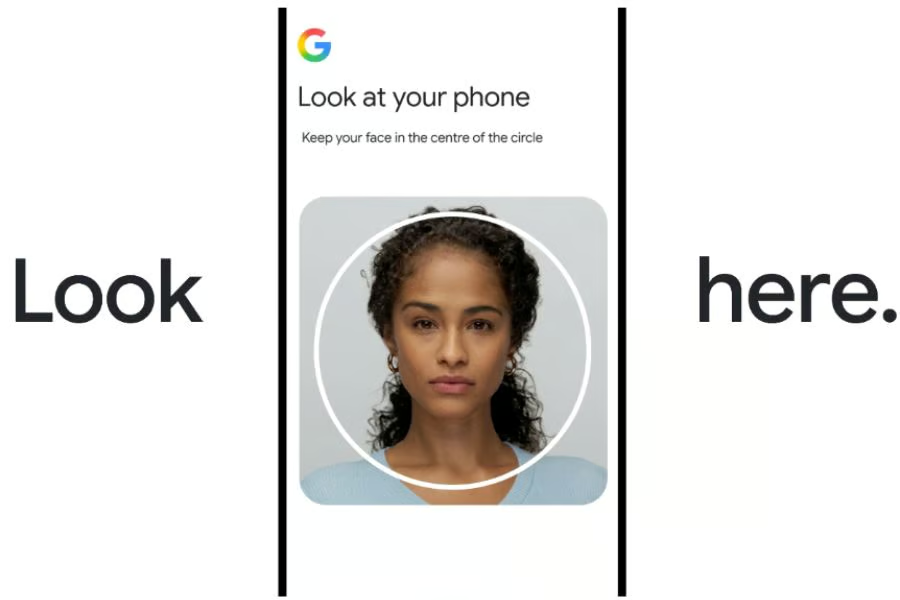
Google on Thursday rolled out selfie video as a new sign-in and account recovery option for eligible Google Account users, giving people another way to regain access if they are locked out or cannot use their usual phone or computer.
The feature joins existing recovery methods such as passkeys, recovery contacts, recovery phone numbers, and email addresses as part of Google’s broader effort to reduce reliance on passwords.
To use the feature, users must set up a selfie video before they lose access to their account. During setup, Google asks users to look into their device’s camera and complete a series of guided head movements that capture multiple angles of their face.
If they later need to recover their account, they record another selfie video. Google then compares the new recording with the saved one to verify the user’s identity.
Google says privacy and security come first
Google said the feature was built with privacy protections, noting that selfie videos are recorded only with user consent and can be deleted at any time from a user’s Google Account. The company said the videos are encrypted while stored and are used only for account sign-in unless users choose to allow additional uses.
Google also said it has built safeguards against spoofing attempts.
“When you use a selfie to sign in, we use multiple layers of security to help prevent impersonation attempts like fake photos and videos (i.e., deep fakes),” Google said in its announcement.
“For example, we match your video against your saved selfie and require you to perform simple movements to prove it’s a live video. We also use our standard security practices to detect and help prevent suspicious sign-in attempts.”
Not available for every Google account
The feature is available only to eligible Google Account users. Reports indicate it is not supported for Google Workspace accounts, children’s accounts, or accounts enrolled in the Advanced Protection Program. Google also said availability may vary by region, account type, and device.
The company recommends enabling multiple recovery methods rather than relying on a single option to avoid losing access to important data such as emails, documents and photos.
More Google coverage
- New Google Search AI Mode is ‘Total Reimagining,’ Says CEO Sundar Pichai
- In Major Ruling, Judge Finds Google ‘Willfully Acquired and Maintained Monopoly Power’ Over Digital Ad Market
- Google’s Big Bet on Nuclear Energy: ‘The Race to Power AI-Driven Data Centers is Accelerating’
- Computer History Museum Releases Original AlexNet Code: Why It Matters
What it means for users
The move reflects a broader shift across the technology industry toward biometric authentication as passwords become less reliable and phishing attacks grow more sophisticated.
By adding a facial verification option that works even when users lose access to a trusted device, Google aims to reduce the number of accounts permanently locked out after stolen phones, forgotten passwords, or lost recovery methods.
At the same time, the rollout is likely to renew debate over biometric privacy.
While Google says users control their stored videos and can delete them, facial data remains more sensitive than traditional credentials because it cannot simply be changed like a password if concerns arise.
Also read: Google said Gemini reached 950 million monthly users as Alphabet reported stronger AI and cloud momentum.