
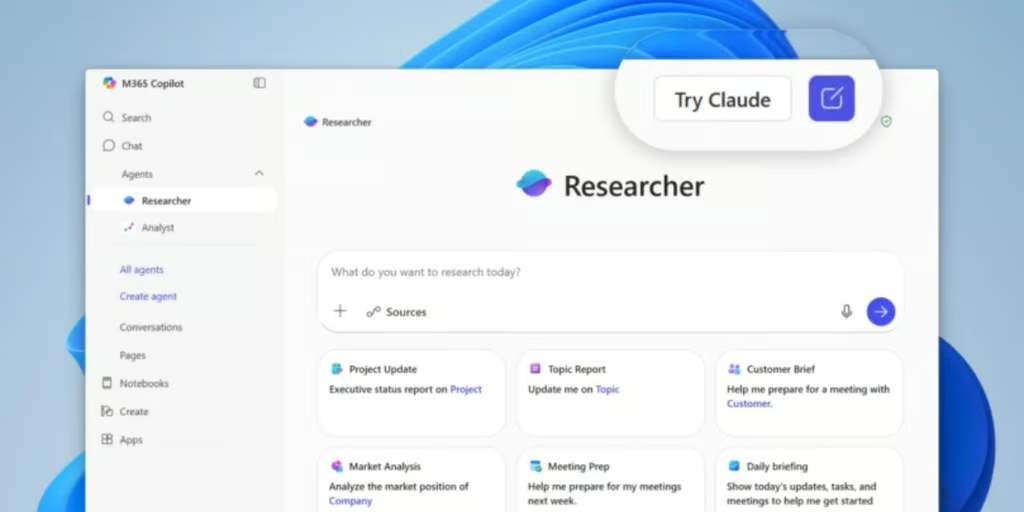


Anthropic’s Claude AI models are now accessible through Microsoft 365 Copilot. Opus 4.1 can be used in Microsoft’s Researcher Agent and, along with Sonnet 4, in Copilot Studio.
Researcher is Microsoft’s multistep reasoning agent used for in-depth information gathering and analysis, while Copilot Studio allows users to create custom AI agents. Microsoft 365 Copilot-licensed customers must opt in to its Frontier Program to gain access to Claude Opus 4.1 and Sonnet 4.
“This may be the first time that Microsoft’s hundreds of millions of users with access to Copilot ever get to try Claude, which is a big deal,” Grant Harvey, AI writer for The Neuron, said. “Microsoft AI CEO Mustafa Suleyman actually mentioned this in our latest podcast interview with him, talking about how Microsoft is ‘such a huge organization’ that they need to have ‘maximum optionality.’”
Indeed, Microsoft says the addition of Anthropic’s models to its products is intended to provide its customers with greater flexibility. However, prior reports suggest the company has not been impressed with the performance of OpenAI’s models, which Microsoft has been primarily using thus far for its AI features.
Testing found that the Claude models outperformed OpenAI’s in automating tasks such as financial functions in Excel, and also generated “more aesthetically pleasing” PowerPoint slides from basic prompts. As a result, it is looking to also bring Anthropic’s Claude into Office 365 apps.
Nevertheless, in a Sept. 24 statement, Microsoft maintained that, “Copilot will continue to be powered by OpenAI’s latest models,” while the two companies publicly present a united front. At a New York Times event in June, OpenAI CEO Sam Altman insisted the partnership with Microsoft remained strong, while conceding it has faced its share of turbulence.
More must-read AI coverage
- SS&C Intralinks DealCentre AI vs. Datasite: Which platform is built for the future of dealmaking?
- SS&C Intralinks FundCentre AI vs. Juniper Square: Which platform better supports modern private markets fund managers?
- Why Data, Not Models, Determines AI Success
- The Rise of the AI-Native Factory: How Physical AI Is Transforming Manufacturing
Tensions are brewing between Microsoft and OpenAI
Microsoft has been in a partnership with the ChatGPT maker since 2019, when it made a $1 billion investment in exchange for an exclusive license to commercialise the core GPT models. This was extended in January 2023 with a multibillion-dollar investment in OpenAI, which made Azure its exclusive cloud provider. It is estimated that Microsoft has spent about $13 billion on OpenAI so far.
However, recently, several indicators have suggested that the relationship is souring. The inclusion of Anthropic’s models in Microsoft 365 Copilot is one of them, as the two AI companies are fierce rivals, with Anthropic’s value recently surging to $183 billion.
Redmond has been forging partnerships with several OpenAI competitors. It has struck non-exclusive licensing deals with Inflection AI and Mistral AI, and Azure AI Foundry features hundreds of foundation models from the likes of Meta, DeepSeek, Nvidia, and, controversially, Elon Musk’s xAI. Musk has been locked in a feud with OpenAI since stepping down from its board in the late 2010s.
Furthermore, Microsoft, whose approval is required for OpenAI’s proposed shift to a for-profit structure, has demanded a bigger slice than the startup is willing to concede. Microsoft has also begun creating its own AI models, blurring the lines around the mutual benefits of its partnership with Altman’s company.
Another flashpoint is a contract clause that could cut Microsoft off from future OpenAI models if the company declares it has achieved artificial general intelligence. The disputes have grown tense enough that OpenAI executives have considered accusing Microsoft of anticompetitive behavior.
The ChatGPT maker has been making moves to reduce its dependence on Microsoft; Altman said OpenAI is now “beyond the compute demand” of what any single hyperscaler can offer. In January, he renegotiated the agreement with Microsoft to allow OpenAI to use cloud services from providers other than Azure, as long as Microsoft doesn’t want the business.
OpenAI has since inked a massive cloud computing deal with Oracle, despite rumours that it was leaning toward Google Cloud. It has also begun working with SoftBank and Oracle on its own data centre, the $500 billion Stargate project planned for Texas, and has made a deal with CoreWeave for billions in computing power.
On Monday, Nvidia pledged to invest up to $100 billion in OpenAI, and, in turn, the AI startup will use as many as five million Nvidia GPUs to deploy at least 10 GW of new compute infrastructure.