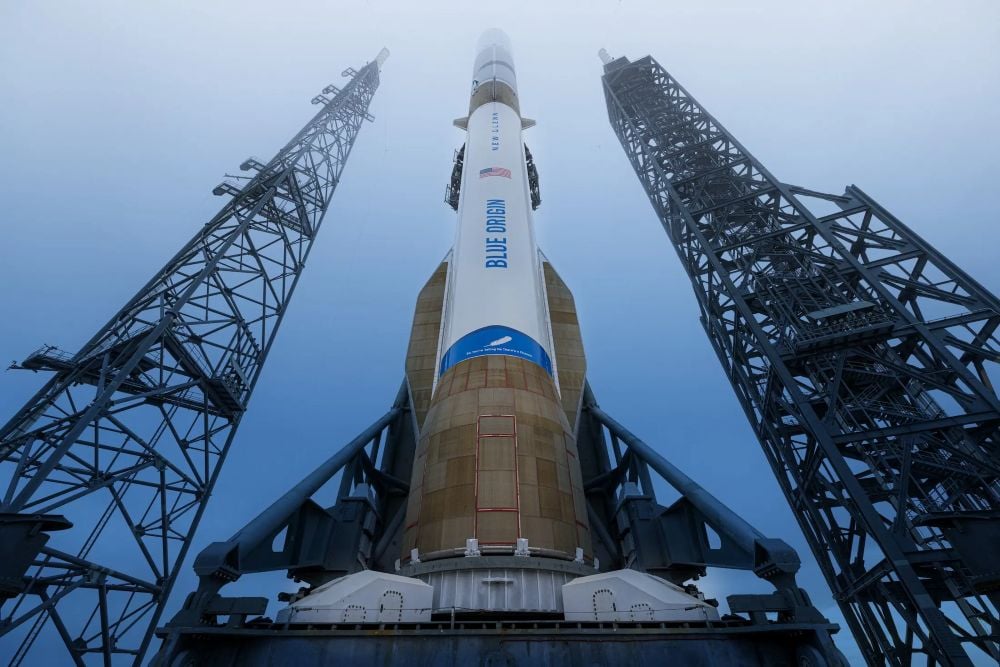
New Glenn Rocket. Source: Blue Origin
Blue Origin’s New Glenn rocket exploded during a Florida ground test, leaving crews to assess launch-site damage, debris risks, and the cause of the fireball.

Blue Origin’s biggest rocket was supposed to fire its engines while locked to the ground. Instead, the test ended in a fireball.
The company’s New Glenn rocket exploded Thursday night at Cape Canaveral Space Force Station in Florida during a prelaunch ground test, creating a blast seen from miles away and felt by nearby residents.
Jeff Bezos called it a “very rough day,” while Blue Origin began sorting through what failed and what survived.
The test was meant to be controlled. New Glenn remained secured to the launchpad while its first-stage engines fired, a standard prelaunch check to verify systems before flight.
Instead, flames appeared near the base of the rocket as the engines ignited. Within moments, the fire spread up the vehicle, giving way to a much larger blast.
Blue Origin kept its statement brief: “We experienced an anomaly during today’s hotfire test. All personnel have been accounted for.”
No injuries were reported, but the cause was not immediately known.
Emergency crews remained part of the immediate response as officials shifted from the failed test to the condition of the launch site and the surrounding safety area.
The FAA told CNN the static-fire test was not part of FAA-licensed launch activity and did not affect air traffic. The Space Force also said the Eastern Range remained capable of supporting other operations, a key point for a site that handles missions from multiple companies.
The safety warning extended beyond Cape Canaveral. Blue Origin posted on X that debris from the incident could wash ashore in the coming days and warned people not to touch or approach anything they found.
Space Force officials cautioned that tests involving developmental systems and emerging technologies carry inherent risk. The immediate review now centers on two questions: what failed during the engine test, and how much of the launch infrastructure was damaged.
New Glenn is the rocket Blue Origin needs for its biggest orbital missions.
Unlike New Shepard, the smaller vehicle known for short space-tourism flights, New Glenn was designed to carry large payloads into orbit and return its booster for reuse. It is the vehicle the company has been counting on for heavier commercial and government missions.
Launch Complex 36 is where New Glenn flies from, and where much of the work around each flight happens. The site includes the pad, fueling systems, vehicle integration, and booster refurbishment.
The rocket was being prepared for an Amazon satellite mission, and New Glenn also figures into Blue Origin’s NASA lunar work. Before any of that can move forward, the company has to determine how badly the blast damaged the system that gets the rocket off the ground.
The FBI’s latest warning shows how ransomware groups are blending phishing with more personal social engineering tactics.
Liz Ticong is a staff writer for eWeek and TechRepublic focused on AI, cybersecurity, enterprise software, and data. She has more than 10 years of editorial experience as a technology industry writer, combining reporting, product research, and hands-on software testing in her coverage. Her work has been published on Datamation, Enterprise Networking Planet, and TechnologyAdvice.com. She writes technology news, software reviews, product comparisons, and buyer’s guides for business and IT readers.

