


Nothing is preparing to launch its first AI-native device in December 2026, but the company is keeping almost everything about it under wraps. CEO Carl Pei has confirmed that the product won’t introduce a new screen and that its purpose couldn’t be served by a conventional smartphone app.
Pei announced the plans Nov. 4 in a post titled “Toolmakers,” describing the upcoming hardware as a productivity tool rather than another attempt to create an all-purpose AI companion.
Nothing hasn’t revealed the device’s name, design, features, price, or launch markets. That leaves plenty of room for speculation, but only a few details are confirmed.
What has Nothing confirmed about its new AI device?
Pei’s announcement offered three concrete clues: the product is designed around AI, it won’t introduce another screen, and it needs dedicated hardware rather than an app.
“Our first AI-native product ships next month,” Pei wrote, adding that it has “no new screen” and “couldn’t have been an app.”
The wording is important. Pei didn’t say the product would operate entirely without a display. It could potentially work alongside a smartphone, although Nothing hasn’t confirmed that either.
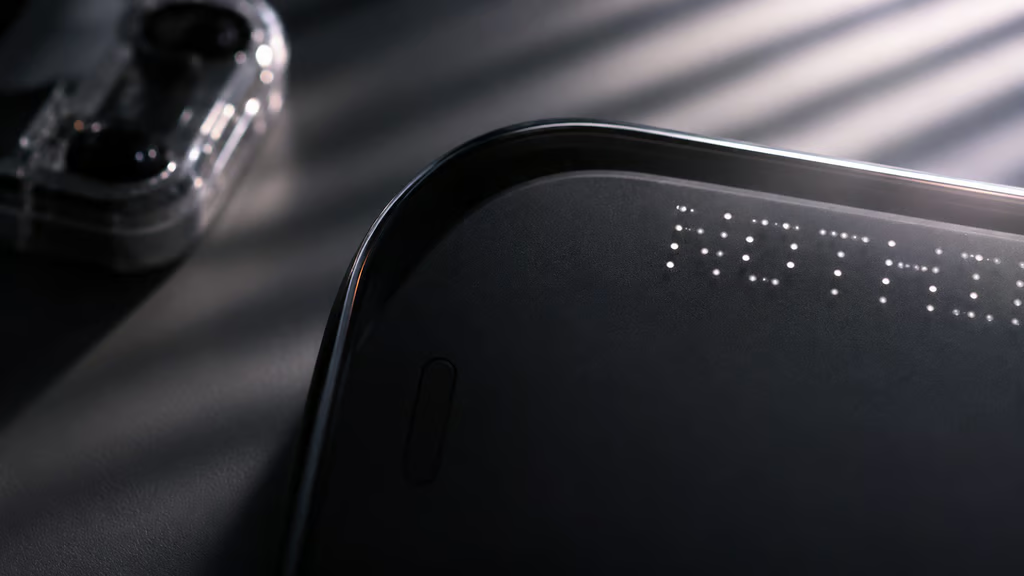
The company shared a teaser image showing part of a dark object with a rounded corner. The image doesn’t reveal enough to identify its shape or intended use.
Nothing has also been linked to rumors about AI smart glasses and other wearable accessories. Those reports predate Pei’s announcement, and there’s no confirmation that the December product is a pair of glasses, a pendant, or another wearable.
The company hasn’t disclosed whether it will include a camera, microphone, speakers, or other sensors.
For now, the confirmed details are limited:
- Release: Shipping is planned for December 2026.
- Product type: An AI-native productivity tool.
- Display: No new screen, according to Pei.
- Price: Not announced.
- Availability: Launch countries haven’t been confirmed.
- Compatibility: Nothing hasn’t said whether it requires one of its phones.
Why Nothing is building AI hardware instead of another app
Pei believes AI needs better access to the context surrounding people’s everyday activities.
Current AI assistants can work with information from emails, calendars, documents, and connected services. But users often have to explain what they’re doing, supply background information, or manually record ideas before an assistant can help.
In his “Toolmakers” essay, Pei argued that useful context frequently exists outside the applications people already use. Conversations, passing observations, and ideas can be difficult to capture without interrupting what someone is doing.
He believes dedicated hardware could eventually make AI more useful by reducing that effort.
That doesn’t establish what Nothing’s December device will actually do. Pei hasn’t confirmed conversation recording, automatic note-taking, or continuous listening.
Those capabilities already exist in some wearable AI note-takers, including devices designed to capture meetings and turn recordings into summaries or action items.
Nothing will need to demonstrate what its hardware offers that existing products and smartphone apps cannot.
Pei also cautioned against expecting one revolutionary AI gadget to replace the smartphone anytime soon. He sees more immediate opportunities in specialized tools that solve specific problems.
How the device fits Nothing’s AI strategy
The December launch follows Nothing’s broader efforts to bring AI into its hardware and software.
The company has been developing more personalized software experiences and expanding AI features across its phones. Its Nothing OS 5.0 rollout is part of that ongoing software development.
Pei has also discussed plans for an AI-native operating system that adapts to individual users rather than relying entirely on traditional apps.
The upcoming device could offer an early indication of how Nothing intends to bring those ideas into a dedicated product, although the company hasn’t confirmed whether it will use that operating system.
Competition is growing across AI hardware. Companies are exploring smart glasses, wearable assistants, and other devices that let people interact with AI without constantly reaching for a phone.
For example, Samsung’s AI glasses are also reportedly approaching a release, although Nothing’s product hasn’t been confirmed as competing in the same category.
Pei’s emphasis on productivity suggests Nothing wants to differentiate its device through practical uses rather than position it as a replacement for a smartphone.
What about privacy, pricing, and phone compatibility?
Nothing has yet to answer several questions that will determine whether its new device is useful to buyers.
The first is what information it collects. Pei’s emphasis on real-world context raises the possibility of hardware that captures information outside a conventional app, but Nothing hasn’t confirmed any recording or sensing capabilities.
If the device processes conversations or other personal information, buyers will need to know whether data is stored locally or in the cloud, how long it is retained, and what controls they have over collection and deletion.
Compatibility is another unknown. Nothing hasn’t said whether the product will work independently, require a Nothing phone, or support other Android devices and iPhones.
There’s also no confirmed price, battery specification, subscription requirement, or list of countries where it will be sold.
Those details will be particularly important if the device requires an ongoing AI service to deliver its main features.
Pei says the product will ship in December, so buyers shouldn’t have to wait much longer for a proper look. Until then, its biggest unanswered question is also the simplest: what can this dedicated AI device do that a phone cannot?
Also read: Meta’s camera-free smart glasses offer another look at how companies are experimenting with AI hardware that doesn’t depend on a conventional display.