


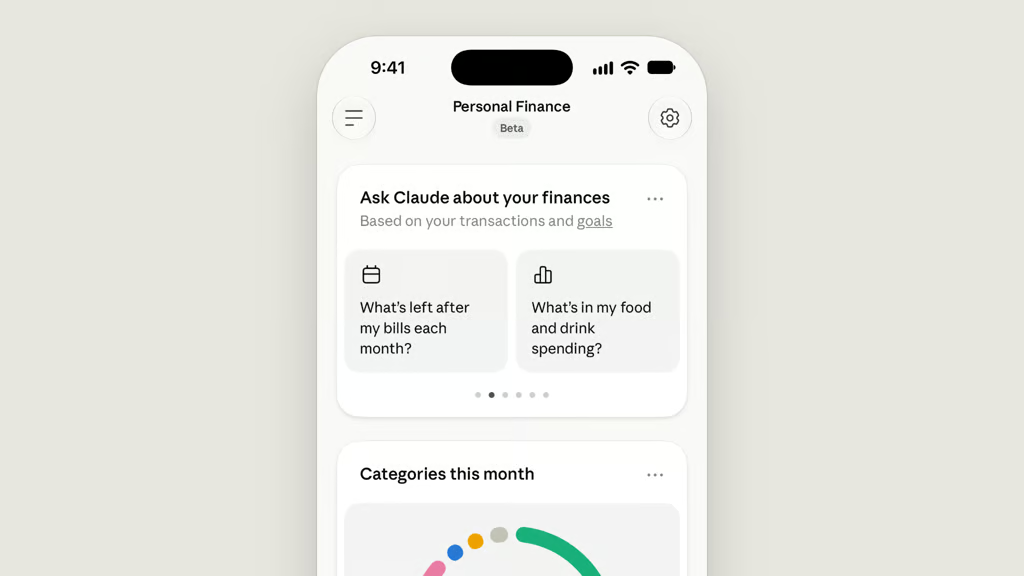
Claude can already help users make sense of complex information. Now, Anthropic wants it to make sense of their bank accounts, too.
Anthropic has launched Personal Finance, a feature that allows eligible Claude users to connect bank and credit card accounts through Plaid. The chatbot can then analyze transaction histories, identify recurring payments, flag potentially unusual charges, and answer questions about spending and account balances.
The feature, which TechRepublic spotlighted in September, gives Claude a much more detailed picture of users’ financial lives. Anthropic says the integration is read-only and cannot initiate payments, nor is it used to train its models; still, it could raise privacy concerns for privacy-conscious users.
Anthropic wants to be your financial advisor
One would agree that keeping track of where your money goes isn’t always easy. Between bills, subscriptions, everyday purchases, and those little expenses that quietly add up, many people struggle to identify what’s eating up most of their income or where they could cut back. Anthropic wants Claude to help make sense of all that.
In September, when we reported that Anthropic was testing the feature, we noted that it could use Plaid, though it was then referred to as Claude Money. While the company has since dropped the Claude Money name, it has retained Plaid as the connective layer.
The feature lets users link their financial accounts to Claude, giving the chatbot access to financial records, including account balances and transaction histories dating back up to two years.
Users can then ask questions in everyday language, such as how much they spent on groceries last month, which subscriptions they are still paying for, or whether their expenses have increased over time.
Claude can also identify recurring payments, flag potentially unusual transactions, and help users understand their money like a financial advisor. The company notes that Claude can still make mistakes, so users should always double-check.
Because AI excels at data analytics, users can have the chatbot analyze bank statements and expenses instead of manually reviewing them, and get personalized insights.
What about privacy and security?
Getting users to connect their bank accounts to an AI chatbot may be a harder sell than getting them to ask it questions about money.
Anthropic describes Personal Finance as read-only, but that doesn’t necessarily address users’ privacy concerns about giving an AI access to their financial lives.
Unlike ordinary conversations, where users consciously decide what information to share and what to leave out, financial records can reveal much more than people might realize. Income, spending habits, financial obligations, and even personal routines can all emerge from transaction histories.
There’s also the security question. Banks are already high-value targets for cybercriminals. Adding a financial data connectivity service like Plaid and an AI platform like Claude expands the attack surface, making the protection of financial information a responsibility that extends beyond the banks themselves.
That leaves Anthropic with two jobs beyond making Personal Finance useful: convincing users that sharing their financial records with Claude is worth the convenience, and demonstrating that those records will remain private and secure.
Not everyone can use it yet
For now, Anthropic is keeping Personal Finance within a fairly limited circle. The feature is currently available to Claude Pro, Max, and Ultra subscribers in the US to connect through Plaid.
Per its FAQ page, the feature is available across Claude’s web, desktop, iOS, and Android applications, so eligible users aren’t restricted to a particular device.
For those who meet the requirements and want to try it, they can:
- Open Claude on an eligible device.
- Find and open Personal Finance from the sidebar.
- Select the option to connect a financial account.
- Follow the Plaid authentication process to select their bank and authorize access to the relevant account information.
How does it compare with Finances in ChatGPT?
| Feature | Claude Finance | Finances in ChatGPT |
|---|---|---|
| Launch | November 5, 2026 | May 15, 2026 |
| Connective layer | Plaid | Plaid |
| Availability | US only | US only |
| Subscription | Pro, Max, Ultra | Free, Go, Plus, Pro |
| Financial dashboard | No | Dedicated financial dashboard |
| Credit score analysis | No | Yes, via the Experian connection |
| Read-only access | Yes | Yes |
Finance in ChatGPT offers a more developed experience, with a dedicated dashboard and credit score analysis, and is available at more subscription levels. Claude, on the other hand, is newer and more focused on conversational experiences. However, future updates to both can change where they sit in the comparison.
Who gets to benefit the most from this feature?
Claude’s Personal Finance feature could be particularly useful for people who struggle to keep track of multiple expenses, recurring subscriptions, and changing spending habits.
Freelancers and people with irregular income, for instance, could use it to get a clearer picture of their cash flow, identify periods of heavier spending and income, and understand how much they have left to work with.
However, users should treat Claude’s financial insights as a starting point rather than a substitute for checking bank statements or seeking qualified financial advice.
For Anthropic, the bigger test will be getting people to see Claude as more than a chatbot they consult for answers, but as an assistant they can trust with some of their most sensitive information. The convenience may be appealing, but when it comes to personal finances, trust will matter just as much as what the AI can do.
Want to get better results from AI? TechRepublic readers can try The Neuron Academy’s free six-minute How to Talk to AI course to learn simple prompting techniques and practical tips for using AI more effectively at work. Plus, enjoy free seven-day access to The Neuron Academy’s full library of AI courses. Explore all lessons here →