


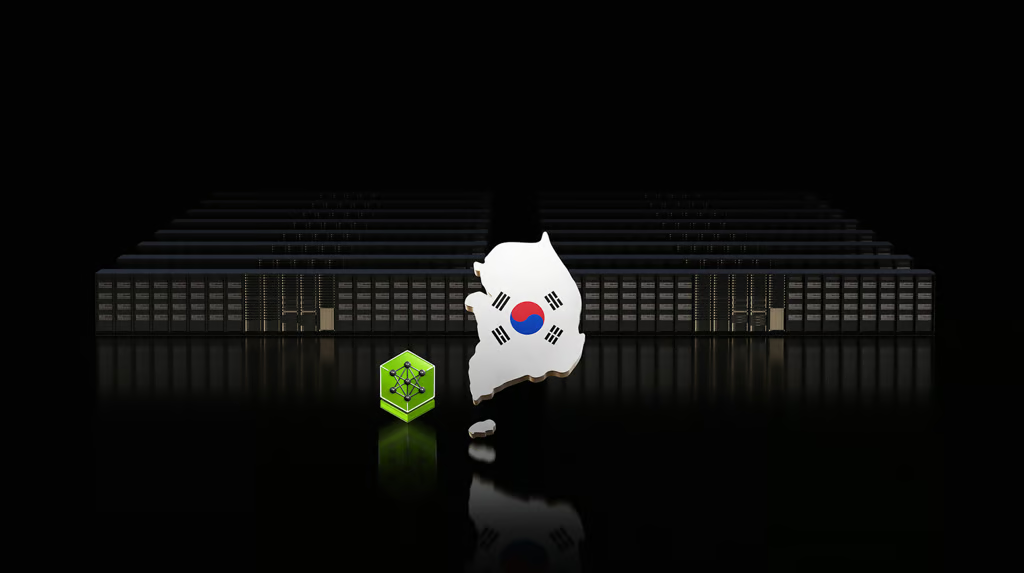
South Korea’s AI infrastructure push is becoming a test case for how much sovereign compute can still depend on one vendor.
New June 2026 announcements tie Nvidia to government-backed AI capacity and private-sector AI factories led by SK hynix, SK Telecom, Naver, LG, Hyundai and Doosan. The buildout gives South Korea a clearer path to locally operated AI compute, but it also concentrates key hardware, memory roadmaps and AI factory architecture around Nvidia’s platform.
How Nvidia is powering South Korea’s AI buildout
Nvidia said in October 2025 that South Korea’s government and major companies planned to add more than 260,000 Nvidia GPUs across sovereign clouds and AI factories. The program included more than 50,000 GPUs for government-backed AI infrastructure across the National AI Computing Center and Korean cloud and IT providers, plus large deployments tied to Samsung, SK Group, Hyundai Motor Group and NAVER Cloud.
SK hynix and Nvidia announced a multiyear technology partnership to co-develop memory for Nvidia’s AI infrastructure roadmap, including Vera Rubin AI supercomputers, Vera CPUs, RTX Spark-powered PCs and Jetson Thor robotic computing platforms. The companies also plan to use Nvidia tools for semiconductor design, manufacturing simulation and fab digital twins.
SK Telecom plans to build a gigawatt-scale AI Cloud in South Korea using Nvidia DSX, with its first AI factory planned for 2027. Nvidia said the infrastructure is intended to support sovereign, physical, enterprise and agentic AI services across Korea, with a broader Asia expansion in view.
That memory link matters across the region. Broadcom’s recent AI chip guidance showed how quickly demand signals can move through Samsung, SK hynix and the wider high-bandwidth memory supply chain.
The real test starts after the announcements
Naver is also pushing into sovereign AI cloud. The company said it will expand AI infrastructure at its GAK Sejong data center, starting at 55 megawatts and moving toward gigawatt scale with Nvidia DSX. Nvidia also said Naver is the first Korean company to join the Nemotron Coalition and plans to fine-tune HyperCLOVA X models using Nvidia Nemotron 3 Ultra.
LG, Hyundai and Doosan extend the story beyond cloud infrastructure. Nvidia said LG’s AI factory plans cover robotics, autonomous driving, data center technologies and GPU cloud services. The same update said Doosan’s collaboration spans physical AI, robotics and AI factory infrastructure, while Hyundai’s Nvidia-backed work includes mobility, smart factories and autonomous-driving AI.
South Korea is not only buying GPUs for cloud capacity. It is tying AI infrastructure to memory supply, telecom networks, manufacturing, robotics, automotive systems, energy infrastructure and domestic model development.
That gives the country locally operated AI compute, but not full-stack independence. The hardware and much of the AI factory architecture still run through Nvidia.
Execution remains the harder test. Moving to gigawatt-scale AI infrastructure will require power, land, cooling, permitting and supply-chain capacity that the announcements have not fully detailed. Across APAC, those physical constraints are already visible as AI data centers reshape Australia’s private investment.
Local GPU cloud capacity now depends on delivery, not announcements. Similar questions are shaping other cloud deals, including Google’s $30 billion SpaceX compute agreement for Nvidia GPUs. Construction milestones, power agreements and eligibility rules will determine how soon South Korea’s Nvidia-backed infrastructure becomes usable production capacity.
Also read: AI infrastructure is running into physical limits, with SpaceX warning investors that water access could affect data center growth.