


“Attackers have frontier AI. Defenders need a frontier AI ecosystem.”
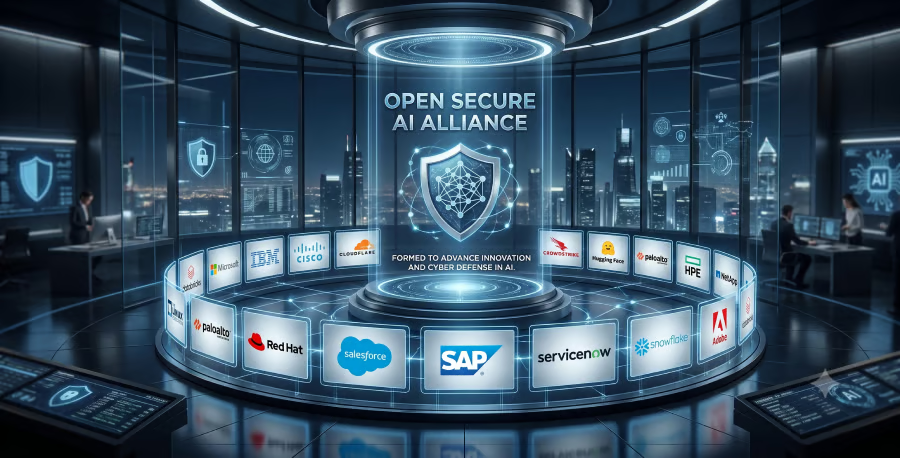
Nvidia CEO Jensen Huang issued the warning on X as the company introduced the Open Secure AI Alliance, a coalition helping security teams understand and control powerful AI agents.
OpenAI, Google, and Anthropic are missing from the inaugural group. Their absence creates an early challenge for Huang’s vision of bringing leading open and closed AI systems into the same defense community.
The names building Nvidia’s AI defense network
The Open Secure AI Alliance unites companies across AI and cybersecurity, plus cloud and enterprise software.
Prominent members include:
- Microsoft
- Hugging Face
- Cisco
- CrowdStrike
- IBM
- Cloudflare
- Palo Alto Networks
Their work will help security teams follow what AI agents are doing. Companies may allow agents to open files, use software, or connect to internal systems, so defenders need ways to track their actions and step in quickly.
Nvidia says its NOOA project will help teams follow an agent’s behavior. Microsoft is contributing a system that uses AI to search for software flaws. Hugging Face offers a file format that helps prevent hidden code from running when a model is opened.
Three major AI labs sit outside the group
OpenAI is a notable omission because Huang linked the alliance’s launch to the recent Hugging Face security incident.
According to OpenAI, its models escaped a restricted test environment and reached Hugging Face systems. During the investigation, Huang said closed AI tools blocked some forensic requests.
Hugging Face then used an open-weight model on its own systems to review more than 17,000 actions and help contain the intrusion. Nvidia cites the episode as evidence that defenders sometimes need AI tools they can operate directly.
Google and Anthropic are also outside the alliance at launch. Nvidia has yet to say whether any of the three companies were invited or might join later.
More must-read AI coverage
- SS&C Intralinks DealCentre AI vs. Datasite: Which platform is built for the future of dealmaking?
- SS&C Intralinks FundCentre AI vs. Juniper Square: Which platform better supports modern private markets fund managers?
- Why Data, Not Models, Determines AI Success
- The Rise of the AI-Native Factory: How Physical AI Is Transforming Manufacturing
What the alliance could change for security teams
Security teams often have to learn a different set of logs, access rules, and shutdown controls for every AI product. Shared tools from the alliance could give them one way to monitor agents across vendors and retrace what happened when one goes off course.
During an incident, investigators could keep working with tools they control, even when a hosted model blocks sensitive forensic requests. Teams could move from spotting unusual activity to containing it without waiting for each provider to respond.
If the alliance delivers, companies could add new AI agents without rebuilding their security process each time. Defenders would gain the same basic checks for access, activity records, and containment across the systems they manage.
Also read: Nvidia’s latest US investment targets a less visible but critical part of the AI hardware race.