


If your team pays a cloud API to process the same kind of request every day, that workload is a candidate for a desktop pilot.
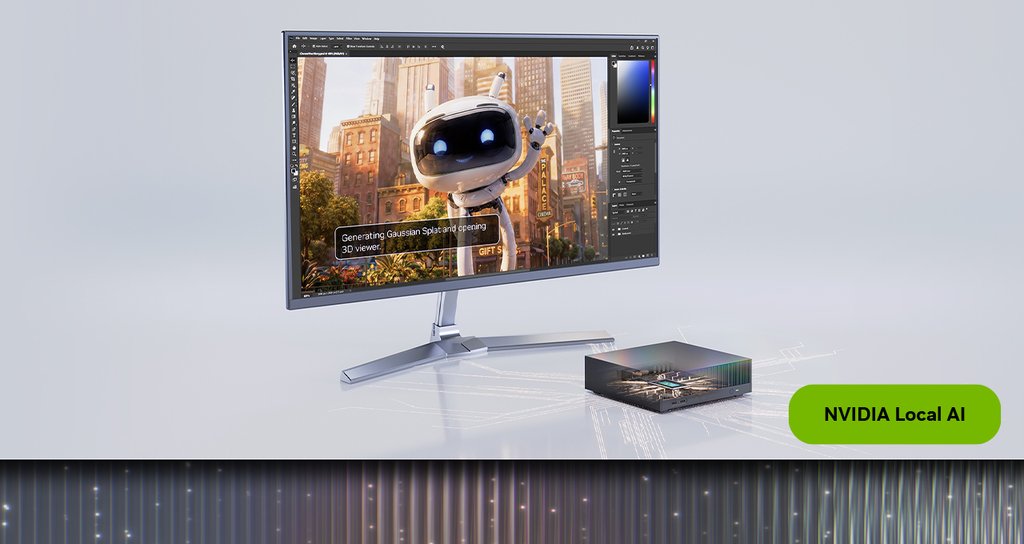
On Nov. 18, Nvidia announced that compact Windows desktops powered by RTX Spark were available from ASUS, Dell, and MSI. The systems offer up to 128GB of unified memory and can run supported AI models locally, avoiding per-token cloud API charges for tasks they complete on the device. NVIDIA Blog
The upfront cost makes the choice of workload matter. ASUS’s ProArt GR1X starts at $4,499 for a 64GB configuration, according to The Verge. To judge whether a desktop can earn back that cost, buyers need to know how much paid cloud work it can take on at the speed and quality their teams expect.
Last month, Nvidia announced its RTX Spark laptops for Windows PCs. Now, it’s announcing the desktop version.
How the RTX Spark is supporting local AI
The new desktops come with native support for system-level applications and integrations with application-level software that developers normally use. The capabilities span the following development layers:
- System-level support: CUDA support and Linux development tools through Windows Subsystem for Linux.
- AI agents: Developers can use Hermes Agent and Nvidia NeMoClaw to develop agentic applications.
- Integrations: Adobe’s expanding Windows on Arm and RTX acceleration support brings AI-powered editing capabilities to RTX Spark systems. Additionally, users can use ComfyUI to connect local image and video generation workflows with their creative applications.
- Hybrid AI: NvidiaSwitchyard helps distribute workloads between local and cloud models.
What buyers should consider before investing in local AI desktops
Enterprise buyers should evaluate workload suitability and total cost of ownership before investing in RTX Spark desktops.
First, teams need to determine whether the hardware matches their daily demands—such as continuous inference, AI development, or specialized creative workloads. If cloud GPUs deliver significantly better performance for those specific tasks, local hardware may not be worth the trade-off.
Additionally, enterprises need to compare upfront hardware costs against recurring cloud API expenditure. They need to account for electricity, maintenance, software licensing and IT support for the local systems.
Ultimately, they need to evaluate whether the estimated utilization will run enough workloads to justify its purchase.
The takeaway: Local AI desktops are not a complete cloud replacement
Nvidia’s RTX Spark introduces another infrastructure option for organizations seeking to reduce cloud bills on their AI workloads.
Businesses with recurring inference workloads, data-sensitive applications and AI development requirements could benefit from local processing. They can run internal knowledge assistants, fine-tune LLMs and also generate code.
However, organizations running highly variable workloads or requiring substantial computing capacity may still find cloud infrastructure more practical.
Buyers still need to evaluate the workload requirements, utilization rates and total cost of ownership before committing to local AI hardware.
Therefore, the purchasing decision should not be whether to abandon cloud AI. It should be determining which workloads make financial and operational sense to run locally and which should remain in the cloud.
In other news, Nvidia’s quarterly revenue more than doubled year over year to $115.8 billion, with its data center business accounting for roughly 93% of sales.