
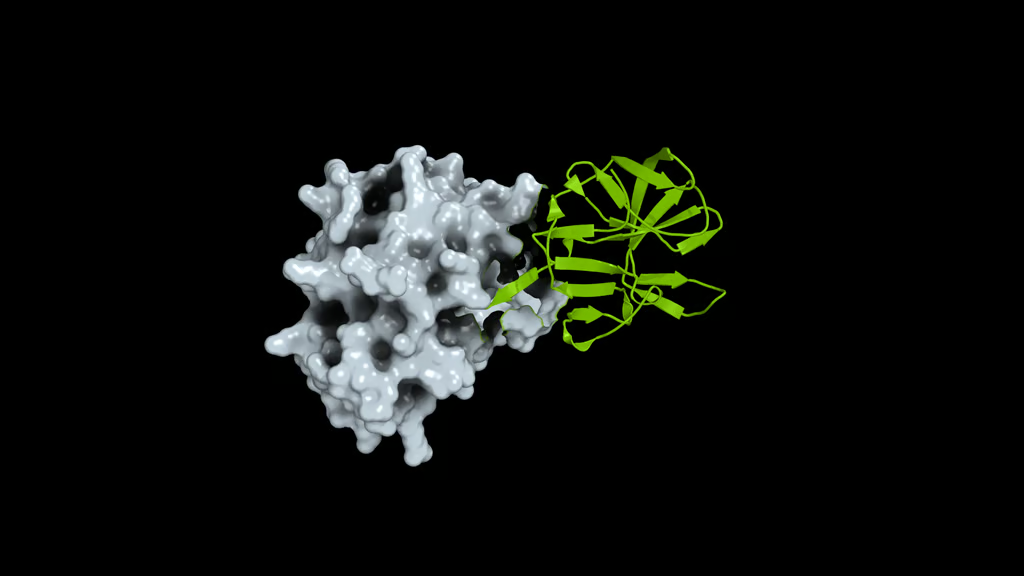


Researchers studying an unfamiliar virus need clues about its proteins before they can investigate potential drug or vaccine targets. AI-predicted structures can provide a starting point quickly, although experiments are still needed to test the predictions.
NVIDIA, in collaboration with Google Deepmind and several other research partners, has announced the release of a predicted dataset of 3D structures for protein complexes from more than 2,800 viruses, including those known to infect humans. The predictions are freely available through the AlphaFold Database’s Pandemic Preparedness Portal, developed by Google DeepMind and EMBL-EBI.
NVIDIA says that they want to equip researchers with the tools to fight the next pandemic.
“When the next pandemic happens, there may be something that comes out of the blue, and we’ll be lacking the knowledge we had for COVID,” said Joe Grove, professor of molecular virology at the Medical Research Council-University of Glasgow Centre for Virus Research and a collaborator on the project. “What we’re trying to do is stockpile some of that knowledge ahead of time,” he added.
AI against viruses
The new dataset was inferred by AlphaFold2, a machine learning model by Google DeepMind that predicts the structure of 3D proteins from their amino acid sequences. The model used NVIDIA’s BioNemo workflow to provide GPU acceleration during the inference.
According to the announcement, NVIDIA says about 30% of the protein interactions added have not been documented in the Protein Data Bank, which holds experimentally determined structures.
In addition to the dataset release, NVIDIA also released the BioNeMo Structure Prediction Pipeline to enable researchers to generate 3D protein predictions for other protein complexes that they have.
Even though AlphaFold has enabled discovery of millions of protein complexes, it’s important to note that it only provides high probability predictions and not confirmed structures. Researchers still need to make lab experiments to confirm the predicted results.
How AlphaFold2 will affect future medicine
The biggest advantage that using an AI model like AlphaFold2 gives to medical researchers is that it reduces the time and financial cost associated with going through the standard process of predicting 3D protein structures.
The goal is to accelerate response time for emerging diseases. During COVID19, researchers already had decades of research on coronavirus, so they were able to come up with solutions relatively fast. However, that may not necessarily be true in the future.
Risha Patel, life sciences partnerships manager at Google DeepMind, said: “This collaboration to bring thousands of viral complexes into the database will equip scientists around the world with insights they need to help prepare for future outbreaks.”
For research teams, the immediate gain is access to predicted structures for lesser-studied viruses and a released pipeline for investigating their own protein targets. The next step is to test promising predictions in the lab before treating them as a basis for diagnostics or treatments.
Read more: NVIDIA’s work with Lilly and Thermo Fisher shows how its BioNeMo platform is being used alongside laboratory research in drug discovery.