


Qualcomm has announced plans to acquire Arduino, the Italian open-source hardware and software company known for its developer-friendly boards and global community of creators. The deal, whose financial details remain undisclosed, aims to deepen Qualcomm’s presence in the edge computing, robotics, and AI development markets.
According to Qualcomm, the acquisition will provide millions of developers from students to startups with easier access to its AI and edge computing technologies, while building on its previous integrations with Edge Impulse and Foundries.io.
In its announcement, Qualcomm stated that the move would combine its “leading-edge products and technologies” with Arduino’s “simplicity, affordability, and community,” creating what it termed a “full-stack platform” that encompasses hardware, software, and cloud services.
“With our acquisitions of Foundries.io, Edge Impulse, and now Arduino, we are accelerating our vision to democratize access to our leading-edge AI and computing products for the global developer community,” Nakul Duggal, Group General Manager for Automotive, Industrial, and Embedded IoT at Qualcomm Technologies, said in the release.
He added that Arduino’s open-source ecosystem had created a “vibrant global community of developers and creators,” and that combining it with Qualcomm’s technology would help “enable millions of developers to create intelligent solutions faster and more efficiently — including a path towards global commercialization by leveraging the scale of our ecosystem.”
Arduino to remain independent
A major concern for Arduino’s 33-million-strong community is whether this acquisition will change the open, accessible platform they love. Both companies are making strong promises to the contrary.
Arduino will continue operating under its own brand, keeping its tools, products, and community-driven mission intact. The company also confirmed it will maintain support for a wide range of microcontrollers and microprocessors from other semiconductor partners.
“Joining forces with Qualcomm Technologies allows us to supercharge our commitment to accessibility and innovation. The launch of UNO Q is just the beginning — we’re excited to empower our global community with powerful tools that make AI development intuitive, scalable, and open to everyone,” said Fabio Violante, CEO of Arduino, in the statement.
“Our passion for simplicity, affordability, and community gave rise to a movement that changed technology,” Massimo Banzi, Arduino’s co-founder, added. “By joining Qualcomm Technologies, we’ll bring cutting-edge AI tools to our community while staying true to what has always mattered most to us.”
More must-read AI coverage
- SS&C Intralinks DealCentre AI vs. Datasite: Which platform is built for the future of dealmaking?
- SS&C Intralinks FundCentre AI vs. Juniper Square: Which platform better supports modern private markets fund managers?
- Why Data, Not Models, Determines AI Success
- The Rise of the AI-Native Factory: How Physical AI Is Transforming Manufacturing
The first fruit of the partnership: Arduino UNO Q
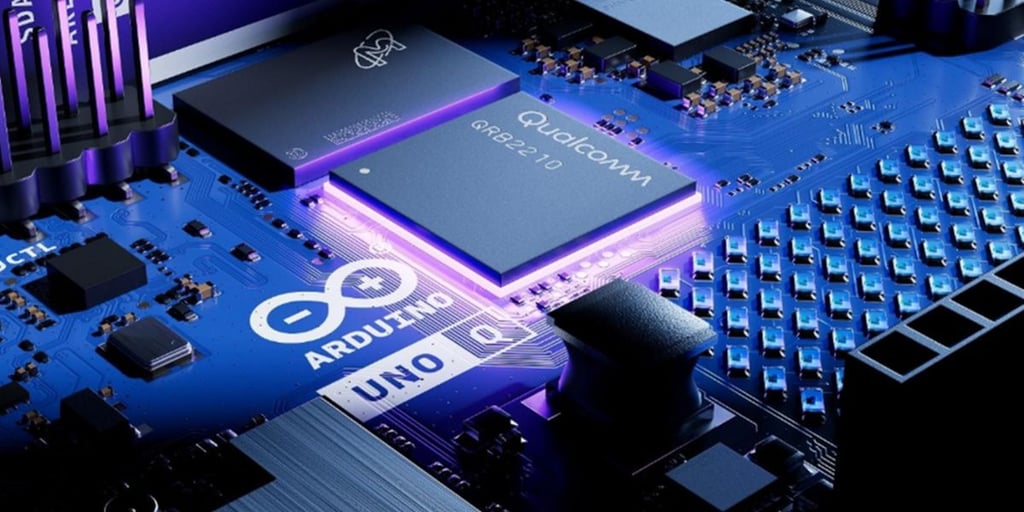
As part of the announcement, Arduino unveiled its next-generation board, the Arduino UNO Q, the company’s first “dual-brain” single-board computer powered by Qualcomm’s Dragonwing QRB2210 processor.
The UNO Q combines a Linux Debian-capable microprocessor with a real-time microcontroller, allowing it to handle AI-powered vision and sound applications. It’s designed for use cases ranging from smart home devices to industrial automation systems.
Priced between $44 and $55, the board will also support the newly introduced Arduino App Lab, an integrated development environment (IDE) that unifies workflows across Real-Time OS, Linux, Python, and AI projects.
App Lab works hand in hand with Edge Impulse, one of Qualcomm’s earlier acquisitions, to help developers quickly build and deploy AI models for image recognition, anomaly detection, and other advanced use cases.
This deal comes just months after its $2.4 billion bid for UK chipmaker Alphawave Semi, this signals a sustained effort to diversify its business and find new areas of growth.