


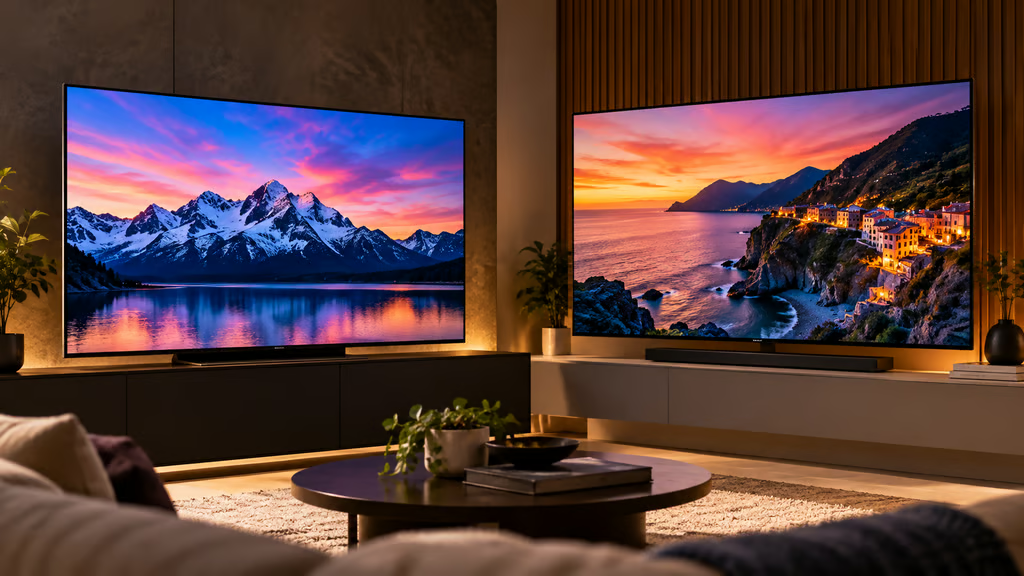
The Samsung S95H and LG G6 sit at the top of their companies’ 2026 OLED TV lineups, and the 55-inch versions carry the same $2,499.99 MSRP. The buying decision comes down less to price than to where each screen performs best.
The LG G6 has the higher measured HDR peak brightness, slightly lower input lag, Dolby Vision, and a five-year panel warranty. Samsung’s S95H covers more of the BT.2020 color gamut, handles direct reflections more aggressively, supports HDR10+, and delivers particularly strong dark-room contrast.
- Samsung S95H vs LG G6 OLED at a glance
- How we compared
- Picture quality: LG wins brightness, Samsung wins color gamut
- Bright rooms and reflections: The winner depends on the problem
- HDR formats: Dolby Vision vs HDR10+
- Gaming: Both are excellent, but LG has a small latency edge
- Design, smart TV software, and warranty
- Which OLED TV should you buy?
Samsung S95H vs LG G6 OLED at a glance
| Feature | Samsung S95H 55-inch | LG G6 55-inch |
|---|---|---|
| MSRP | $2,499.99 | $2,499.99 |
| Panel | QD-OLED | Primary RGB Tandem 2.0 OLED |
| HDR peak, Filmmaker Mode | 2,739 nits | 3,004 nits |
| Full-screen HDR, Filmmaker Mode | 449 nits | 451 nits |
| BT.2020 coverage | 89.2% | 83% |
| HDR formats | HDR10+, HDR10, HLG | Dolby Vision, HDR10, HLG |
| Maximum gaming refresh | 4K 165Hz | 4K 165Hz |
| 4K/60 input lag | 9.5 ms | 8.9 ms |
| HDMI | 4 x HDMI 2.1 | 4 x HDMI 2.1 |
| Smart TV platform | Tizen | webOS 26 |
Promotional and retailer prices may differ.
How we compared
This comparison uses the exact US 55-inch Samsung S95H and LG G6.
Official manufacturer specifications and launch pricing were used for HDR formats, refresh rates, gaming support, ports, smart-TV features, warranty terms, and MSRP.
For side-by-side picture quality and bright-room performance, we used TechRadar’s direct S95H and G6 comparison and its separate bright-room evaluation. Updated benchmark figures for color gamut, SDR accuracy, and input lag come from TechRadar’s later S95H review, which lists results for both models using the publication’s current testing methodology.
Both are flagship OLEDs, so the comparison focuses on differences that can change which one fits a room, movie library, or gaming setup better.
Picture quality: LG wins brightness, Samsung wins color gamut
In TechRadar’s Filmmaker Mode testing, the LG G6 reached 3,004 nits on a 10% HDR window, compared with 2,739 nits for the Samsung S95H.
That sounds like a decisive LG advantage, but full-screen HDR brightness was almost identical at 451 nits for the G6 and 449 nits for the S95H.
Picture mode also changes the result. Samsung reached 2,831 nits in Standard Mode, compared with 2,739 nits in Filmmaker Mode. Buyers should therefore avoid treating a single peak-brightness number as the complete picture.
Samsung has the measurable advantage in HDR color gamut. TechRadar’s current benchmark table records 99.97% UHDA-P3 and 89.2% BT.2020 coverage for the S95H, versus 99.3% UHDA-P3 and 83% BT.2020 for the G6.
SDR accuracy was close. TechRadar’s current measurements give a Delta-E of 1.6 for Samsung and 1.4 for LG, where lower is better. Both scores are low enough to indicate highly accurate SDR color.
Bright rooms and reflections: The winner depends on the problem
Samsung’s Glare Free matte treatment remains unusually effective at suppressing direct reflections.
In TechRadar’s side-by-side testing under overhead lighting, the S95H turned mirror-like reflections into a diffuse haze. The G6 left more visible reflections, despite a major improvement over earlier LG OLED generations.
That does not automatically make Samsung the better bright-room TV.
The G6 preserved black levels and contrast better in some bright-room scenes, particularly with both sets in Filmmaker Mode. In dark sequences from The Batman, the reviewer found the G6 easier to watch under strong ambient lighting.
Samsung improved considerably when switched to Movie Mode, making the comparison much tighter.
In a dark room, the balance shifts again. The S95H produced deeper blacks and stronger perceived contrast, although TechRadar also observed some black crush that could hide shadow detail. LG preserved more detail in those dark areas but could look brighter overall.
Choose Samsung when direct window or lamp reflections are the dominant problem. Choose LG when preserving contrast and shadow detail in a generally bright room is more important.
HDR formats: Dolby Vision vs HDR10+
The format split is straightforward.
The LG G6 supports Dolby Vision, HDR10, and HLG, including Dolby Vision Gaming.
Samsung supports HDR10+, HDR10, and HLG, including HDR10+ Gaming, but not Dolby Vision.
For buyers with a large Dolby Vision Blu-ray or streaming library, LG has the cleaner advantage. Samsung is the better fit for viewers who specifically use HDR10+ content.
Both TVs also support standard HDR10.
Gaming: Both are excellent, but LG has a small latency edge
Both TVs support 4K gaming at up to 165Hz, Nvidia G-SYNC, AMD FreeSync, variable refresh rate, and auto low-latency features across four HDMI 2.1 ports.
The Samsung uses FreeSync Premium Pro and HDR10+ Gaming. LG adds Dolby Vision Gaming.
TechRadar’s current input-lag testing gives LG a small measurable advantage. At 4K/60, it recorded 8.9 ms for the G6 and 9.5 ms for the S95H. At 1080p/120, LG measured 4.6 ms versus Samsung’s 5.0 ms.
Those differences are unlikely to be noticeable outside highly competitive gaming.
PC gamers trying to approach 4K at 165Hz also need enough graphics card performance to feed either display at those frame rates.
For console gaming, both TVs offer more refresh-rate headroom than current consoles normally use.
Design, smart TV software, and warranty
Samsung runs Tizen and includes its Vision AI features. TechRepublic has previously covered the company’s Vision AI Companion, which adds conversational search and contextual information directly to supported Samsung TVs.
The S95H also adopts Samsung’s FloatLayer design. Connections have moved back onto the TV itself rather than relying on an included One Connect Box, although the set supports Samsung’s optional Wireless One Connect system.
LG uses webOS 26 and builds the G6 around its Gallery design. The 55-inch US model includes a flush wall mount rather than a tabletop stand.
Both platforms increasingly mix smart-TV functions with AI and connected-home features. Buyers concerned about data collection should review the privacy controls during setup; TechRepublic recently examined LG smart TV privacy following questions about its connected features.
LG has a clear warranty advantage on paper. Its five-year limited panel warranty covers the panel, parts, and labor during year one. From years two through five, panel replacement remains covered but labor is charged separately.
Which OLED TV should you buy?
Buy the LG G6 if you want Dolby Vision, the highest measured Filmmaker Mode HDR peak, slightly lower gaming latency, stronger bright-room contrast retention, or LG’s five-year panel warranty.
Buy the Samsung S95H if wider HDR color gamut, HDR10+, dark-room contrast, or the strongest suppression of direct reflections is more important.
For gaming, there is no meaningful loser. LG has the small measured input-lag advantage, while both provide four HDMI 2.1 ports, 4K/165Hz PC support, FreeSync, G-SYNC, and low-latency modes.
At matched 55-inch MSRP, the LG G6 is the slightly stronger all-around recommendation because Dolby Vision, its bright-room performance, lower measured latency, and longer panel warranty apply to a broader range of buyers.
Samsung remains the more compelling choice for a room with difficult direct reflections or for viewers who prioritize HDR color gamut and HDR10+.
Also read: Samsung is extending its TV strategy beyond picture quality, bringing displays into its broader AI home ecosystem alongside appliances and Galaxy devices.