
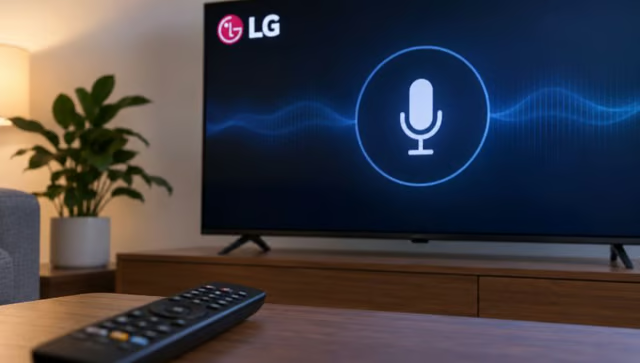


Your smart TV may know more about what is happening inside your home than you realize, but LG says recent claims about its televisions recording ambient conversations misrepresent how its voice features actually work.
The controversy began after Gamers Nexus, Level1Techs, and independent security researchers presented a 135-minute investigation into LG televisions and their data collection practices. The researchers said their analysis of network traffic and software uncovered extensive data collection, including audio transcripts and information about other devices connected to the same home network.
LG, however, disputes this idea. In a statement to Al Jazeera, the company said it records voice data only when a user presses and holds the voice button on the remote or activates the “Hi LG” wake word after enabling Far-Field voice recognition.
The company also said audio is processed only in response to explicit user commands. If the wake word is not recognized, the company said it immediately deletes the audio. The company separately stated that wake-word detection is processed locally on the smart TV and that speech-recognition results are associated with specific voice interactions rather than continuous conversations.
What researchers found about LG’s voice features
Gamers Nexus reported that researchers were able to record audio through an LG television while it was in hibernation mode. The investigation also suggested that disabling the television’s microphone switch does not necessarily disable other microphones connected to the TV, including the one in the remote.
Researchers further alleged that the system captured background sounds from as far as 40 feet away and could retain audio that did not produce a recognized wake-word interaction. According to the investigation, some of that audio could be converted into text and stored locally for possible later transmission.
Al Jazeera has not independently verified those findings, and LG disputes the broader characterization that its TVs continuously record conversations.
University of California, Davis computer science researcher Yash Vekaria told Al Jazeera that the potential security implications could be significant, particularly because televisions can remain in homes for years, often past their update support.
Vekaria also questioned the need to retain voice data after a voice interaction. He said that possible explanations could include diagnostics or improvements to speech recognition, but stressed that retaining recordings from inside people’s homes would still raise questions about meaningful consent.
He said he was not aware of concrete evidence that ambient audio or transcripts were being used for advertising or profiling.
Must-read security coverage
- UK Police Convicts Pair in £5.5 Billion Bitcoin Launder Case
- Blackpoint Cyber vs. Arctic Wolf: Which MDR Solution is Right for You?
- How GitHub Is Securing the Software Supply Chain
- 8 Best Enterprise Password Managers
Smart TVs can see beyond the screen
The investigation also raised concerns about LG televisions scanning users’ home networks.
Researchers said the LG TVs scanned home networks and collected information such as internal IP addresses, nearby Wi-Fi networks, location data and information about other devices. LG responded that scanning for nearby devices is a standard smart-TV function.
Such device discovery can have legitimate purposes, as it can allow TVs to support functions such as screen casting, media sharing and connections with smart-home products.
But depending on how the feature is implemented, Anna Maria Mandalari, a lecturer in communications and networking at University College London, said it may also be able to reveal the names, manufacturers and types of devices on a household network, potentially providing information about the composition of a home and helping create a broader profile of the people living in it.
LG maintains that its Automatic Content Recognition, voice recognition, and interest-based advertising features are separate, requiring explicit user opt-in consent, and can be disabled through the TV’s settings.
For smart-TV owners, the dispute is a reminder to treat televisions like any other connected device with microphones, network access, and data-collection settings. Users who do not rely on voice controls should review whether Far-Field Voice Recognition is enabled and check settings related to Automatic Content Recognition and interest-based advertising.
LG maintains that those features require separate consent and can be disabled. The researchers’ findings, however, have reopened a broader question that extends beyond LG: whether consumers can easily understand what data their smart-home devices collect when they appear to be idle.
Other news: Apple has launched AppleCare One Family, a $49.99-per-month plan that covers eligible devices for up to six people, potentially giving households with multiple Apple products a cheaper way to consolidate coverage.