


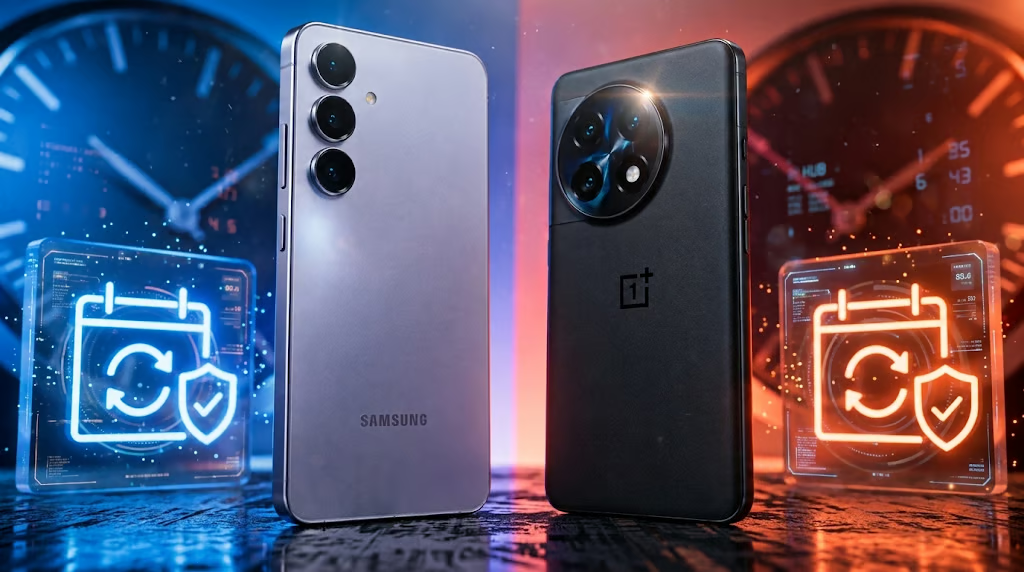
Buying a cheaper flagship can save you money upfront. But the calculation changes when one phone is promised major software upgrades for several years longer than another.
That question is especially relevant for OnePlus buyers now. With the OnePlus 16 arriving as OnePlus ends new product rollouts in North America and Europe, the company’s changing US presence has put more attention on the long-term value of the phones it already sells.
Instead of simply asking which company promises more updates, we compared Samsung and OnePlus from a different angle: How much useful software life could you potentially get for the money you spend?
| Comparison | Samsung Galaxy S26 series | OnePlus Nord 6 |
|---|---|---|
| Major OS updates | 7 generations | 4 Android OS updates |
| Security updates | 7 years | 6 years |
| Security support period | 7 years from global launch date | 6 years |
| Longevity advantage | Longer OS and security commitment | Shorter OS commitment, but lengthy security coverage |
| Important caveat | Policy varies by Galaxy model | Policy varies by OnePlus model |
Video produced by Caleb Kinchlow
Samsung and OnePlus take different approaches to longevity
Samsung has made long software support a selling point for eligible recent Galaxy phones.
The Galaxy S26 series receives seven generations of OS upgrades and seven years of security updates from its initial global launch date. Samsung has also brought lengthy support commitments to other eligible devices, although the exact policy varies by model.
OnePlus takes a different approach, and its software commitments also vary by device.
Recent OnePlus phones can still have lengthy security lifespans, but some receive fewer major Android upgrades than Samsung’s latest flagships. The OnePlus Nord 6, for example, is promised four Android OS updates and six years of security updates, according to OnePlus’ specifications.
That difference matters because an Android phone effectively has two software clocks. The first measures how long it takes to receive new Android versions and their accompanying features. The second measures how long the manufacturer continues delivering security patches.
A phone can therefore continue to receive security fixes after it stops receiving the latest versions of Android.
Paying less doesn’t automatically mean getting better value
OnePlus has historically competed in part by offering high-end hardware at prices that undercut premium rivals. But sticker price alone doesn’t tell you how much value a phone will deliver over its entire life.
Two phones can cost different amounts and have very different software-support windows. A longer update commitment can be one factor in long-term value if the owner actually keeps the device long enough to benefit from those additional Android releases.
Software support alone doesn’t determine value. Batteries deteriorate, hardware can break, applications can raise their requirements, and users may simply want a newer device. Purchase price, repair costs, resale value, and hardware longevity can matter just as much.
But for someone who keeps a phone for several years, the length of the manufacturer’s software commitment is another factor worth considering. That’s where Samsung’s current flagship policy becomes significant.
The Galaxy S26 series is promised seven generations of operating system upgrades and seven years of security updates from its initial global launch date. A OnePlus device such as the Nord 6, with four promised Android OS updates, has a shorter window for receiving major new versions of Android, even though its security coverage continues longer.
TechRepublic’s Android guide breaks down how software and security support vary among manufacturers, an increasingly important distinction for people planning to keep expensive phones for years.
The extra Android upgrades won’t matter equally to everyone
Seven promised generations sounds substantially better than four, but that doesn’t automatically make Samsung the better purchase for every buyer.
Someone who replaces a phone every two or three years is unlikely to reach the end of either device’s support window. For that buyer, price, battery life, cameras, performance, storage, or other hardware differences may matter more than updates scheduled to arrive years later.
The equation changes for someone trying to keep the same device for five years or longer. In that case, Samsung’s additional promised Android upgrades can become more meaningful because the owner has a greater chance of actually using them.
This is also why security support should be considered separately from Android upgrades. A OnePlus device reaching its final major Android version does not immediately become obsolete if security patches are still scheduled.
TechRepublic recently covered what the other end of that timeline looks like when the OnePlus 10T reaches the end of its guaranteed security support period. Once guaranteed security updates end, continuing to use a device carries different considerations than simply missing the latest Android features.
OnePlus’ US retreat changes the value calculation
There is another factor that isn’t captured by counting updates.
OnePlus’ decision to end new product rollouts in North America and Europe means US customers considering an existing OnePlus device are buying into a product line with a different regional future than Samsung’s.
OnePlus says existing devices will continue receiving software updates, security patches, and applicable support. Its customer service channels will remain available, applicable warranties will continue under their existing terms, and eligible devices will retain access to repair and after-sales services.
The company’s software experience is changing, too. OnePlus says that after ColorOS 17 is officially released, eligible existing devices will have the option to voluntarily switch from OxygenOS to ColorOS. Users will be able to decline the switch, while OnePlus says devices outside the eligible upgrade group will continue receiving software maintenance.
OnePlus also says users who move to ColorOS will have a rollback option to OxygenOS, although the specific versions available for rollback will be detailed in future announcements. But that doesn’t mean an existing OnePlus phone suddenly becomes a bad purchase or stops receiving support.
But it gives buyers another reason to look beyond specifications and the price displayed at checkout. Remaining software support, warranty coverage, repair options, regional availability, and the future software experience can all affect how practical a device is to keep over the long term.
For existing owners, the exact model matters more than a broad promise about the OnePlus brand. Support periods vary by device, so owners should check the schedule for their specific phone.
So which one gives you more for your money?
There isn’t a universal winner because the answer depends heavily on which models you’re comparing and how long you actually keep your phone.
If you typically upgrade every two or three years, the difference between four and seven promised Android upgrades may have little practical value. You may never own either device long enough to reach its final operating system release.
If you buy a phone intending to keep it for five years or longer, Samsung’s extended support on eligible models becomes considerably more relevant. Those additional promised Android generations offer a longer window for receiving new operating system versions, although software support alone doesn’t mean the device will necessarily last longer or save you money.
Existing OnePlus owners face a different calculation. Newer eligible models can still have substantial security support windows remaining, even if major Android upgrades end sooner. Replacing a functioning OnePlus solely because another manufacturer promises more Android generations could also undermine the savings you’re trying to achieve.
The smartest comparison, then, isn’t simply Samsung versus OnePlus.
Before buying, look at the exact model’s price, promised Android upgrades, remaining security coverage, warranty and repair situation, and how long you realistically expect to own it.
For someone who upgrades frequently, a lower upfront price on a comparable phone may carry more weight than updates they’ll never use. For someone who wants to stretch a single purchase across as many Android generations as possible, Samsung’s longer support commitment for eligible devices becomes a stronger part of the value equation.
The best value is the one whose price, hardware, and remaining support best match how long you actually plan to keep it.
Related reading: See which Samsung Galaxy phones are getting Android 17 with One UI 9 and what the rollout means for owners trying to determine how much software support their device has left.