


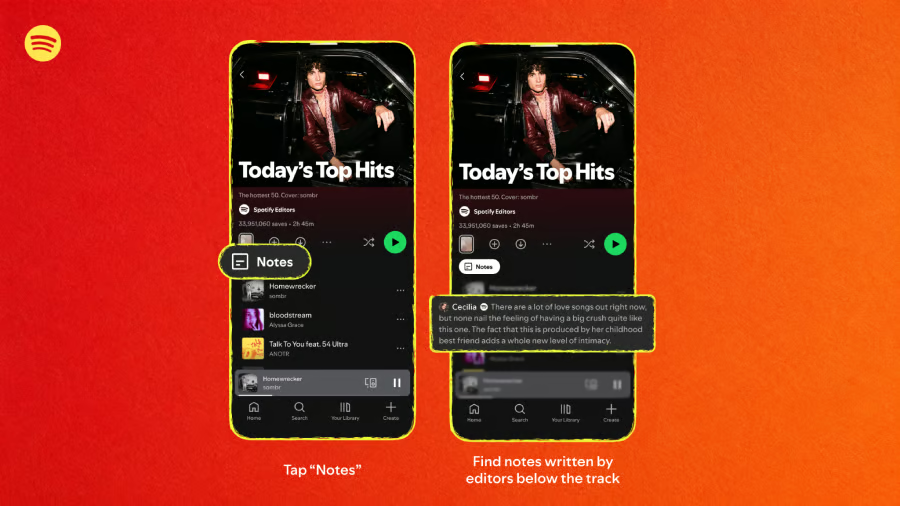
Spotify is finally giving listeners an answer to the question every playlist has silently left hanging: Why is this song here?
The company has launched Playlist Notes, a feature that lets listeners add short explanations to songs, podcast episodes, and audiobooks in playlists they create or manage.
The move adds a human layer to a service that increasingly relies on algorithms and AI to help people discover content. Instead of a playlist being only a sequence of recommendations, Spotify now wants some of those selections to come with the story, memory, or reasoning behind them.
Spotify has been steadily pushing AI deeper into discovery. Its Prompted Playlist lets users describe what they want in natural language, and the platform’s embedded AI turns that prompt into a collection of music.
Playlist Notes takes the opposite approach. Prompted Playlist uses AI to help decide what belongs in a playlist; Notes lets people explain in their own words why a particular song, podcast, or audiobook made the cut.
In April, Spotify introduced its Verified by Spotify badge to help listeners identify authentic artist profiles, and just last week it announced AI Persona badges for profiles representing AI-generated identities.
Starting in September, those profiles will also be excluded from Spotify’s editorial and algorithmic recommendations by default. Against that backdrop, Playlist Notes feels less like a minor playlist feature and more like another way for Spotify to keep human identity and judgment visible on a platform becoming increasingly shaped by AI.
How Spotify playlist notes work
For a playlist that you created or help manage:
- Open the playlist.
- Find the song, podcast episode, or audiobook.
- Tap the three-dot menu beside the item.
- Select Add note.
- Write the note.
- Save it.
TechRadar reports a 250-character limit for these notes.
According to TechCrunch, user-created Playlist Notes will roll out to iOS and Android users in more than 100 markets. Spotify’s separate Editor Notes feature will have a narrower launch, reaching free and Premium users aged 16 and older in the U.S., U.K., Canada, Australia, Ireland, and New Zealand.
More about Innovation
- Sovereign AI Explained
- The Rise of the AI-Native Factory
- Why Data Determines AI Success
- SS&C Intralinks DealCentre AI vs. Datasite: Which platform is built for the future of dealmaking?
What this means for users
For Spotify users, Playlist Notes adds a simple way to make playlists feel more personal.
Instead of handing someone a list of songs with no explanation, users can now add the memories, recommendations, or reasons that make those selections meaningful, turning a playlist into something closer to a shared story.
The feature could also prompt other streaming platforms to follow suit. If this feature catches on, competitors such as Apple Music and YouTube Music could eventually explore similar features, especially as users increasingly demand that music platforms retain their human authenticity.
For Spotify, Playlist Notes is a relatively small feature with a bigger purpose. As algorithms and AI play a larger role in deciding what users hear, the notes give listeners and editors a simple way to show where human taste, memory, and judgment still enter the mix.
Other News: Samsung may be preparing Galaxy H1, a new pair of full-size wireless headphones that could expand its Galaxy audio lineup beyond earbuds, according to clues found in the Galaxy Wearable app.