



March doesn’t bring a dramatic reshuffle at the top of the TIOBE Index, but it does deliver a small twist in the lower tier: SQL and R trade places in the top 10. With the rankings mostly steady otherwise, TIOBE CEO Paul Jansen uses this month to answer a question he says keeps coming up: why the index still relies on search engine data in the age of LLMs.
The TIOBE Programming Community Index tracks programming language popularity using search engine activity.
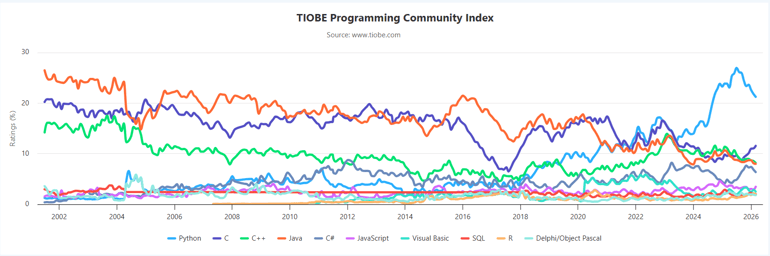
The leader stays the same, and second place looks even sturdier
Python remains in first at 21.25%, still comfortably ahead of the pack even after a month-to-month dip. C strengthens its hold on second at 11.55%, continuing to separate itself from the tight cluster behind it.
That chase group keeps the same order: C++ at 8.18%, Java at 7.99%, and C# at 6.36%. The spacing shifts slightly, but not enough to change the hierarchy or the storyline: Python is still in its own category, and C is the clearest “best of the rest.”
The middle holds, while SQL and R swap positions
JavaScript stays sixth at 3.45%, and Visual Basic remains seventh at 2.50%. These positions continue to be the least volatile part of the table, with changes too small to trigger movement.
The notable change happens lower down: SQL sits eighth at 2.00%, while R slips to ninth at 1.88%, reversing their order from February. Delphi/Object Pascal holds tenth at 1.80%, keeping a strong foothold in the bottom slot.
Why search engines still matter, even with LLMs everywhere
Jansen’s response to the “why not ask an LLM?” question is straightforward: the index is measuring how much material exists on the public internet for each programming language, and search engines are still the most direct way to estimate that footprint.
LLMs don’t solve that problem, he argues, because they ultimately draw from the same web pages. In practice, swapping search engine signals for an LLM’s opinion would be less a new measurement and more a blurred reflection of the same underlying sources.
A stable table, a timely warning
March’s stability still carries a signal, because it shows where the index is most sensitive. The top of the table has wide gaps, so small month-to-month changes don’t alter the order. The bottom of the top 10 is the opposite. The percentages are tightly clustered, which means modest swings in online visibility can flip positions.
That’s why SQL and R trading places is meaningful — not as a dramatic trend shift, but as evidence that competition is tight and small changes in public footprint can change the ranking.
Microsoft’s latest Windows 11 preview fixes the File Explorer white flash that has been irritating users.