



September brings little movement in the TIOBE top 10, though several races beneath the surface remain unsettled.
Python keeps its lead, C++ widens its advantage over Java, and the final positions remain closely fought. Elsewhere, Julia nears a return to the top 20 as MATLAB slips again, adding another turn to a story that began last month.
The TIOBE Programming Community Index tracks programming language popularity using search activity related to skilled engineers, courses, and third-party vendors.
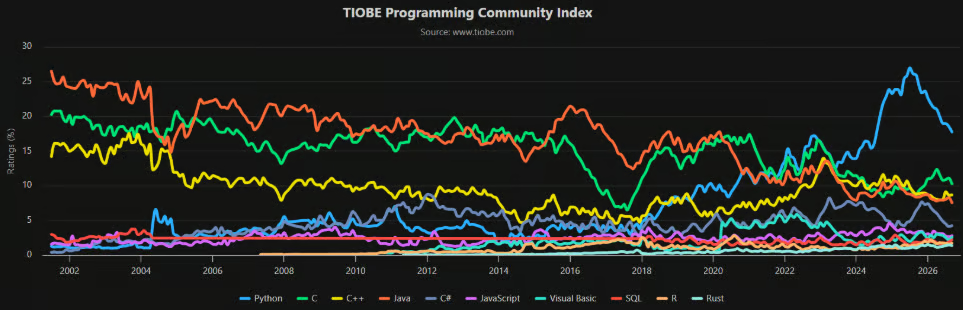
Python falls below 18% as C also weakens
Python stands at 17.76% in September, continuing the gradual decline in its rating seen through much of 2026.
C also loses ground, falling to 10.28%. With both of the top two languages moving lower, Python still holds a sizable advantage and faces no immediate challenge for first place.
C++ opens up more room over Java
The contest for third place looks less close this month.
C++ rises slightly to 8.67%, while Java falls to 7.54%, widening the difference between them to 1.13 percentage points. August had brought the pair within 0.37 points, making another ranking switch look increasingly possible.
C# remains fifth at 4.22%, followed by JavaScript at 2.76% and Visual Basic at 2.55%. All three gain rating share this month, with Visual Basic recording the strongest increase among them.
Rust keeps No. 10 as the cutoff stays tight
SQL holds eighth at 2.16%, followed by R at 1.69%. Both strengthen their ratings without changing position.
Rust stays at No. 10 with 1.34%, extending its first run inside the top 10 to a third month. Fortran sits directly behind at No. 11 with 1.24%, leaving only a tenth of a percentage point between them and keeping the final place open to relatively small changes.
Must-read developer coverage
- What Powers Your Databases? Take This DZone Survey Today!
- Microsoft’s Historic 6502 BASIC Code is Now Open Source
- TIOBE Index: Top 10 Most Popular Programming Languages
- TechRepublic Exclusive: AWS Says Entry-Level Workers Need ‘Curiosity’ In the Age of AI
Julia nears the top 20 as MATLAB slips again
Julia reaches No. 21 at 0.74%, putting it just behind COBOL at No. 20. MATLAB falls another two places to No. 27, continuing the decline that drew attention last month.
TIOBE CEO Paul Jansen says Julia has claimed some of MATLAB’s territory in numerical and scientific computing, modeling, and data processing. He also notes that Julia remains concentrated in specialist fields and has yet to gain widespread use as a general-purpose language.
A return to the top 20 could show that Julia’s strength in those technical areas is enough to support a stronger place in the index even without a broader breakthrough. Holding that position may be the tougher test, while a substantially larger climb could depend on whether Julia can reach developers beyond the areas where Jansen says it is strongest.
Also read: Meta is touting Muse Spark 1.3 as a coding leader, but independent testing raises questions about cost and consistency.