


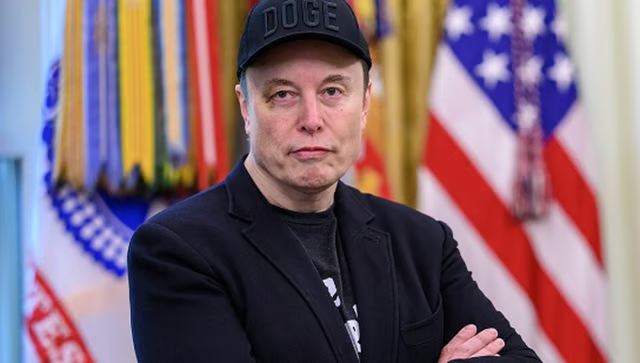
Silicon Valley’s top brass took home America’s ultimate scientific bling on Oct. 8.
President Donald Trump awarded the National Medal of Science and the National Medal of Technology and Innovation to six prominent technology leaders during the White House “Science: A New Golden Age Summit” at the US Institute of Peace.
The event highlighted new commitments to federal research, including a reported $2.4 billion in AI computing credits and scientific tools from technology companies, according to NBC News. Together, the announcements underscored the administration’s ambitions for American scientific leadership and the growing role of private industry in achieving them.
Trump conferred the National Medal of Science upon Tesla and SpaceX chief Elon Musk, Nvidia CEO Jensen Huang, AMD CEO Lisa Su, and Google co-founder Sergey Brin. Meanwhile, Dell Technologies founder Michael Dell and Microsoft CEO Satya Nadella received the National Medal of Technology and Innovation.
“We live in an age of American wonders and technological marvels, and with the help of the brilliant men and women here today, we will always be on top,” Trump said during the afternoon ceremony. Calling Musk “our modern-day Thomas Edison,” Trump added, “Few Americans in history have done more to advance America’s national interest than Elon in one field after another.”
Michael Kratsios, director of the White House Office of Science and Technology Policy, said the recipients had helped establish the foundations for future technological advances.
Science ambitions meet immigration tensions
The ceremony came hours after Vice President JD Vance announced the suspension of Microsoft and other companies from a program that allows foreign workers to pursue green cards. The timing raised questions about how the administration intends to attract global scientific talent while tightening access to immigration pathways.
Five of the six medal recipients were born outside the United States. Huang, who immigrated to the country with his parents, told NBC News, “I was an immigrant, and my parents brought us here to pursue the American dream. It’s an incredible honor and something that could only happen here in America.”
The juxtaposition does not establish that the immigration measures will directly affect scientific research. However, it raises a broader question about how US technology companies will recruit and retain specialized workers as demand for expertise in AI, semiconductors, and advanced computing grows.
Aside from computing credits and scientific tools from technology companies, other priorities included quantum computing, nuclear technology and AI-assisted scientific discovery.
More must-read AI coverage
- SS&C Intralinks DealCentre AI vs. Datasite: Which platform is built for the future of dealmaking?
- SS&C Intralinks FundCentre AI vs. Juniper Square: Which platform better supports modern private markets fund managers?
- Why Data, Not Models, Determines AI Success
- The Rise of the AI-Native Factory: How Physical AI Is Transforming Manufacturing
What the awards mean for America’s tech industry
The medals recognize individual achievements, but the summit also highlights the administration’s growing reliance on private technology companies to advance national research priorities. AI computing resources, semiconductor expertise, and cloud infrastructure could help researchers tackle complex problems faster.
However, the value of these commitments will depend on how resources are distributed and whether they translate into measurable scientific progress.
There is a potential complication: advanced research depends not only on computing power and funding but also on access to skilled workers. Immigration restrictions affecting technology employers could complicate recruitment and retention, depending on their scope and implementation.
The growing involvement of major technology companies also raises questions about how the government balances industry collaboration with independent oversight. As companies supply AI tools and infrastructure for public research, transparency around funding commitments, project outcomes, and accountability will be essential to determining whether these initiatives deliver lasting benefits.
Other news: Tesla is reportedly ramping up production of its Optimus humanoid robot as Elon Musk targets public sales by late 2027.