


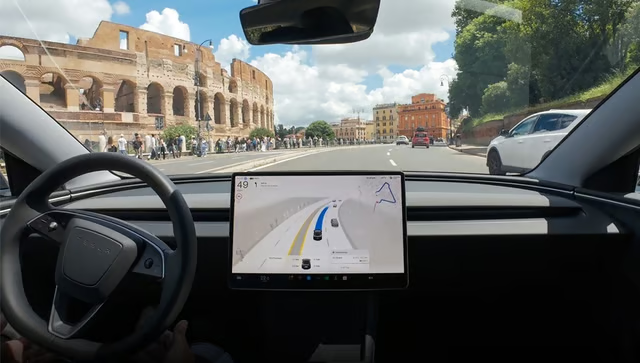
Tesla’s “Full Self-Driving” just got a new name in Europe, one that admits you’re still the one doing the driving.
The company has renamed its flagship driver-assistance system “Tesla Assisted Driving” across European websites, dropping the “Full Self-Driving (Supervised)” branding that German regulators criticized as misleading. The US site continues to offer FSD subscriptions for $99 a month.
The change comes as Tesla seeks broader European approval for the technology. While the new name does not change how the system operates, it addresses concerns about whether the original branding overstated its capabilities.
What happened
Germany’s Federal Ministry of Transport said Tesla’s FSD name was “somewhat misleading,” noting the system “is not a system that takes over the entire driving task.” Transport Minister Steffen Bilger discussed the issue with Tesla, and the company proposed the change during negotiations, according to the ministry.
Bilger now says he’ll push for EU-wide approval. Elon Musk on Wednesday thanked him on X with a German-language “Danke Schön.”
The Netherlands became the first European country to approve the system in April, though regulators stressed it was more restrictive than the US version. Eight EU member states have now approved it.
FSD represents significant recurring revenue — roughly $99 monthly per subscriber across an estimated 1.48 million active subscriptions Tesla reported in its second-quarter earnings. More critically, it anchors Musk’s vision of Tesla as an autonomous-vehicle and robotics leader rather than just a carmaker. The European market matters because EV sales there have risen amid soaring fuel costs. Tesla sales have shown signs of recovery from last year’s slump.
What this means for Tesla drivers
For European owners, the practical experience won’t change immediately; the system still requires full attention and hands ready to take control. But the rebranding removes a psychological barrier for regulators and potential customers who found “Full Self-Driving” overpromising.
The speed ceiling matters, though. Reports say Germany supports allowing the system to operate at 10% above detected speed limits. The Dutch-approved version permits up to 50% over. If Germany prevails, European drivers get a more constrained experience than their American counterparts.
The branding paradox
Tesla’s concession reveals an uncomfortable truth: the company spent nearly a decade selling an aspiration it couldn’t deliver.
The California Department of Motor Vehicles (DMV) issued an administrative decision in December 2025, adopting an administrative law judge’s findings that Tesla violated state law by misleadingly marketing its driver-assistance features as “Autopilot” and “Full Self-Driving Capability.” The DMV found that the branding overstated the vehicles’ autonomous driving capabilities.
The rename isn’t just regulatory appeasement; it’s an admission embedded in branding. “Full Self-Driving (Supervised)” contradicts itself: self-driving means the car drives itself; supervised means it doesn’t.
Regulatory differences could also affect the experience. Reports indicate that Germany and the Netherlands have taken different positions on permitted speeds when the system is active. The precise limits and how they would apply across Europe remain important questions as Tesla seeks broader approval.
The European rebrand addresses part of that concern by more clearly describing the driver’s role. However, changing the name does not resolve questions about how safely the system performs or whether drivers understand its limitations.
What's hot at TechRepublic
- Blackpoint Cyber vs. Arctic Wolf: Which MDR Solution is Right for You?
- Why AWS Sellers Choose Deepgram Over Other Voice AI Tools
- SS&C Intralinks DealCentre AI vs. Datasite: Which platform is built for the future of dealmaking?
- SS&C Intralinks FundCentre AI vs. Juniper Square: Which platform better supports modern private markets fund managers?
- Verito vs. Rightworks: Which IT Provider Is Best for Your Firm?
Risks ahead
An EU vote is not expected until December at the earliest, with France and Sweden raising speeding concerns. Block-wide approval requires 15 of 27 member states representing 65% of the EU population.
Meanwhile, some safety evidence Tesla submitted has been questioned by researchers. George Mason University professor Missy Cummings told CNBC that European agencies are “ignoring both past and ongoing NHTSA investigations” into FSD safety defects. She criticized Dutch regulators for approving the system “based on secretive data.”
Meanwhile, the US National Highway Traffic Safety Administration has investigated FSD-related safety concerns, including performance in reduced visibility and traffic violations associated with collisions.
The rebrand may help Tesla address concerns about how it presents the technology, but wider approval will depend on more than its name. Regulators must still determine whether the system meets applicable safety requirements, while drivers remain responsible for its operation.
Other news: China’s DEEP Robotics is testing waterproof humanoid robots to direct traffic and assist tourists in Hangzhou, even during heavy rain.