


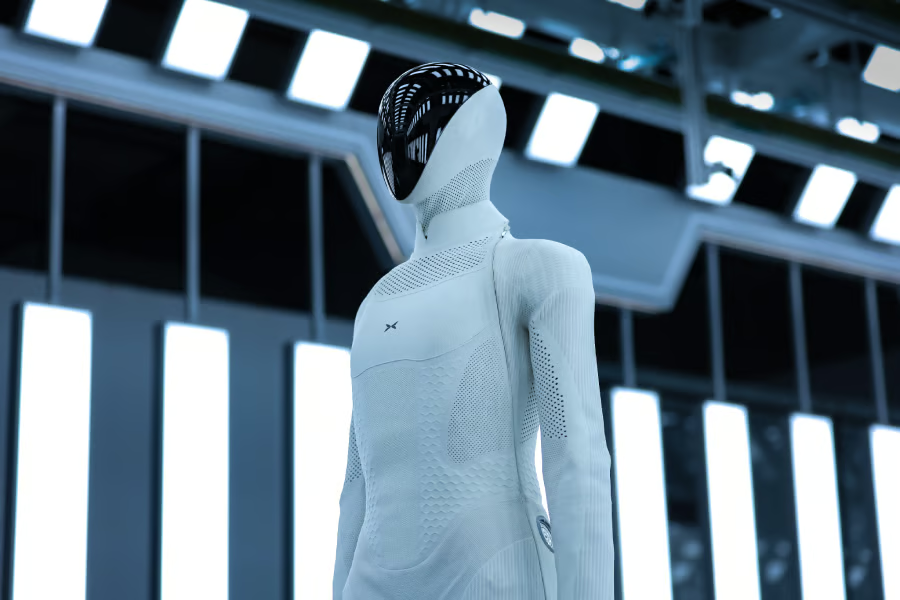
After its human-like movements prompted speculation that a person was inside, XPENG’s IRON humanoid robot has reached a new milestone: walking off the company’s newly commissioned production line in Guangzhou.
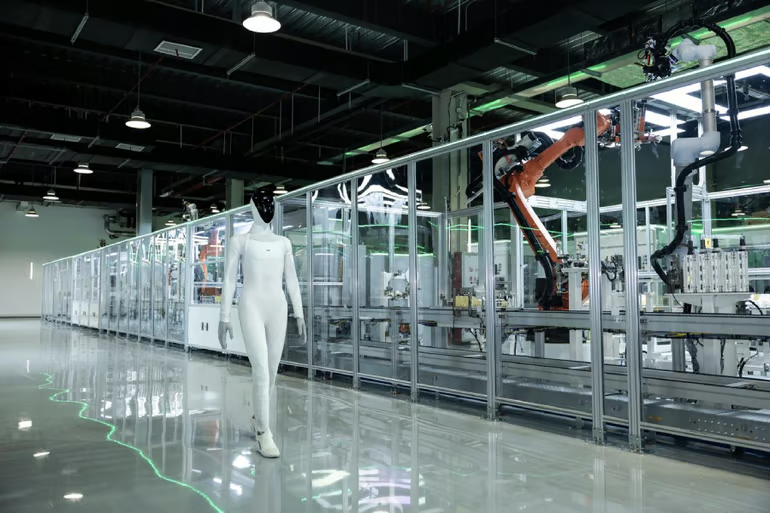
The Chinese EV maker said the dedicated facility marks a shift from developing IRON in the lab to manufacturing it through a repeatable assembly process.
According to XPENG, the first IRON completed on the line walked off the production floor autonomously. The company describes the facility as the world’s first automated production line for advanced humanoid robots, though that claim has not been independently verified.
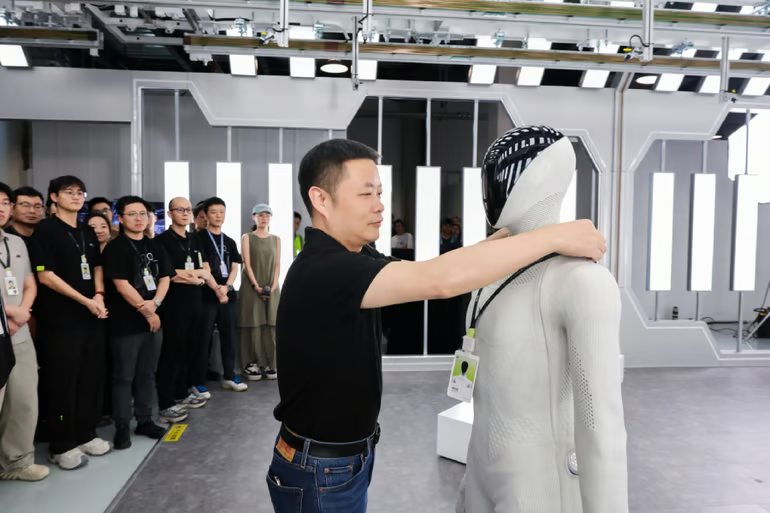
More than 80% of the line’s core processes are automated. XPENG said it built the system around automotive-grade quality controls and designed it to support higher production volumes as the robotics business grows.
“The robot production lines were created from scratch with no precedent to follow,” XPENG Chairman and CEO He Xiaopeng said. “Today’s step is small, but XPENG is building the production lines for an entirely new product category.”
What makes IRON different
IRON is being developed as a general-purpose humanoid rather than a machine built around a single industrial task.
The robot has 76 degrees of freedom across its body and 21 in each hand. Three proprietary Turing AI chips provide up to 2,250 TOPS of effective computing power, allowing XPENG to run its Physical AI foundation model directly on the robot.
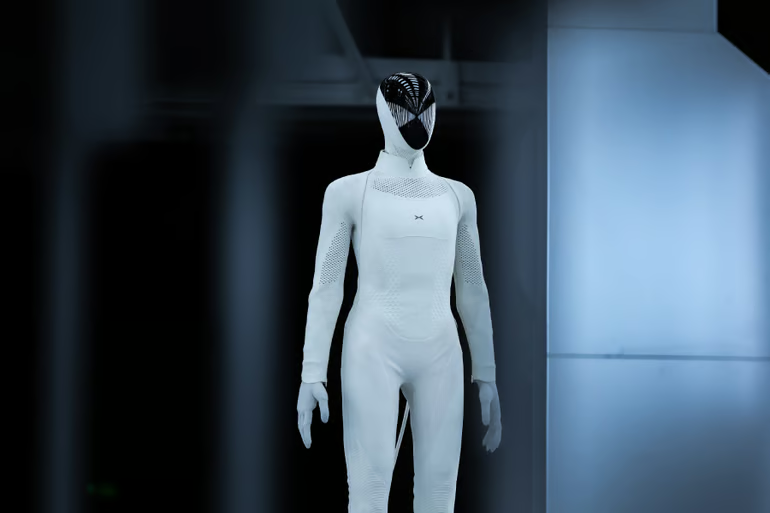
That on-device approach is intended to let IRON handle complex tasks without remote operation while keeping inference latency low and improving data security, according to XPENG.
The company has also designed IRON with a fully enclosed flexible lattice structure aimed at combining a human-like appearance with safety.
More must-read AI coverage
- SS&C Intralinks DealCentre AI vs. Datasite: Which platform is built for the future of dealmaking?
- SS&C Intralinks FundCentre AI vs. Juniper Square: Which platform better supports modern private markets fund managers?
- Why Data, Not Models, Determines AI Success
- The Rise of the AI-Native Factory: How Physical AI Is Transforming Manufacturing
The hard part starts now
The production line is an important milestone, but it does not yet prove that XPENG can manufacture humanoids cheaply or at high volume.
The company has not disclosed the line’s production capacity or IRON’s price. Those figures will matter as much as the robot’s technical specifications because scaling a humanoid involves maintaining precision across a machine with numerous moving parts and complex electronics.
For businesses evaluating humanoid robots, the more meaningful measures will be price, uptime, maintenance requirements and whether the machines can perform useful tasks without constant human supervision.
XPENG says it expects IRON to enter mass production by the end of 2026, with initial deployments at its stores and campuses. The company is targeting wider deliveries in China and overseas markets in 2027. That strategy could give XPENG a controlled environment to test whether IRON can perform useful work consistently before it faces the tougher demands of outside customers.
XPENG bets on robotics as a new business
The manufacturing push comes shortly after XPENG’s robotics business secured more than $900 million from investors at a post-money valuation of more than $6.3 billion.
XPENG sees robotics as its second growth curve alongside vehicles and global expansion. XPENG Co-President Brian Gu has said IRON could eventually produce higher gross margins than the company’s electric vehicles because of the technology’s high barriers to entry. That projection remains untested because the robotics unit has yet to generate meaningful revenue.
The newly commissioned line gives XPENG a way to begin testing those ambitions at production scale, but pricing, output and results from its initial deployments will determine whether IRON is ready to become a viable commercial product.