
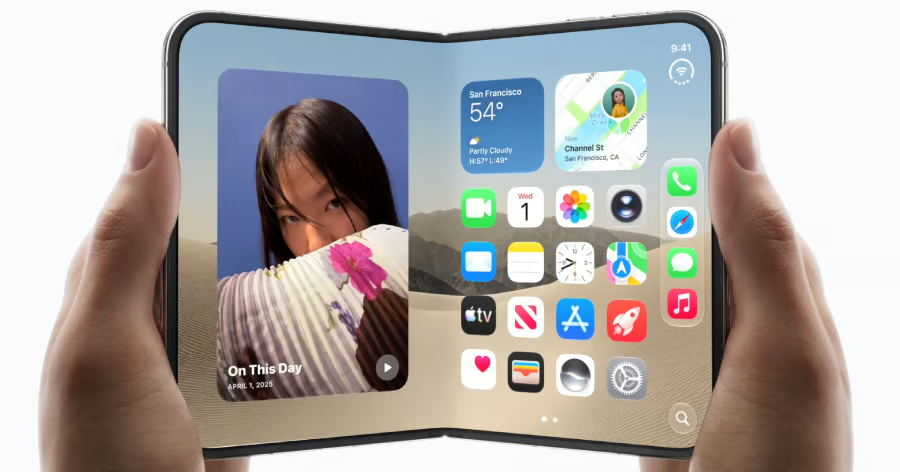


Apple’s first foldable iPhone comes with an equally eye-catching price: $1,999.
The iPhone Duo arrives Oct. 23 with a 7.6-inch folding display, A20 Pro chip, and iOS 27.1. Apple has tailored iOS 27 for the Duo’s foldable design, while support for Apple Pencil with USB-C will arrive later this year, according to Apple’s iPhone Duo announcement.
But buyers willing to spend nearly $2,000 on a phone have several alternatives, including established Android foldables and a considerably cheaper way to remain in Apple’s ecosystem.
The best alternative depends on why the Duo caught your attention in the first place. Samsung offers a mature foldable experience, Google provides an even larger inner display, Motorola emphasizes battery life, and Apple’s own iPhone 18 Pro Max delivers flagship performance without a hinge.
- How we chose the best iPhone Duo alternatives
- iPhone Duo alternatives compared
- Samsung Galaxy Z Fold8: The closest iPhone Duo alternative
- Google Pixel 11 Pro Fold: A bigger screen with Google AI
- Motorola Razr Fold: The battery-focused alternative
- iPhone 18 Pro Max: The Apple alternative that saves $700
- Which iPhone Duo alternative makes sense for you?
How we chose the best iPhone Duo alternatives
We selected these alternatives based on the features that make the iPhone Duo distinctive, including its foldable design, large-screen experience, flagship performance, software ecosystem, and $1,999 starting price.
Rather than choosing four phones with similar specifications, we looked for devices that offer a compelling alternative for different types of buyers. The Galaxy Z Fold8 emphasizes foldable multitasking, the Pixel 11 Pro Fold pairs a larger inner display with Google’s Android and AI ecosystem, and the Motorola Razr Fold prioritizes battery capacity and charging. We also included the iPhone 18 Pro Max for Apple users who want flagship performance and ecosystem integration without a folding screen.
Our comparisons use manufacturer specifications and pricing where available. Battery-life claims come from each manufacturer’s own testing, so they should not be treated as directly comparable real-world results. Prices are starting list prices before trade-ins, promotions, or carrier discounts and may change over time.
iPhone Duo alternatives compared
| iPhone Duo | $1,999 | 7.6 inches | Apple users who want a foldable |
| Samsung Galaxy Z Fold8 | $1,899.99 | 8.0 inches | Multitasking and mature foldable software |
| Google Pixel 11 Pro Fold | $1,899 | 8 inches | Google AI and a larger folding display |
| Motorola Razr Fold | $1,899.99 | 8.09 inches | Battery life and fast charging |
| iPhone 18 Pro Max | $1,299 | 6.9 inches | Apple users who do not need a foldable |
Prices are manufacturer starting prices before current promotions or trade-ins and can change.
Samsung Galaxy Z Fold8: The closest iPhone Duo alternative
For buyers who specifically want a book-style foldable, Samsung’s Galaxy Z Fold8 is the most direct alternative.
According to Samsung’s Galaxy Z Fold8 specifications, the phone starts at $1,899.99 with 256GB of storage, putting its regular starting price about $100 below the iPhone Duo. Samsung gives it an 8.0-inch main display, Snapdragon 8 Elite Gen 5 for Galaxy processor, up to 1TB of storage, and a 4,800mAh battery rated for up to 26 hours of video playback.
Samsung has considerably more experience shipping book-style foldables. The Galaxy Z Fold8 builds on seven previous generations of Samsung foldables, while the Duo is Apple’s first foldable iPhone, giving buyers two different approaches to large-screen mobile software.
That distinction matters most for productivity. Samsung positions the Fold8’s 4:3 main display for reports, dashboards, video calls, and running multiple apps side by side, making it an appealing option for users who expect their foldable to serve as a pocket-sized work device.
TechRepublic’s iPhone Duo and Galaxy Z Fold8 comparison takes a closer look at their different approaches to multitasking, portability, and ecosystem integration.
Consider the Galaxy Z Fold8 if: You want the closest Android equivalent to the Duo and care heavily about multitasking.
Stick with the iPhone Duo if: You are already invested in Apple services and devices and do not want to move your workflow to Android.
Google Pixel 11 Pro Fold: A bigger screen with Google AI
Google takes the large-screen approach even further.
According to Google’s Pixel 11 Pro Fold specifications, the phone has an 8-inch inner OLED display and a 6.5-inch outer display, compared with the Duo’s 7.6-inch inner and 5.4-inch outer displays. Google’s foldable also supports a 1-120Hz refresh rate and reaches up to 3,600 nits of peak brightness.
Google lists the Pixel 11 Pro Fold at $1,899 before trade-in offers, again placing its regular starting price $100 below the Duo.
Google’s software is another differentiator. Android’s foldable interface supports split-screen multitasking, while Google’s Pixel experience puts its AI features at the center of the device.
TechRepublic’s Pixel 11 Pro Fold and Galaxy Z Fold8 comparison examines the two Android foldables with an emphasis on productivity, portability, and everyday use.
Consider the Pixel 11 Pro Fold if: You want a larger folding display and prefer Google’s Android and AI ecosystem.
Stick with the iPhone Duo if: Apple ecosystem integration, iMessage, FaceTime, Apple Intelligence, and continuity with other Apple devices matter more than display size.
Motorola Razr Fold: The battery-focused alternative
Motorola’s Razr Fold gives buyers another large book-style foldable without crossing the $2,000 line.
According to Motorola’s Razr Fold product listing, the phone starts at $1,899.99 with a Snapdragon 8 Gen 5 processor, 16GB of RAM, and 512GB of storage. It has an 8.09-inch inner display and a 6.56-inch outer screen.
Its biggest differentiator may be power. Motorola equips the phone with a 6,000mAh battery and rates it for more than 43 hours of battery life on a single charge. Motorola’s Razr Fold charging specifications also list support for up to 80W wired and 50W wireless charging.
By comparison, Apple’s iPhone Duo specifications rate the device for up to 31 hours of video playback on the inner screen, 44 hours on the outer screen, or up to 24 hours of typical use. Apple says the Duo can reach 50% charge in about 20 minutes with the specified wired charging setup.
Those figures are based on each manufacturer’s own testing and are not directly comparable, but they illustrate the different priorities behind the devices.
Consider the Razr Fold if: Battery capacity, fast charging, and a large display are higher priorities than joining Apple’s foldable ecosystem.
Stick with the iPhone Duo if: You prefer iOS, want Apple’s integration between iPhone, Mac, iPad, and Apple Watch, or expect to use the Apple Pencil support Apple says is coming later this year.
Must-read Apple coverage
- Nearly 7 in 10 iPhone Owners Plan iPhone 17 Upgrade
- Apple Prepares AI-Powered Siri Upgrade With Google Search Integration
- Apple’s Xcode 26 Beta Now Supports GPT-5 and Claude
- Apple’s Vision Pro Adoption Stalled As Content Released ‘Drip by Drip’
iPhone 18 Pro Max: The Apple alternative that saves $700
Not everyone interested in the iPhone Duo actually needs a folding phone.
According to Apple’s iPhone 18 Pro announcement, the iPhone 18 Pro Max starts at $1,299, which is $700 less than the $1,999 Duo. It retains Apple’s A20 Pro chip, Apple Intelligence, and Siri AI.
The trade-off is obvious: the Pro Max does not unfold into a tablet-sized screen. But it offers Apple’s flagship camera system, including a 48MP Fusion Main camera with variable aperture, and Apple rates it for up to 45 hours of video playback on eSIM-only models.
The Duo instead emphasizes flexibility. Apple says its 7.6-inch inner screen provides 50% more screen area than the iPhone 18 Pro Max display, while iOS 27 introduces foldable-specific experiences designed around that extra space.
TechRepublic has also examined six iPhone Duo features built for its foldable design, including Split View and dual Home Screens.
Consider the iPhone 18 Pro Max if: You want Apple’s flagship performance and ecosystem without paying $1,999 for a foldable.
Stick with the iPhone Duo if: The large folding display is the primary reason you are upgrading in the first place.
Which iPhone Duo alternative makes sense for you?
The $1,999 iPhone Duo is not simply a more expensive iPhone. Buyers are paying for a different form factor, a 7.6-inch folding screen, and software designed to turn that extra display space into something useful.
That makes the deciding question relatively simple: Do you actually need the fold?
If the answer is yes, Samsung, Google, and Motorola all offer Android alternatives around the same price, with different strengths in multitasking, display size, and battery life. The Galaxy Z Fold8, Pixel 11 Pro Fold, and Razr Fold all provide larger inner displays than the Duo.
If the answer is no, the iPhone 18 Pro Max cuts $700 from the starting price while keeping users inside Apple’s ecosystem. For buyers who are still undecided, Apple says in its iPhone Duo launch announcement that preorders begin Oct. 16, with availability starting Oct. 23.
At nearly $2,000, the question is less about which phone has the longest list of specifications and more about which features you will actually use. A folding screen can create considerably more workspace in your pocket, but if that extra canvas does not change how you work, read, watch, or multitask, one of the alternatives may be enough.
More Apple news: Still deciding whether Apple’s foldable is worth $1,999? See whether the iPhone Duo can really replace an iPhone 18 Pro and iPad Mini.