


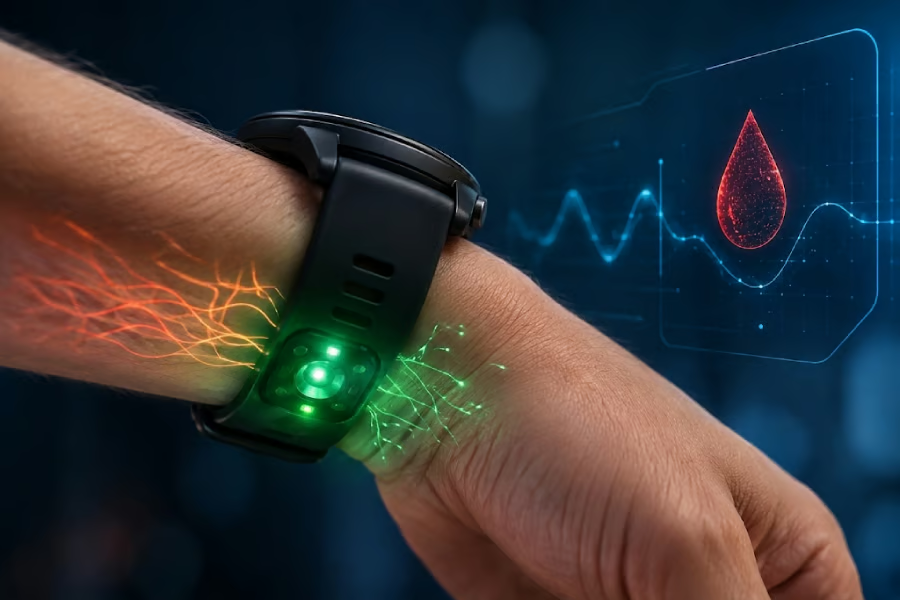
New scrutiny of Garmin’s patent portfolio is revealing how the company is exploring ways to bring blood sugar insights directly to the wrist.
A collection of related patent filings sheds new light on the company’s research into non-invasive HbA1c estimation, including technology for measuring glycated hemoglobin with optical sensors in a wearable device. The research comes as Apple and other smartwatch makers pursue their own approaches to bringing more metabolic health information to wearables.
The latest attention comes from a Tech Advisor report highlighting Garmin’s patent activity around the technology. While patents are no guarantee of a commercial product, they provide a clearer picture of how Garmin researchers are approaching the problem and why the company’s work differs from the real-time glucose monitoring many users might expect.
Garmin’s patents point to HbA1c measurements from the wrist
One Garmin patent application, titled “Determination of a User’s Glycated Hemoglobin Level Using Pulse Spectroscopy,” describes a wearable device that sends multiple wavelengths of light through the skin and analyzes the resulting optical signals.
The system would use those signals to estimate the amount of glycated hemoglobin in a user’s blood. The patent application was published in February 2026.
That distinction matters: HbA1c is not the same thing as a live blood glucose reading.
Continuous glucose monitors, or CGMs, can show glucose levels changing throughout the day. HbA1c instead reflects average blood sugar levels over a much longer period. Garmin’s proposed technology focuses on estimating that longer-term marker rather than telling users how their glucose changes immediately after a meal or workout.
Current Garmin devices can already display readings from compatible Dexcom CGM systems, but the glucose measurements come from the external sensor rather than the watch itself.
Garmin’s patent research explores a different possibility: estimating HbA1c through optical measurements taken by a wrist-worn device.
Garmin is also tackling the ‘too-tight watch’ problem
A related Garmin patent reveals one of the less obvious challenges standing in the way.
The company’s “Pressure Compensation for Wrist-Based Pulse Spectrometry” filing describes technology designed to account for pressure between a wearable and a user’s skin. A watch pressing against the wrist can affect blood vessels and alter optical signals, potentially distorting physiological measurements.
Garmin’s proposed system calculates a pressure metric from photoplethysmography (PPG) signals and applies a compensation factor to physiological measurements. The patent specifically identifies HbA1c as one of the measurements to which the technique could be applied.
The filing does not prove Garmin has solved non-invasive HbA1c estimation. But viewed alongside the company’s dedicated HbA1c patent, it shows researchers examining both the measurement itself and one practical variable that could interfere with optical readings on a real wrist.
Apple is pursuing its own glucose breakthrough
Garmin is hardly alone in trying to extract more metabolic health information from the wrist.
Apple has spent years researching non-invasive glucose monitoring, but it has yet to put a glucose-measuring sensor inside an Apple Watch. TechRepublic has previously examined Apple’s efforts to bring blood sugar monitoring to the Apple Watch, including the technical and regulatory obstacles standing in the way.
The Apple Watch can already display glucose data from compatible CGM devices, including Dexcom devices. Like Garmin’s current watches, however, the device serves as a display rather than measuring glucose independently.
Apple has not publicly announced how or when it might bring independent glucose measurement to the Apple Watch. Reports about the company’s long-running research have nevertheless kept the possibility of non-invasive glucose monitoring in the spotlight.
Garmin’s documented research is not targeting the exact same measurement. Its HbA1c patent centers on estimating glycated hemoglobin rather than providing continuous, real-time glucose readings.
The two companies are therefore exploring different approaches within a broader push in wearable metabolic health: how to extract more useful health information from the wrist without relying entirely on separate sensors.
What's hot at TechRepublic
- Blackpoint Cyber vs. Arctic Wolf: Which MDR Solution is Right for You?
- Why AWS Sellers Choose Deepgram Over Other Voice AI Tools
- SS&C Intralinks DealCentre AI vs. Datasite: Which platform is built for the future of dealmaking?
- SS&C Intralinks FundCentre AI vs. Juniper Square: Which platform better supports modern private markets fund managers?
- Verito vs. Rightworks: Which IT Provider Is Best for Your Firm?
Don’t expect a Dexcom replacement yet
The promise of needle-free glucose tracking has generated years of smartwatch rumors, but the terminology can make emerging technologies sound further along than they really are.
Garmin’s patents do not establish that a future watch will continuously measure glucose. They do not confirm that Garmin has completed clinical validation, received regulatory clearance, or decided to ship HbA1c estimation in a consumer product.
They also do not confirm that the technology is coming to the rumored Fenix 9.
Recent reporting has linked Garmin’s patent activity to speculation about its next flagship watch, but there is currently no public evidence directly tying HbA1c estimation to the Fenix 9. Patent filings frequently describe technologies that never reach commercial products.
There is also a significant regulatory barrier.
The US Food and Drug Administration has warned consumers against relying on smartwatches or smart rings that claim to independently measure blood glucose without piercing the skin. The agency has warned that inaccurate readings could lead people to make incorrect decisions about diabetes management.
That makes accuracy more than a specification-sheet problem. Any technology intended for medical use would face a very different standard from familiar wellness features such as step counts or sleep scores.
The smartwatch blood sugar race is getting more crowded
The wearable industry has steadily expanded from counting steps to monitoring heart rhythm, blood oxygen, temperature, sleep, and other health signals. Blood sugar remains a much tougher prize.
TechRepublic’s guide to wearables for blood sugar tracking shows how varied these efforts already are. Some watches display readings from separate CGMs, while companies continue researching ways to extract metabolic information directly from wearables.
The broader shift is already underway, just not through the needle-free smartwatch sensor many consumers might imagine. As TechRepublic explained in its look at the smartwatch blood sugar revolution, today’s biggest advances still largely depend on CGM and tighter integration between medical sensors and consumer wearables.
Garmin’s patents add another approach to that broader push.
Rather than demonstrating that Garmin is ready to replace a CGM, the filings show researchers exploring whether optical sensors could eventually estimate HbA1c from the wrist and how problems such as pressure against the skin might affect those measurements.
Whether that research becomes a commercial Garmin feature remains an open question.
For now, the patents offer a glimpse at another front in wearable metabolic health. Apple and Garmin may be pursuing different measurements and technologies, but both are confronting a formidable challenge: extracting meaningful metabolic information from the wrist without breaking the skin.
Also read: For a broader look at what today’s wearables can already detect, explore five smartwatch health alerts that go beyond blood sugar, from hypertension warnings to irregular heart rhythms and emergency detection.