


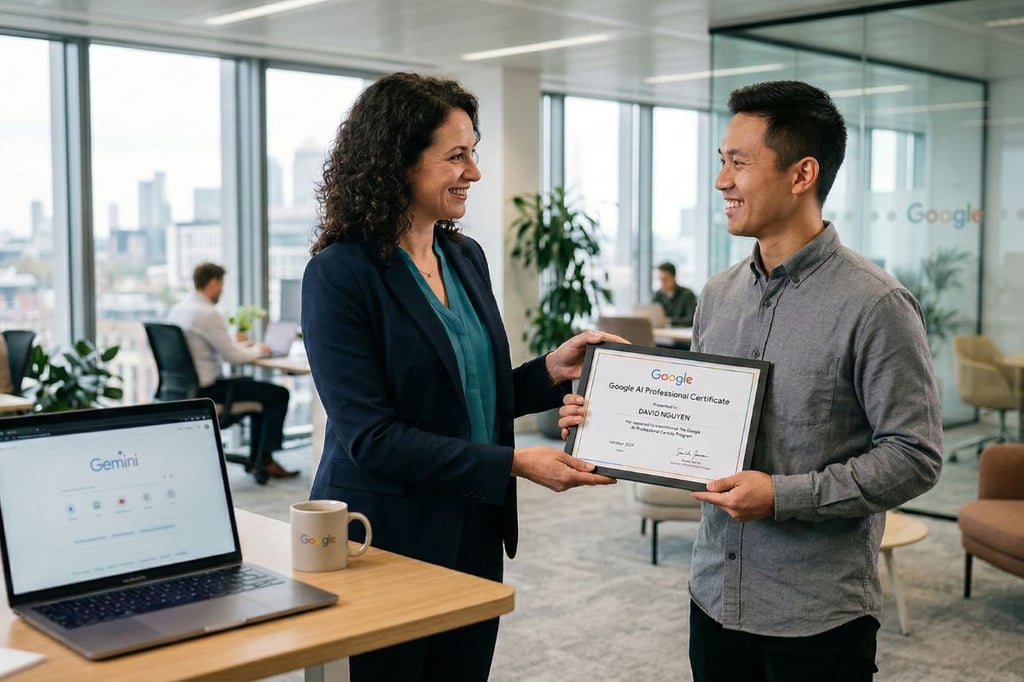
Google is betting that AI literacy needs to move from theory to task lists.
The tech titan has launched a new AI Professional Certificate designed to train workers on real-world workflows, from expert prompting and research to building functional apps without writing code.
The program expands its Career Certificates lineup with hands-on training across planning, writing, data analysis, content creation, and app development, giving learners structured practice inside Google’s own AI tools.
A six-course track built around doing, not watching
Google AI Professional Certificate is structured as a six-course sequence capped by a final project, with more than 20 hands-on activities threaded throughout. Each module focuses on applying tools to concrete workplace scenarios, moving participants from core concepts to practical execution.
The coursework spans brainstorming and planning, research and insight generation, writing and communication, content creation, and data analysis. It culminates in a capstone centered on building a custom app through “vibe coding,” allowing learners to automate or streamline a real task without writing traditional code.
Participants work directly inside Google’s AI ecosystem, including Gemini tools, Deep Research, NotebookLM, Workspace integrations, and AI Studio.
Instead of abstract exercises, participants are guided to connect tasks into repeatable processes that generate finished deliverables they can use on the job, reinforcing the program’s focus on practical execution over passive learning.
Major employers sign on to train their workforce
Google is not rolling this out alone. Employers that include Walmart, Sam’s Club, Deloitte, Verizon, and Colgate-Palmolive plan to use the certificate to train their employees, signaling early corporate backing for the program.
The distribution strategy extends beyond large enterprises. Google is offering no-cost access to the certificate, along with three months of Google Workspace Business Standard, to small businesses nationwide.
To expand its reach, the company is working with the US Chamber of Commerce and America’s Small Business Development Centers, while partners such as ADP, PayPal, and Verizon will help circulate the program across their networks
By tying it to corporate training tracks, Google moves the certificate into the flow of workforce development.
More Google coverage
- New Google Search AI Mode is ‘Total Reimagining,’ Says CEO Sundar Pichai
- In Major Ruling, Judge Finds Google ‘Willfully Acquired and Maintained Monopoly Power’ Over Digital Ad Market
- Google’s Big Bet on Nuclear Energy: ‘The Race to Power AI-Driven Data Centers is Accelerating’
- Computer History Museum Releases Original AlexNet Code: Why It Matters
A critical skills mismatch emerges
Corporate demand for AI capability is rising faster than formal training programs. Research cited by Google from Ipsos shows that 70% of managers believe an AI-trained workforce is critical to business success, yet only 14% of employees say they have been offered AI training.
The disparity highlights how quickly expectations inside companies have shifted. As AI tools move into everyday tasks, many workers are being asked to use them without structured guidance, leaving employers to close the skills gap in real time.
New Gartner projections indicate customer service job cuts tied to AI may not be permanent.