



Being the language developers want to use is one thing. Being the language they still rely on to get work done is another.
Stack Overflow’s 2026 Developer Survey reveals a tighter contest among the most widely used programming languages. A longtime leader has lost ground, while another contender has overtaken two established rivals. Developers’ preferences for future projects add another interesting dimension.
The annual survey covers languages used extensively during the past year, technologies developers want to work with next, and their use of AI coding tools.
A closer race emerges among the leading languages
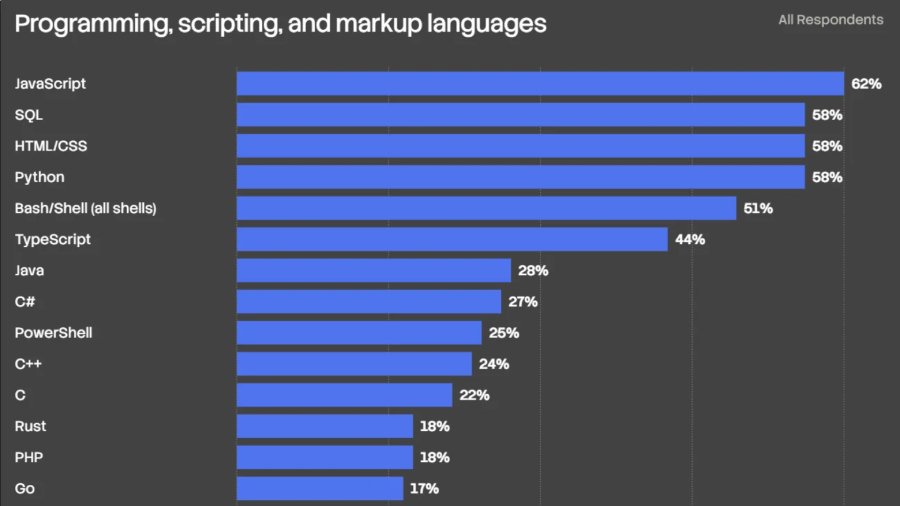
JavaScript remains the top programming language on Stack Overflow’s rankings at 62%, down from 66% in 2025. Its advantage over the other leading languages has narrowed considerably over the past year.
SQL ranks second at 58.4%, followed by HTML/CSS at 58.2% and Python at 58%. Python barely moved from its 57.9% share last year, leaving it four percentage points behind JavaScript compared with 8.1 points in 2025. SQL remains important for working with databases, while HTML and CSS handle the structure and appearance of web pages.
Bash/Shell also gained ground, climbing from 48.7% to 51.3%. Its continued use reflects the role of command-line scripting in automating repetitive development tasks and managing software environments.
Meanwhile, TypeScript edged up from 43.6% to 43.8%, retaining sixth place.
Rust overtakes PHP and Go as usage grows
Rust recorded one of the more substantial increases, climbing from 14.9% to 18%. Its gain pushed the language from 14th to 12th place, ahead of PHP at 17.7% and Go at 16.5%.
Performance and memory safety are central to Rust’s design. Its safeguards help prevent programming errors that can expose sensitive information or create security vulnerabilities, making it useful for systems software and other performance-intensive applications. Growing attention to memory-safe programming languages has also brought the language into discussions about building more secure software.
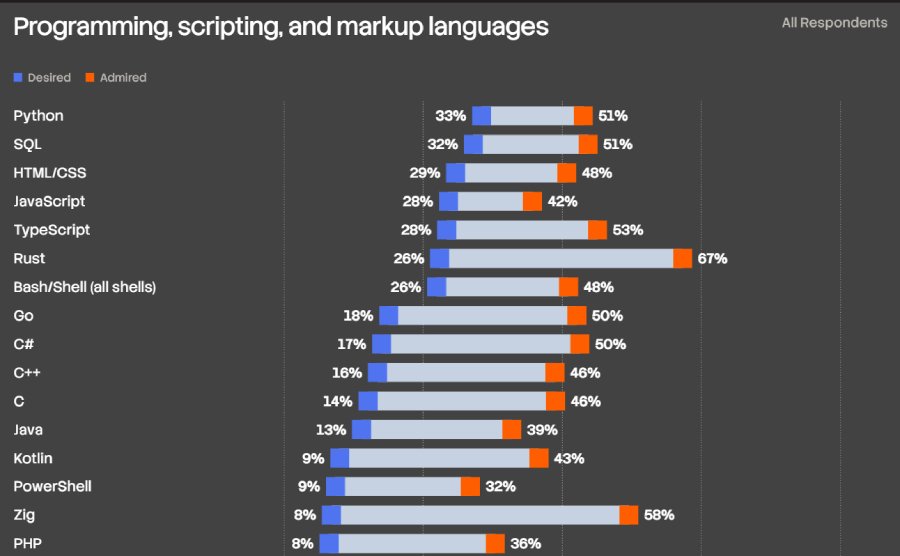
Existing users remain enthusiastic. Rust recorded a 67.4% admiration rate, meaning more than two-thirds of respondents who worked with it want to continue doing so.
Must-read developer coverage
- What Powers Your Databases? Take This DZone Survey Today!
- Microsoft’s Historic 6502 BASIC Code is Now Open Source
- TIOBE Index: Top 10 Most Popular Programming Languages
- TechRepublic Exclusive: AWS Says Entry-Level Workers Need ‘Curiosity’ In the Age of AI
Developers favor Python for future projects and AI coding
When asked which languages they wanted to work with over the next year, respondents put Python first in the desired-language rankings at 33.4%, followed by SQL at 32%. JavaScript and TypeScript attracted 27.8% and 27.5%, respectively, while Rust reached 26.3%.
A major advantage of Python is how easily developers can move between different kinds of work. Someone automating an internal reporting process can use the same language to build a data pipeline or develop a machine-learning application. Established libraries such as pandas and scikit-learn provide much of the functionality needed for those tasks, contributing to Python’s popularity in data science and AI development.
Among languages used with AI coding assistants or agents, Python led at 39%, narrowly ahead of JavaScript at 38.4%. TypeScript followed at 30.4%. Developers can use these tools to generate test cases or troubleshoot existing scripts as part of their daily programming work.
Small scripts can become big business dependencies
Some of the most important software inside a company never reaches customers directly. In the survey’s software-building findings, 77.3% of respondents reported involvement in or plans for small scripts and automations, while 63% selected team-level internal tools. Both categories ranked ahead of customer-facing products.
For example, an internal reporting dashboard may rely on Python to process incoming data, SQL to retrieve records, and JavaScript to present the results. Each component performs a different job, and a failure in any one of them could interrupt the entire workflow. These applications can become critical to daily operations even when they began as small projects.
Python leads the 2026 JetBrains survey and November’s TIOBE and PYPL indexes. That said, a company’s most immediate programming challenge may have little to do with whichever language currently leads. An automated process written years earlier could be handling important business information without anyone actively maintaining it.
Looking ahead, Python’s popularity and Rust’s recent gains leave room for further movement in developer rankings. For engineering managers, a more immediate test is whether critical automations can still be maintained when their original developers are unavailable.
Assigning ownership and testing updates before deployment can help prevent small software problems from disrupting business operations.
More on programming languages: Rust recorded 162% growth in GitHub’s latest report, while Python and TypeScript continued attracting developers. Read our breakdown of the findings.