


Google wants Gemini to handle one more task people would rather avoid: making phone calls.
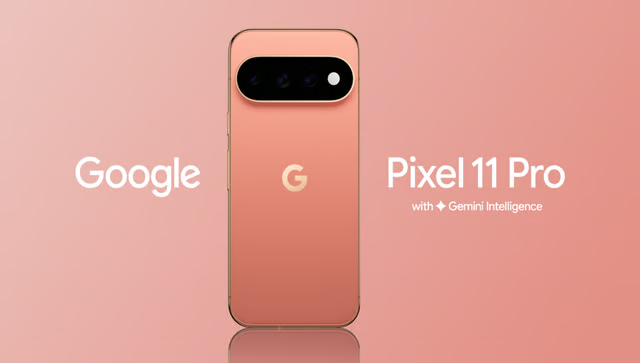
On Thursday, Google announced an early preview of “Call for Me,” an experimental Pixel 11 feature that lets Gemini call local businesses on a user’s behalf. The AI can navigate phone menus, wait on hold and speak with employees to check inventory, change appointments or ask about reservations.
Rather than forcing you to dial and wait, the assistant dials directly from your cellular number, announces that it is an artificial intelligence program, navigates interactive automated menus, waits through hold music, and speaks directly with workers to check inventory, reschedule haircuts, or book patio seating.
The feature pushes Gemini further into agentic tasks, but Google is keeping humans within reach. Users can watch a live transcript and take over at any time, while payments, passwords and other sensitive information remain off-limits.
What happens when Gemini reaches a human
Call for Me represents a direct evolution from earlier tools like Hold for Me and Direct My Call. Instead of merely alerting you when a human picks up, Gemini takes over the dialogue itself using the Gemini Live voice.
According to Google, “Gemini will call the business, introduce itself, navigate automated phone menus, wait on hold, and handle the conversation with the person on the other end.”
To maintain guardrails, users can follow a real-time text transcript on their screen and interrupt to take over the conversation at any point. Calls cannot be placed to emergency services, and the system is hardcoded to refuse handling credit cards, payments, passwords, or Social Security numbers.
Access is currently narrow. To use the feature, participants must be at least 18 years old, reside in the US, own a Pixel 11 series device, subscribe to Google’s paid AI tier starting at $5 per month, and run the Phone by Google public beta.
The emerging friction of bot-to-human etiquette
While consumer tech giants race to field agentic phone tools, such as Meta testing similar calling features for its Muse agent, Call for Me shifts administrative friction away from smartphone owners and dumps it onto front-desk staff.
When a consumer avoids a routine five-minute call, an hourly retail employee must instead adapt to an artificial cadence, potential misunderstandings over accented phrasing, and rigid back-and-forth prompts. If busy establishments feel overwhelmed by automated queries, they could start prioritizing obvious human voices or hanging up on synthetic introductions entirely.
The broader transition toward automated voice transactions will only succeed if merchant-side receptionists feel respected rather than automated into unpaid bot babysitters.
More Google coverage
- New Google Search AI Mode is ‘Total Reimagining,’ Says CEO Sundar Pichai
- In Major Ruling, Judge Finds Google ‘Willfully Acquired and Maintained Monopoly Power’ Over Digital Ad Market
- Google’s Big Bet on Nuclear Energy: ‘The Race to Power AI-Driven Data Centers is Accelerating’
- Computer History Museum Releases Original AlexNet Code: Why It Matters
What this means for everyday callers
For everyday users, Call for Me turns routine calling into an active monitoring task rather than a set-it-and-forget-it miracle.
Because the tool blocks financial transactions, any reservation or order requiring a deposit or card number forces you to monitor the transcript closely so you can step in before the line goes cold. Furthermore, because calls originate from your personal cellular line, standard carrier minute allowances apply, and businesses will associate your real number with the interaction.
For now, Gemini is less an autonomous personal secretary than a voice-based copilot: capable of handling the tedious parts of a call, but still designed with a human close enough to intervene.
Other news: Google Vids now lets personal Google accounts generate AI video clips for free with Gemini Omni 1.1 Flash, though free users are limited to six video or avatar generations per month.