


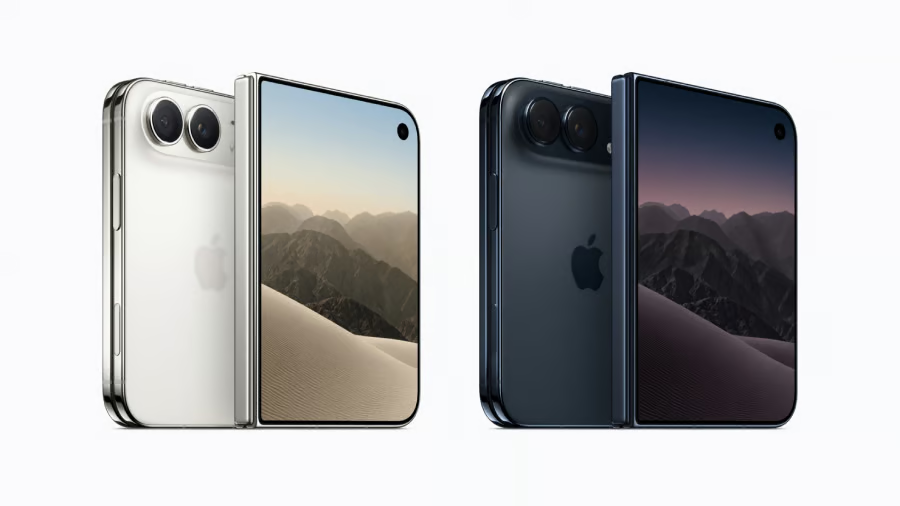
Apple is about to put an iPhone in your pocket that unfolds into something much closer to a small tablet.
The iPhone Duo is Apple’s first foldable iPhone, pairing a compact 5.4-inch outer screen with a 7.6-inch folding display. It starts at $1,999, runs on the A20 Pro chip, and introduces an iOS experience built specifically for multitasking across a larger folding screen. Preorders begin Oct. 16 before the phone reaches stores Oct. 23.
For prospective buyers, the Duo also introduces unfamiliar trade-offs. It costs considerably more than a conventional iPhone, uses Touch ID instead of Face ID, and gives up some of the camera capabilities available on the iPhone 18 Pro lineup. This cheat sheet breaks down the iPhone Duo’s specifications, price, cameras, battery life, software, release date, and the biggest things to consider before buying.
- iPhone Duo at a glance
- What is the iPhone Duo?
- How much does the iPhone Duo cost?
- When does the iPhone Duo come out?
- How does the iPhone Duo folding display work?
- What can you do with the folding screen?
- What processor does the iPhone Duo use?
- What cameras does the iPhone Duo have?
- How long does the iPhone Duo battery last?
- Is the iPhone Duo durable?
- iPhone Duo vs. iPhone 18 Pro Max: What’s different?
- Does the iPhone Duo have MagSafe?
- Does the iPhone Duo use a physical SIM card?
- iPhone Duo FAQ
- What to consider before buying the iPhone Duo
iPhone Duo at a glance
| Feature | iPhone Duo |
|---|---|
| Starting price | $1,999 |
| Preorder date | Oct. 16, 2026 |
| Release date | Oct. 23, 2026 |
| Inner display | 7.6-inch Super Retina XDR OLED |
| Outer display | 5.4-inch Super Retina XDR OLED |
| Refresh rate | ProMotion, up to 120Hz |
| Processor | A20 Pro |
| Rear cameras | 48MP Fusion Main + 48MP Fusion Ultra Wide |
| Front cameras | 12MP Center Stage + under-display FaceTime camera |
| Storage | 256GB, 512GB, 1TB, 2TB |
| Authentication | Touch ID |
| Battery | Up to 44 hours video playback using outer display |
| Water and dust resistance | IP68 |
| Colors | Night Sky, Star White |
| Operating system | iOS 27.1 |
Apple introduced the Duo on Sept. 9 as part of its 2026 product lineup, alongside the iPhone 18 Pro, AirPods 5, and new Apple Watch models.
What is the iPhone Duo?
The iPhone Duo is Apple’s first foldable smartphone and represents one of the largest physical changes to the iPhone since its introduction.
Closed, the Duo uses a 5.4-inch Super Retina XDR outer display designed to function much like a conventional iPhone. Open the device, and it becomes a 7.6-inch display that Apple says provides 50% more screen area than the iPhone 18 Pro Max.
The iPhone Duo technical specifications list a resolution of 1,878 by 2,670 pixels for the inner display and 1,398 by 2,034 for the outer screen. Both support ProMotion adaptive refresh rates up to 120Hz, Always-On functionality, HDR, and up to 3,000-nit peak outdoor brightness.
The Duo measures 5.2mm thick when open and 11.3mm when closed and weighs 254 grams.
Unlike recent conventional iPhones, the Duo uses Touch ID integrated into its side button rather than Face ID.
How much does the iPhone Duo cost?
The iPhone Duo starts at $1,999 in the U.S. with 256GB of storage.
Apple offers the phone with 256GB, 512GB, 1TB, or 2TB of storage. That makes even the entry-level Duo a major investment. Buyers considering spending nearly $2,000 on a foldable can also compare four iPhone Duo alternatives, including conventional and folding phones from Apple, Samsung, Google, and Motorola.
When does the iPhone Duo come out?
Apple will open iPhone Duo preorders at 5 a.m. PT on Oct. 16, with general availability beginning Oct. 23 in more than 70 countries and regions, including the U.S.
Another 28 countries and regions will receive the phone beginning Oct. 30, according to Apple’s iPhone Duo announcement.
How does the iPhone Duo folding display work?
The Duo’s defining feature is its ability to transform between a compact smartphone and a larger 7.6-inch workspace.
Both displays share the same aspect ratio, allowing content to scale proportionally as users move between the outer and inner screens. Apple has also redesigned parts of iOS 27 around the foldable hardware, including controls that adapt to different positions and orientations.
Apple does not claim that the folding display is completely crease-free. Instead, the company says its display construction, including a nano-textured surface and a custom adhesive system, is designed to minimize creasing.
The display also incorporates high-strength glass, a titanium plate, custom adhesives, and a polymer cover layer.
Because the phone has not yet reached consumers, its folding display and hinge have not undergone months of independent real-world durability testing.
What can you do with the folding screen?
The extra display space is about more than watching larger videos.
iOS 27 introduces foldable-specific functionality, including Split View, which allows two apps to run side by side. Users can also open two windows from the same app and save frequently used app combinations.
The Duo can be positioned at different angles for activities such as hands-free FaceTime calls, while its outer screen can act as a preview when taking photos of another person.
Apple has also announced support for Apple Pencil (USB-C) on both screens, making the Duo the first iPhone designed to work with an Apple Pencil.
There is an important catch: Apple Pencil functionality will not be available at launch. Apple says support is coming later in 2026 but has not announced a more precise date. TechRepublic has detailed what to expect from Apple Pencil support on the iPhone Duo.
What processor does the iPhone Duo use?
The iPhone Duo uses Apple’s A20 Pro chip with a six-core CPU, seven-core GPU, and Dual 16-core Neural Engine.
According to Apple, the six-core CPU is up to 20% faster than the A19 Pro, while the seven-core GPU is up to 40% faster and more power efficient. Apple also says the A20 Pro provides 50% more unified memory bandwidth than the A19 Pro. Those figures are Apple’s performance claims rather than results from independent TechRepublic testing.
The foldable also uses an advanced thermal management system with a vapor chamber to help dissipate heat during demanding workloads.
What cameras does the iPhone Duo have?
The Duo has a 48MP Dual Fusion camera system consisting of:
- 48MP Fusion Main camera
- 48MP Fusion Ultra Wide camera
- 12MP Center Stage front camera
- Under-display FaceTime camera
The main camera supports 0.5x, 1x, and 2x shooting, with up to 2x optical-quality zoom. The folding design also enables several features unique to the Duo:
- Duo Preview can display a live camera preview on the outer screen so the person being photographed can see the shot.
- Smart Take uses on-device intelligence to recognize when subjects are posing and automatically capture a photo.
- Kid Cue can display animations on the outer screen to help attract a child’s attention toward the camera.
However, the Duo lacks the dedicated telephoto camera found on the iPhone 18 Pro lineup.
How long does the iPhone Duo battery last?
Instead of squeezing a single battery into one side of the phone, Apple places a battery on each side of the Duo and uses software to manage them together.
Apple rates the phone for:
- Up to 44 hours of video playback using the outer display
- Up to 31 hours of video playback using the inner display
- Up to 24 hours of typical use
These figures are Apple estimates and have not yet been independently verified in long-term testing.
Apple also says the Duo can reach approximately 50% charge in 20 minutes using a 60W-capable or higher adapter with a USB-C charging cable. With a 35W or higher adapter and MagSafe Charger, Apple rates it for approximately 50% charge in 30 minutes.
Is the iPhone Duo durable?
Durability may be one of the biggest questions surrounding Apple’s first folding phone.
The Duo uses a titanium foldable design, Ceramic Shield 2 on the outer display, Ceramic Shield on the back, and an IP68 rating for water and dust resistance. Apple specifies that the IP68 rating covers a maximum depth of 6 meters for up to 30 minutes under IEC standard 60529.
The folding display presents a different challenge. Apple says the inner screen combines high-strength glass, custom adhesives, a titanium plate, and a polymer cover layer as part of its effort to strengthen the display and minimize the crease.
However, Apple has not published a rated number of folds for the display or hinge. That makes durability one area where buyers may want to wait for independent testing after the Oct. 23 release before drawing conclusions about long-term reliability.
iPhone Duo vs. iPhone 18 Pro Max: What’s different?
Both phones use the A20 Pro processor, but their designs prioritize different things.
The Duo’s advantage is screen space. Its 7.6-inch folding display is intended for multitasking, media, document viewing, and workflows that would otherwise benefit from carrying a small tablet.
The iPhone 18 Pro Max uses a conventional 6.9-inch display and retains advantages in areas including its camera system, battery life, and Face ID.
Price is another major difference. The iPhone 18 Pro Max starts at $1,299, compared with $1,999 for the Duo.
That puts a $700 gap between the two devices, with the Duo’s premium centered on its folding hardware, larger workspace, and foldable-specific software features. TechRepublic has a deeper iPhone Duo vs. iPhone 18 Pro Max comparison for buyers weighing the two devices.
Does the iPhone Duo have MagSafe?
Yes.
The iPhone Duo supports MagSafe and Qi2 wireless charging at up to 25W.
Apple is also releasing accessories designed specifically for the foldable, including a Duo Case and Duo Folio with Kickstand. The Folio’s built-in stand is designed to take advantage of the phone’s ability to remain open at different viewing angles.
Does the iPhone Duo use a physical SIM card?
No. The iPhone Duo is eSIM-only worldwide.
Apple says removing the physical SIM tray frees up internal space that can be used for battery capacity. The phone supports two active eSIMs and can store eight or more.
For organizations considering managed Duo deployments, it’s worth verifying carrier compatibility and eSIM provisioning before replacing existing devices, particularly when phones are provisioned at scale.
Must-read Apple coverage
- Nearly 7 in 10 iPhone Owners Plan iPhone 17 Upgrade
- Apple Prepares AI-Powered Siri Upgrade With Google Search Integration
- Apple’s Xcode 26 Beta Now Supports GPT-5 and Claude
- Apple’s Vision Pro Adoption Stalled As Content Released ‘Drip by Drip’
iPhone Duo FAQ
Is the iPhone Duo Apple’s first foldable iPhone?
Yes. The iPhone Duo is Apple’s first foldable iPhone.
How much does the iPhone Duo cost?
The iPhone Duo starts at $1,999 in the U.S. with 256GB of storage.
When can I preorder the iPhone Duo?
Preorders begin Oct. 16 at 5 a.m. PT.
When will the iPhone Duo be released?
General availability begins Oct. 23 in more than 70 countries and regions. Another 28 countries and regions will receive it beginning Oct. 30.
How big is the iPhone Duo screen?
It has a 5.4-inch outer display and a 7.6-inch folding inner display.
Does the iPhone Duo have a crease?
Apple does not claim the folding display is completely crease-free. The company says its display construction is designed to minimize the crease.
Does the iPhone Duo support Apple Pencil?
Yes, but not at launch. Apple says support for Apple Pencil (USB-C) will arrive later in 2026 and will work with both displays.
Does the iPhone Duo have Face ID?
No. The iPhone Duo uses Touch ID built into the side button.
Is the iPhone Duo waterproof?
The iPhone Duo carries an IP68 water- and dust-resistance rating. Water resistance is not the same as waterproofing and can diminish with normal wear.
What colors does the iPhone Duo come in?
Night Sky and Star White.
What version of iOS does the iPhone Duo use?
The iPhone Duo will ship with iOS 27.1.
Does the iPhone Duo support MagSafe?
Yes. It supports MagSafe and Qi2 wireless charging at up to 25W.
Does the iPhone Duo have a physical SIM card?
No. The iPhone Duo is eSIM-only worldwide.
What to consider before buying the iPhone Duo
The iPhone Duo isn’t simply a more expensive iPhone 18 Pro Max. Its appeal depends on whether the folding display changes what you can realistically accomplish with a phone.
For professionals who regularly work across two apps, review documents, join video calls, or currently carry both an iPhone and small tablet, the 7.6-inch screen could consolidate more of that work onto one device. But organizations considering the Duo should also account for its $1,999 starting price, eSIM-only design, first-generation folding hardware, delayed Apple Pencil support, and the need to test business-critical apps on the new form factor.
With the Duo not reaching customers until Oct. 23, some of the most important questions remain unanswered. Independent battery tests, long-term hinge and display durability, app compatibility, and everyday usability will ultimately show how well Apple’s first foldable works outside controlled demonstrations.
For professionals and organizations considering the Duo, those real-world results may matter more than any specification on the page.
Also read: Apple has already released its first iOS 27 update, fixing three iPhone problems involving Face ID, camera artifacts, and an unresponsive touchscreen.