


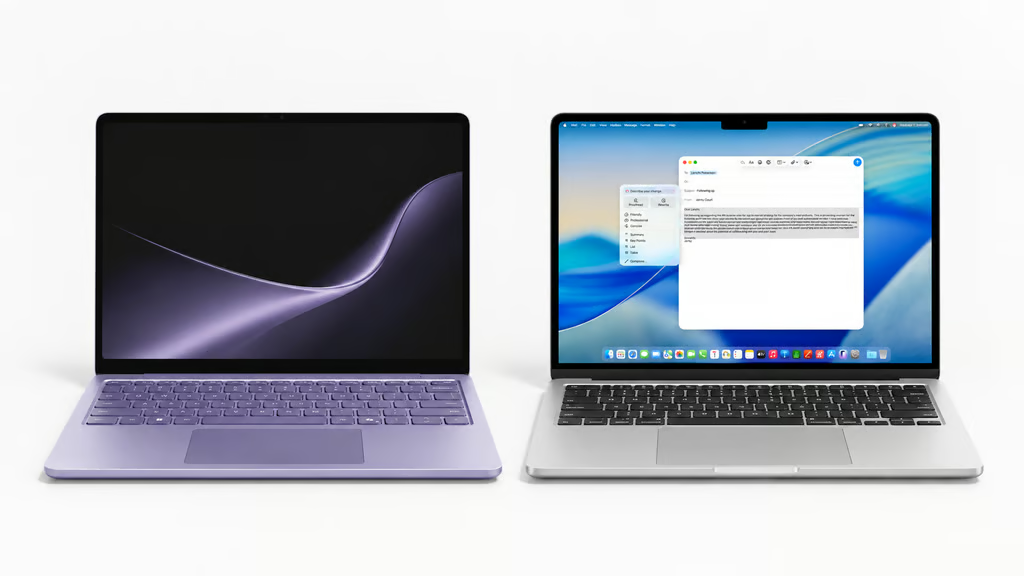
Microsoft’s latest Surface Laptop makes the MacBook Air decision harder, but Apple still has a price advantage. The new 13-inch Surface Laptop with Snapdragon X2 Plus arrives Oct. 13, nearly seven months after the M5 MacBook Air went on sale.
Microsoft’s laptop starts at $1,199.99, while Apple’s 13-inch MacBook Air starts at $1,099. The Air also includes 512GB of storage at that price, double the Surface’s 256GB.
For work, the choice extends beyond price and processor specs. Windows-on-Arm compatibility, ports, battery life, and existing software can outweigh benchmark claims, particularly as Microsoft’s Snapdragon X2 Plus Surface lineup adds more local AI processing to its compact PCs.
| Surface Laptop 13-inch X2 Plus | MacBook Air 13-inch M5 | |
|---|---|---|
| Starting price | $1,199.99 | $1,099 |
| Memory | 16GB | 16GB unified memory |
| Storage | 256GB UFS | 512GB SSD |
| Display | 13-inch, 500-nit touchscreen | 13.6-inch, 500-nit Liquid Retina |
| Ports | 2 USB-C 3.2, USB-A, headphone jack | 2 Thunderbolt 4, MagSafe, headphone jack |
| Battery claim | Up to 22.5 hours video | Up to 18 hours video |
| OS | Windows 11 on Arm | macOS 27 Golden Gate |
How we compared them: We evaluated current US pricing and specifications from Microsoft and Apple, along with platform-compatibility guidance. Because the Surface has not shipped yet, matched independent testing against the M5 MacBook Air is unavailable, so recommendations prioritize confirmed specifications and work requirements over vendor performance claims.
Surface vs. MacBook Air: What matters for work
The biggest split is the operating system. Microsoft says most Windows applications run on Arm either natively or through emulation, but apps and peripherals that depend on drivers still need Arm-compatible drivers. Its Windows-on-Arm guidance makes compatibility checks important for specialized hardware, antivirus, printing, virtualization, VPN, and endpoint security tools.
That supports a broader rule for choosing business laptops for AI workloads: hardware should match the applications employees actually use rather than processor or NPU specifications alone.
Price favors Apple at comparable capacity. Microsoft’s Surface configuration page lists the 16GB/256GB model at $1,199.99 and the 16GB/512GB model at $1,299.99. Apple’s M5 MacBook Air announcement confirms a $1,099 starting price with 16GB of unified memory and 512GB of storage, putting the similarly configured Surface $200 higher.
The hardware trade-offs are mixed. Surface adds a touchscreen and USB-A, while the Air offers Thunderbolt 4 and MagSafe. Apple’s M5 MacBook Air also supports macOS 27 Golden Gate, Apple’s current major Mac operating system.
Microsoft rates the Surface for up to 22.5 hours of local video playback, compared with Apple’s claim of up to 18 hours for the Air, but the companies use different test methods. Microsoft also says the X2 Plus Surface delivers up to 17% faster Office productivity and up to 95% faster local AI inference than the previous generation; those figures come from its Surface performance testing, not a head-to-head test against the M5 Air.
For businesses, that AI hardware is only as useful as the software and workflows that can use it, a consideration that extends beyond the AI PC itself.
Which laptop should you buy for work?
Choose the Surface if Windows is required, touch or USB-A matters, or critical business tools have already been verified on Windows on Arm. Choose the MacBook Air if Windows is unnecessary and lower pricing, 512GB of base storage, Thunderbolt 4, or an existing Apple workflow carries more weight.
At comparable memory and storage, the MacBook Air offers the stronger value on paper. The Surface becomes more compelling when Windows compatibility and its hardware advantages justify the higher price; independent testing after Oct. 13 should provide a clearer performance and battery comparison.
Also read: For more fleet-focused choices, compare the best enterprise laptops for secure, manageable deployments, including models evaluated for security, manageability, AI capabilities, and lifecycle needs.