


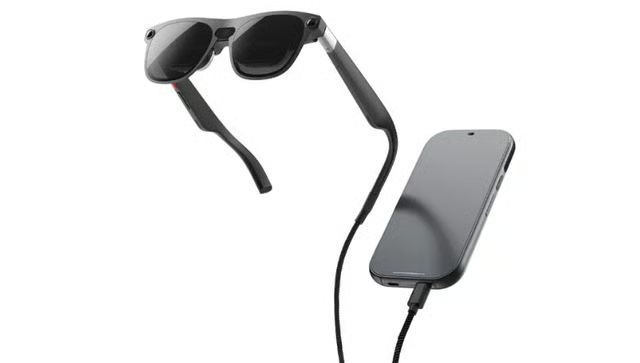
Google and XREAL want to make spatial computing something users can carry in a bag rather than wear as a bulky headset.
The companies unveiled XREAL AURA at Google’s Android Developer Summit on Wednesday, introducing wired Android XR glasses designed for virtual workspaces, entertainment and gaming. Powered by Qualcomm’s Snapdragon Reality Elite platform, the glasses start at a promotional price of $1,099, with shipments expected in mid-November.
Unlike standalone headsets, AURA relies on a separate compute puck connected by cable. That design makes the glasses relatively lightweight, but buyers must decide whether the portability and virtual-screen capabilities justify the price and additional hardware.
A portable workspace without a physical monitor
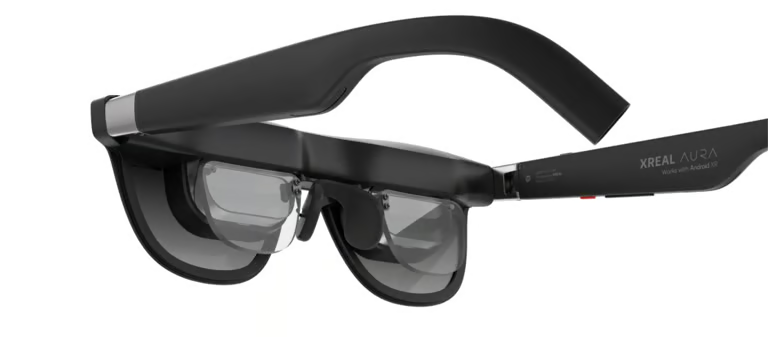
The AURA uses transparent lenses to overlay digital content onto the wearer’s view of the surrounding environment. Its Sony Micro-OLED displays offer 1,920-by-1,200-pixel resolution per eye and a refresh rate of up to 120 Hz, with a 70-degree field of view, according to XREAL.
Unlike a self-contained headset, the glasses connect to a separate compute puck that houses the battery and much of the processing hardware. The glasses weigh less than 95 grams, although users must also carry the puck and its cable.
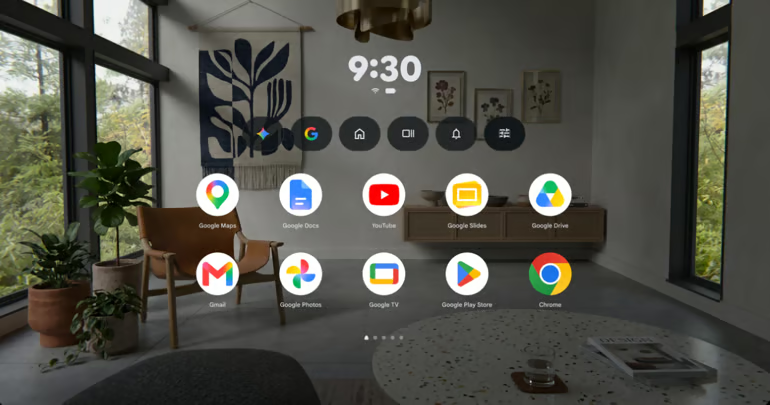
Android XR provides access to Google Play apps, including more than 150 experiences designed for XR. Users can arrange multiple virtual windows, connect a Bluetooth keyboard and mouse, and mirror a compatible laptop through USB-C without installing additional software.
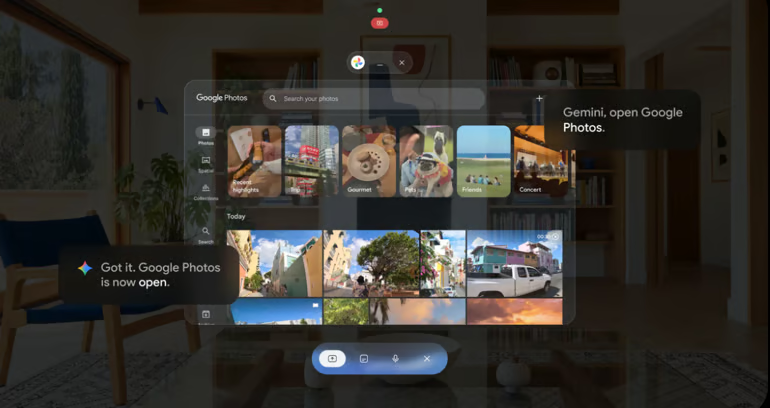
Gemini can also interpret content in the user’s view, including mirrored laptop screens, and provide contextual assistance. For entertainment, the glasses support streaming services, immersive videos and games, with dimmable lenses for adjusting how much of the outside world remains visible.
Enterprise uses extend beyond entertainment
Beyond movies and gaming, AURA could appeal to businesses that want employees to access digital information while remaining aware of their physical surroundings.
XREAL lists enterprise software such as Frontline.io for remote assistance and maintenance workflows, ShapesXR for spatial design, and apoQlar’s HoloMedicine for viewing medical scans as interactive 3D models.
These applications could help technicians, designers and clinicians work with complex information in their field of view.
However, the launch announcement does not establish how these tools perform in real-world deployments or whether businesses can integrate them with existing systems at scale. Organizations will need to assess software compatibility, data protection and employee comfort before deploying the glasses widely.
What's hot at TechRepublic
- Blackpoint Cyber vs. Arctic Wolf: Which MDR Solution is Right for You?
- Why AWS Sellers Choose Deepgram Over Other Voice AI Tools
- SS&C Intralinks DealCentre AI vs. Datasite: Which platform is built for the future of dealmaking?
- SS&C Intralinks FundCentre AI vs. Juniper Square: Which platform better supports modern private markets fund managers?
- Verito vs. Rightworks: Which IT Provider Is Best for Your Firm?
What users should know before buying
The AURA’s biggest selling point is combining a personal, large-screen experience with awareness of the physical environment. Users can work on a laptop in a cramped space, watch films while traveling or play games without carrying a conventional monitor.
But the setup still depends on a wired connection and a separate compute puck. That makes it less convenient than fully wireless glasses, and the starting price puts it firmly in premium territory.
XREAL lists two configurations: 12GB of memory with 256GB of storage for $1,279, discounted to $1,099 through December 2026, and 16GB with 512GB for $1,499, discounted to $1,299. Orders are available through XREAL, with US orders also available through Best Buy.
| 12GB RAM / 256GB storage | $1,279 | $1,099 |
| 16GB RAM / 512GB storage | $1,499 | $1,299 |
XREAL says promotional pricing runs through December 2026. Orders are available through XREAL, with US availability also extending to Best Buy. Google says orders in Japan open Nov. 2, while the other three launch markets are already accepting orders.
Prospective buyers should also consider how they plan to use the glasses. Someone primarily interested in a portable laptop display may have different requirements from a developer building spatial applications or a business evaluating remote assistance.
Compatibility with existing devices, prescription lens options and comfort during extended sessions could be just as important as display resolution or refresh rate.
Ultimately, AURA offers a different approach to spatial computing: lighter glasses paired with a separate device that handles much of the processing. That could appeal to users who want virtual screens without wearing a conventional headset, but the wired design and premium price remain important trade-offs.
Whether AURA becomes a practical everyday device will depend on more than its display specifications. Comfort during extended use, compatibility with existing hardware and the usefulness of Android XR applications will determine whether the glasses can replace a physical screen for more than occasional tasks.
Other news: Humanoid robots are moving closer to real-world deployment in 2027, with Tesla, Figure AI, and Agility Robotics competing to bring the technology into factories and warehouses.