


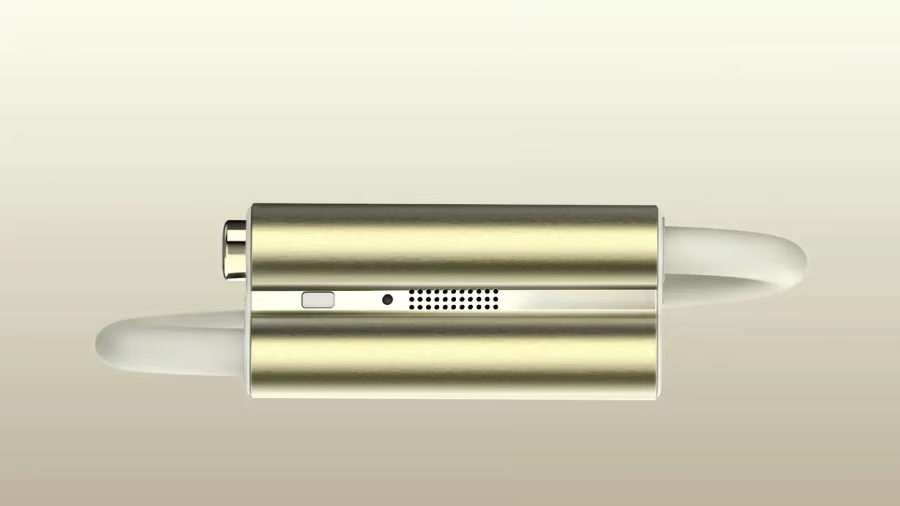
Checking whether an aging parent is okay could soon take fewer phone calls, thanks to a new wearable from Fitbit’s founders James Park and Eric Friedman.
Luffu Link is designed to let family members keep tabs on health, location, and safety via a screen-free band that stays connected even when the wearer’s phone isn’t nearby. It combines health sensors, GPS, LTE, and voice logging, so a wearer can record something as simple as taking medication or feeling unwell. At the same time, trusted contacts can receive check-ins, location information, or requests for help.
The bigger idea is to reduce the manual work involved in caring for relatives, particularly older adults who want to remain independent.
Rather than giving families another dashboard of health charts, Luffu says the device looks for meaningful changes in a person’s normal patterns and helps determine what changed, whether it matters, and whether someone else needs to know.
How Luffu Link works
At its core, Luffu Link is a health-and-safety sensor that works in the background. It tracks activity, steps, sleep, heart rate, and HRV, while GPS handles location. The device also has a physical button that lets users record voice updates about medication, symptoms, meals, or mood.
Luffu says its AI system learns a wearer’s normal patterns and looks for changes that may be meaningful, combining sensor readings with information such as voice logs. Its system learns a person’s normal patterns and looks for meaningful changes, while combining that information with voice logs and other health data rather than simply displaying another set of metrics.
The built-in 4G LTE-M and GPS are especially important for older users who may not always have their phones with them.
The company says the cellular plan is bundled with the device plan.
Privacy and accuracy are two big issues that need addressing
Luffu is landing at a time when privacy has become a major topic of debate in the wearables space. That concern could be a challenge for privacy-conscious individuals.
Accuracy is also a concern. Luffu’s AI relies on wearable data to detect changes in a person’s normal patterns. But sensor readings are not perfect, and a bad reading could lead to unnecessary worry or cause a meaningful change to be missed. That makes the reliability of both the underlying sensors and Luffu’s interpretation important to the product’s value.
What's hot at TechRepublic
- Blackpoint Cyber vs. Arctic Wolf: Which MDR Solution is Right for You?
- Why AWS Sellers Choose Deepgram Over Other Voice AI Tools
- SS&C Intralinks DealCentre AI vs. Datasite: Which platform is built for the future of dealmaking?
- SS&C Intralinks FundCentre AI vs. Juniper Square: Which platform better supports modern private markets fund managers?
- Verito vs. Rightworks: Which IT Provider Is Best for Your Firm?
When can users get access to the device?
The device was announced on Aug. 25 and is expected to begin shipping early next year at $300. Users who preorder can get it at $250. More importantly, the device is currently limited to the U.S.
The founders also intend to extend their push into the home with a separate device targeted at that market, according to TechCrunch.
What’s different about Luffu?
A good number of what Luffu does is already done so well by several smartwatches and Google Fitbit. However, Luffu argues that existing health technology is generally designed for a single individual.
Health information is often scattered across wearables, medical portals, medication records, calendars, messages and other places, leaving one family member to piece together what is happening with a parent, child, partner or another loved one.
Whether Luffu Link succeeds may therefore depend less on whether its sensors can compete with an Apple Watch or Fitbit and more on whether families find its shared-care model useful enough to justify another wearable — and trust it with the sensitive information required to make that model work.
With shipments expected to begin early next year, the bigger test will come when Luffu moves from explaining how AI-assisted family monitoring should work to showing how reliably it works in everyday life.
More News: Several Apple, Google, and Samsung smartwatches are approaching software-support cutoffs in 2026, although some devices may continue receiving security fixes after major OS upgrades end.