
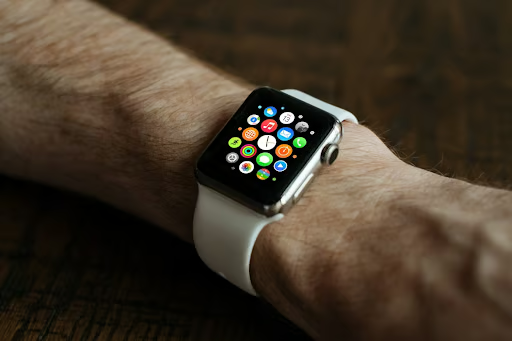


The next Apple Watch may eventually lose the one feature that has defined it from the start: its screen.
According to Bloomberg’s Mark Gurman, Apple’s industrial design team has been exploring several ways to overhaul the Apple Watch, including devices without screens, new display designs and additional sizes and price tiers. The company has not committed to any particular approach, and a major redesign is not expected in the immediate future.
Still, the exploration could represent one of the biggest changes to the Apple Watch since its launch in 2015, and help the company achieve new ways to compete in a rapidly changing health and fitness market.
Apple is looking beyond the traditional smartwatch
According to Bloomberg, Apple is taking the mounting popularity of screen-free fitness devices and smart rings seriously as it evaluates the future of its wearable lineup.
Devices such as Whoop bands and Oura rings have shown there is demand for smaller wearables built around passive health tracking rather than apps, notifications, and frequent screen interaction. A screenless Apple device could give the company a more direct competitor in that category while leaving the traditional Apple Watch to serve users who want a full smartwatch.
Apple has also reportedly explored different display types and sizes. A circular Apple Watch has been considered, although Gurman said such a device is unlikely to eventually ship.
Still, the potential changes would give Apple more ways to serve different types of wearable users rather than relying on its familiar rounded-rectangle Apple Watch design.
Health and AI may become the bigger differentiator
Apple is also reportedly considering changes to the number of wearable devices it offers.
At the premium end, the company could introduce a device positioned above its existing Ultra and Hermès models. At the budget end, Apple could introduce additional affordable options beyond the Apple Watch SE.
That approach could allow Apple to target a wider range of consumers while creating more opportunities to sell wearable devices across different price points.
Rather than relying on annual Apple Watch upgrades, Apple could use multiple form factors and price points to expand the number of consumers using its wearable technology. Introducing these options could help Apple reach consumers who don’t want to spend hundreds of dollars on a smartwatch while also giving existing customers more reasons to upgrade to premium devices.
The reported experimentation comes as Apple looks to reinvigorate its Wearables, Home and Accessories business. A broader product strategy could help Apple respond to competitors that are approaching wearable technology differently.
AI and health could become more important
The biggest change may ultimately have less to do with the Apple Watch’s physical design and more to do with what the device does with the information it collects. Bloomberg reported that Apple is also expected to place greater emphasis on artificial intelligence and health features across its wearable ecosystem.
Those changes could turn the Apple Watch from a device primarily used to record health data into a more proactive tool that interprets that health information and provides personalized guidance. Instead of simply recording activity, heart rate, or other metrics, future Apple wearables could use AI to analyze that data and provide users with more personalized insights.
That puts Apple in competition with a growing group of health-focused wearable companies that emphasize continuous monitoring and AI-powered coaching rather than apps and notifications.
Furthermore, Apple already has a massive hardware and software ecosystem, giving it the ability to connect wearable health data with the iPhone, Health app, and other services. Instead of simply functioning as an accessory to the iPhone, future Apple wearables could increasingly serve as platforms for collecting and interpreting health information.
Major changes aren’t expected this year
Despite the potentially significant long-term plans, consumers should not be hoping for a radically redesigned Apple Watch at Apple’s upcoming September event.
According to Gurman, the Apple Watch Series 12 and Apple Watch Ultra 4 expected in 2026 are likely to receive more incremental updates, including a new chip, health and fitness improvements, new colors and bands, and possibly the return of ceramic cases.
A major redesign could still be a year or two away, which means Apple’s current smartwatch design is likely to remain in place while the company works on what comes next.
But Apple’s willingness to consider these changes is significant. The company’s exploration of screenless devices, new form factors, additional price tiers and AI-powered health features suggests that it believes the wearable market is changing, and that simply adding incremental features to the existing Apple Watch may not be enough to maintain growth.
For now, the most ambitious ideas remain experiments rather than a confirmed product roadmap. But their breadth suggests Apple is considering a future in which the Apple Watch is only one part of its wearable business — alongside devices built for different prices, form factors and levels of interaction.
Whether any of those concepts reach consumers will determine whether Apple’s next major wearable shift is another Apple Watch redesign or something that no longer looks like a watch at all.
Other News: Motorola has patented a flexible wearable that could transform from a smartwatch into a smartphone, although the company has not announced plans to bring the concept to market.