


Apple’s AR headset, Vision Pro, was unveiled during its Worldwide Developers Conference in 2023 after years of anticipation and has since become one of the most talked-about pieces of tech on the market.
Despite the fact that Vision Pro can deliver immersive mixed reality and VR experiences, the headset is designed not to immerse users in a virtual world, but rather to augment reality.
During WWDC 2024, Apple revealed the Vision Pro would be made available to other countries and regions outside the U.S. beginning June 28. The AR headsets will be shipped to mainland China, Hong Kong, Japan and Singapore on June 28, and the U.K., France, Germany, Australia and Canada on July 12.
We break down the details about Apple’s Vision Pro, including pricing and the AR headset’s main features.
What is the price of Apple’s Vision Pro?
The price of Apple’s Vision Pro with 256GB of storage starts at $3,499, which is more than three times the price of its main competitor — Meta’s Quest Pro VR headset, which starts at $999.99.
The Apple Vision Pro can also be purchased in 512GB and 1TB storage options, starting at $3,699 and $3,899, respectively.
The 246BG version will be priced in the U.K. at £3,499.
When is the release date of Apple’s Vision Pro?
The Vision Pro has been available in the U.S. since February 2, 2024.
Pre-orders for the Apple Vision Pro open in mainland China, Hong Kong, Japan and Singapore on June 13 at 6 p.m. PT, with availability beginning June 28.
Customers in Australia, Canada, France, Germany and the U.K. will be able to pre-order Apple Vision Pro beginning June 28 at 5 a.m. PT, with availability beginning July 12.
What are Vision Pro’s main features?
Vision Pro (Figure A) offers a wide range of features. From virtual meetings and highly rendered avatars to 3D images, AR computing and film viewing on a big screen, Vision Pro is designed to seamlessly blend digital content with a user’s physical space.
Figure A
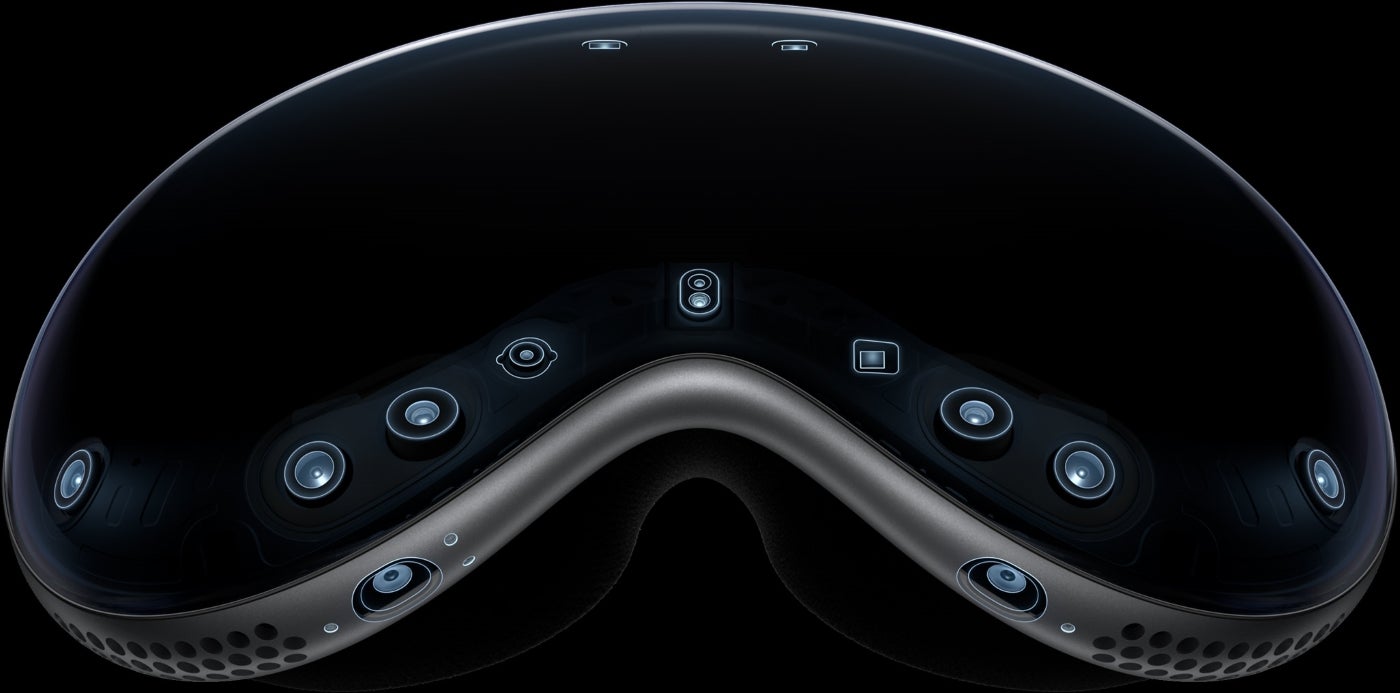
“It’s the first Apple product you look through, not at,” CEO Tim Cook said during the product presentation. Cook added that Vision Pro would introduce spatial computing like how the iPhone introduced mobile computing.
Graphic user interface
The user interface of Vision Pro mimics that of a Mac or an iPhone, but in 3D. Users wearing the headset see icons, graphics, websites, photos and movies as floating screens at a distance from their eyes. Displays are the size of a postage stamp, but these deliver more pixels than a 4K TV to each eye. The custom micro-OLED display system features 23 million pixels, providing excellent resolution and real-life colors.
A new computer, apps and camera
During WWDC23’s keynote, Apple showed how users can seamlessly connect a keyboard and use Vision Pro as a traditional computer that offers multiple large displays (Figure B).
Figure B
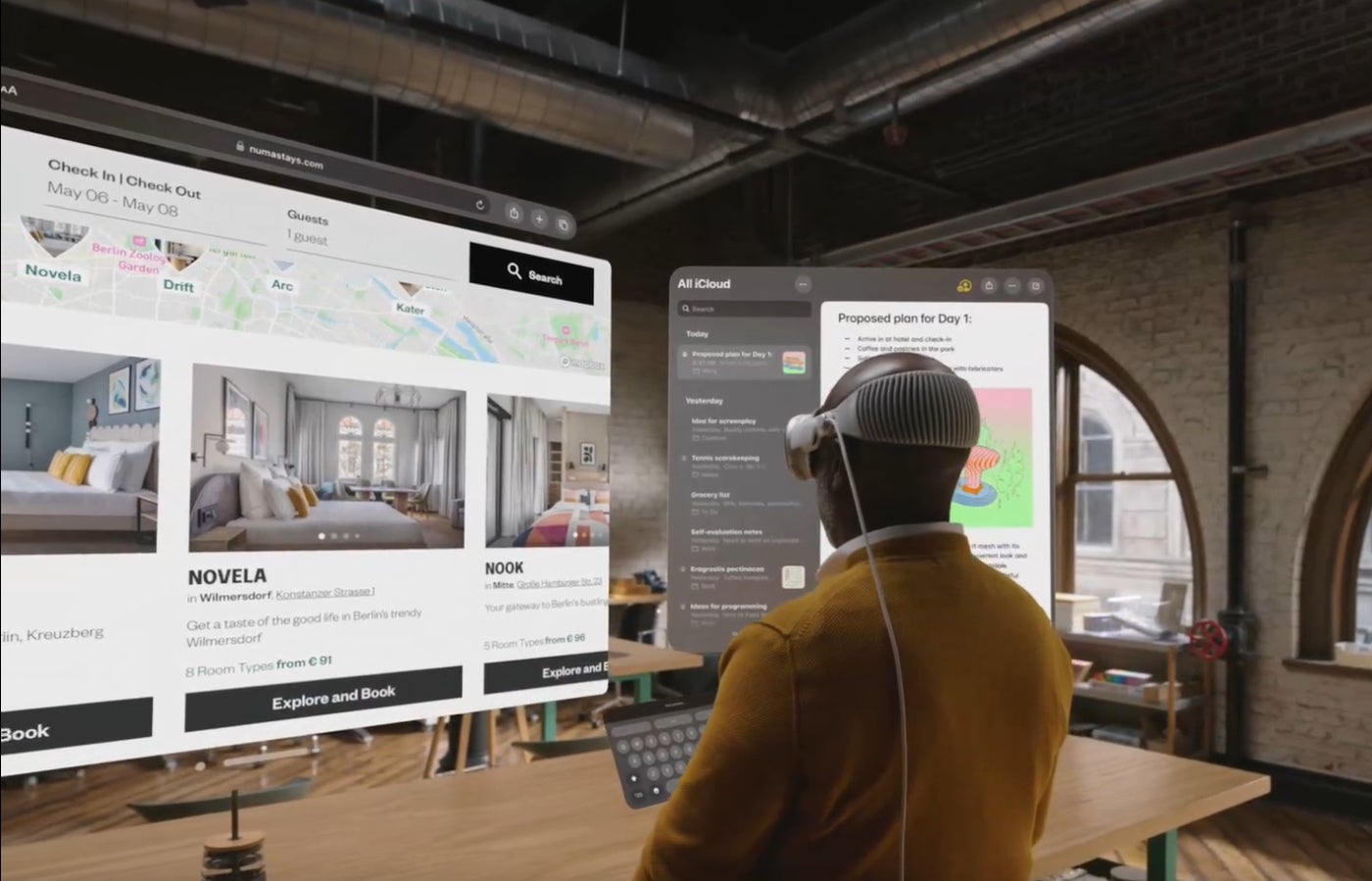
With Vision Pro, users can customize how they see their apps. For instance, apps can be arranged and scaled in size, and workspaces can be designed for personal needs. While using apps, browsing on Safari, chatting on Messages or working, users can switch between apps quickly, always staying present in the real world.
Another function in Vision Pro allows users to use a three-dimensional camera and a microphone system to capture videos and pictures in 3D. This is the first 3D camera Apple has ever built. It includes panoramas that wrap around the user.
The R1 chip
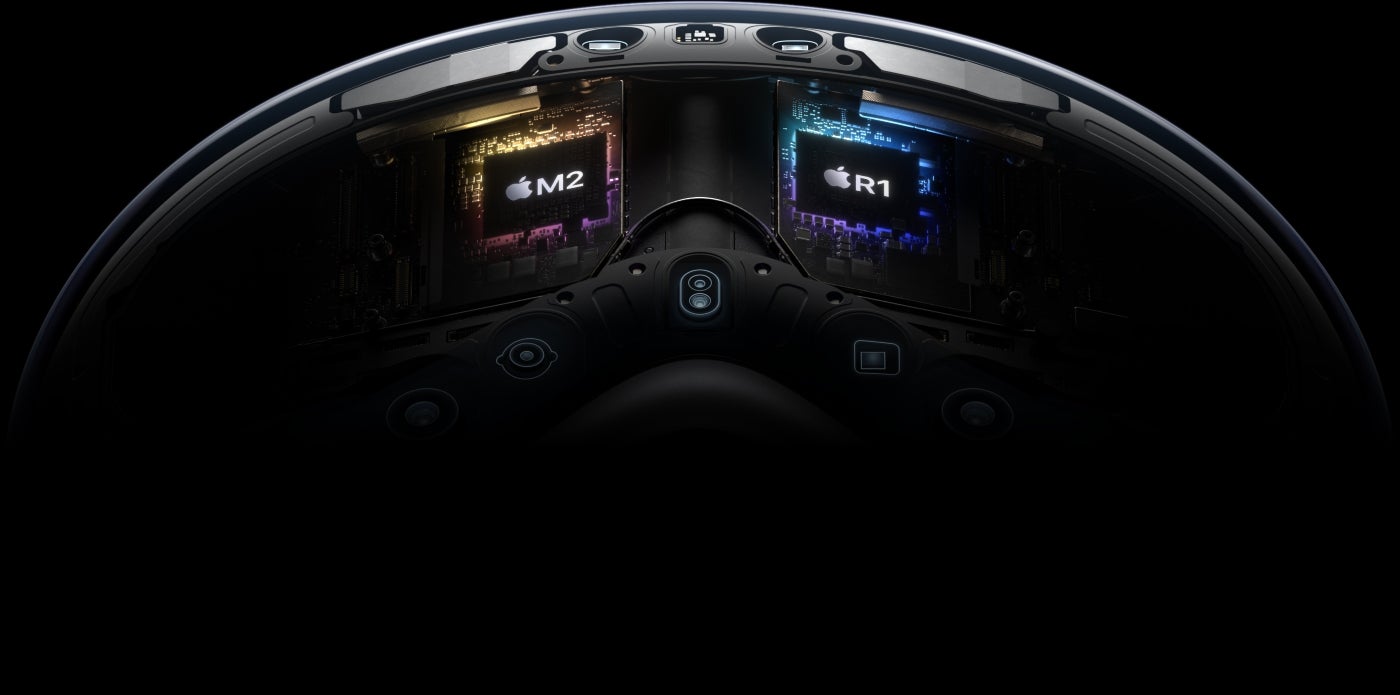
The Vision Pro experience is possible thanks to two chips: the powerful M2 and R1, a new and exclusively developed real-time chip. R1 is responsible for processing all the data from the sensors and cameras in the blink of an eye, along with real-time 3D mapping and eye-tracking (Figure C).
Figure C
Navigating Vision Pro: Hand gestures and digital crown
The R1 chip takes all the data from sensors, cameras and microphones embedded in Vision Pro and creates head, eye and hand tracking. Users can select content inside the goggles with their eyes, tap their fingers together to click and gently flick to scroll. Using the digital crown, users can bring up the Home View or control the level of immersion while using Environments, a feature that creates virtual backgrounds.
Product design
The design for the enclosure is a singular piece of 3D-formed laminated glass that morphs into an aluminum alloy frame and gently curves to wrap around a user’s face. The headset’s exterior display can also reveal the user’s eye to people in the outside world or fully darken when the user is submerged in virtual reality (Figure D).
Figure D

Spatial Audio
Vision Pro analyzes an environment’s acoustic properties, including the physical materials, to adapt and match the sound to the space. This is used to create ambient Spatial Audio, where sounds feel like they are coming from the surroundings.
Apple assures that the Spatial Audio system of Vision Pro is the most advanced it has ever created. Dual-driver audio pods are placed close to the users’ ears, blending the sound generated by the headset with the sounds of the real world.
AR FaceTime
Vision Pro takes virtual meetings to the next level with life-size FaceTime video tiles. The call expands into the room, and the headset allows users to use apps to collaborate with colleagues or work on the same documents while in a meeting.
Zoom
Zoom video conferencing has a Vision Pro native app that allows users to be represented by 3D digital avatars in Zoom that mimic real face and hand movements. Other capabilities include the option to share 3D files and objects and “pin” personas in a physical space around them.
Battery
Vision Pro has two hours of use with an external battery, which is not placed inside the headset to reduce the weight on the user’s head. The device must be plugged into the wall or battery pack.
Home theater
Although Apple’s new headset is through AR technology, it does have several virtual reality features, such as its immersive home theater. Vision Pro can transform any room into a personal theater.
For developers
Developers can submit apps to the Apple Vision Pro’s App Store here. Apple notes that most iPadOS and iOS apps are compatible with Apple Vision Pro by default. Apple provides a way to check whether an app is compatible with the headset’s operating system, visionOS.
Must-read Apple coverage
- Nearly 7 in 10 iPhone Owners Plan iPhone 17 Upgrade
- Apple Prepares AI-Powered Siri Upgrade With Google Search Integration
- Apple’s Xcode 26 Beta Now Supports GPT-5 and Claude
- Apple’s Vision Pro Adoption Stalled As Content Released ‘Drip by Drip’
What apps are available for Apple’s Vision Pro?
A wide variety of apps for work and entertainment are available for the Vision Pro. More than 2,000 spatial apps have been built for Vision Pro that take advantage of AR or VR so far, and more than 1.5 million iOS and iPadOS apps are compatible.
Microsoft’s 365 apps can be used on the Apple Vision Pro, bringing PowerPoint, Excel, Word and other productivity tools. Microsoft Copilot can provide generative AI and natural language voice commands.
visionOS 2
visionOS 2 is the latest software update for Vision Pro and was announced at WWDC 2024. The operating system will be made available this fall and brings a host of new features and capabilities to the headset, including:
- Simplified gestures for interacting with Home View and Control Centre.
- Apps in Home View can be rearranged to a preferred layout.
- Travel Mode, where some of the sensors are turned off to stabilize the visuals, is supported on trains in addition to airplanes.
- 2D photos in the Photos app can be converted into spatial photos that appear 3D.
- Spatial videos can be edited on Final Cut Pro and uploaded to Vimeo.
- Volumetric APIs for running 3D apps side-by-side, TabletopKit for creating table-based experiences, and HealthKit for health and wellbeing-related APIs made available to developers.
- Content can be cast into the headset from an iPhone, iPad or Mac using AirPlay.
- Videos played in Safari can be watched from an “Environment” where your physical surroundings are transformed into a different place, like Bora Bora or the Moon.
- Live captions are available system wide, for both live conversations and audio in apps.
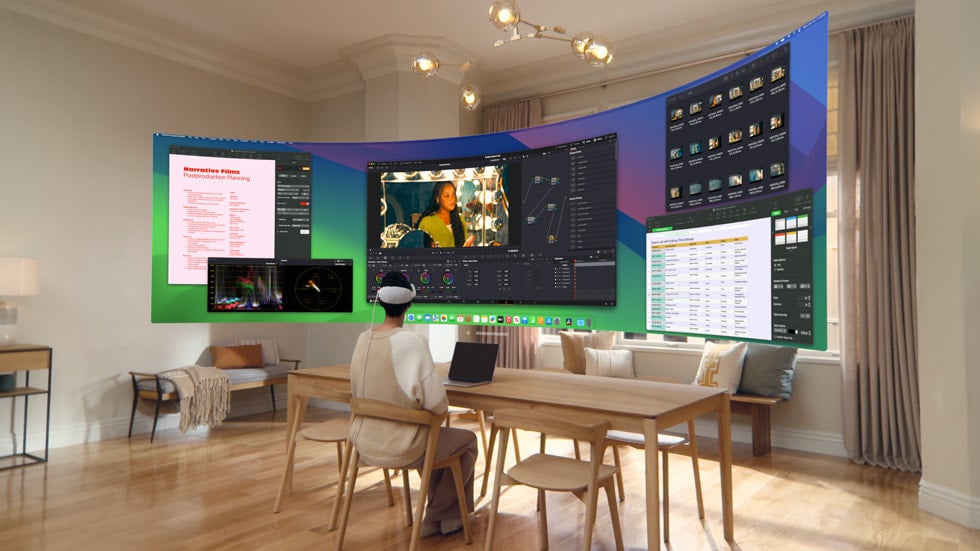
- Mac Virtual Display, which lets you view your Mac screen on the Vision Pro, expands to the equivalent of two 4K monitors side by side (Figure E).
Figure E
Bottom line about Apple’s Vision Pro
Vision Pro is one of the most anticipated products Apple has ever launched. Unfortunately, the AR headset’s price is very high compared to alternatives. Additionally, despite a very well-achieved design, Vision Pro is clunky. Sony announced a competing headset at CES 2024, which is known for now as the “spatial content creation system” and is intended for use by 3D artists and animators.
However, the new Apple headset proves revolutionary in its approach to AR technology and appears to bring the quality that Apple is known for to this new market.
Editor’s note: This article was updated by Fiona Jackson.