


Image: Shutterstock/Dallasetta
Social media platforms deliver a lot of helpful, actionable information for both professional and personal use. But there’s no shortage of unreliable data and false information out there—and that can lead to serious negative consequences. In the financial field, for example, a false report can quickly lower the value of stocks. In the scientific sphere, misinformation or unreliable data can slow down important research, even producing false conclusions. As a result, it’s critical for businesses and users to know how to gauge the accuracy of social media information. The following recommendations can help your business and your social media or PR team.
SEE: Social media policy (TechRepublic Premium)
Must-read leadership coverage
- Shark Tank’s Mr. Wonderful is Building the World’s Largest AI Data Center in Canada
- Why It’s Time to Rethink Your Device Strategy for the AI-Powered Workplace
- Why Snapdragon is Built for the Next Enterprise Frontier
- Sustainability Goals Are Set—So Why Aren’t They Being Met? Closing the IT Operations Gap
Start with the basic facts
When it comes to evaluating the veracity and reliability of information on social media, users should raise some basic questions.
What is the source of the information?
- Is the source a highly trusted media outlet, a well-established journalist, a worldwide known expert?
- Is the source an identifiable individual or an anonymous poster?
- Does the information come from an account that’s existed for years, months or just a few days?
- Is the content in its original form, or is it an abstract or capture? Users should always consider the original source.
- Does it make sense that the person sending the information was near the location of a reported event?
What is the context of the information released?
- What is the date of publication?
- Is the information published on a well-regarded website or a poorly moderated, obscure site?
- If the information is related to an event, is the event real? Can you verify that it happened?
What is the motivation behind the information?
- Why was the information released? If the motives behind a publication are blurry, it might be a deliberate attempt to spread misinformation. It could also be an attempt to attract as many viewers as possible, for financial purpose (e.g., paid ads).
- Why was the account created, what content does it usually provide, and is the information in line with the profile posting it?
SEE: 9 key security threats that organizations will face in 2022 (TechRepublic)
Use search engines and fact checkers
- Hunting on search engines can often reveal that information is false or fake:
- Search for the location—does it actually exist?
- In the case of an event, search to determine whether it exists and if it ever happened at all.
- Search for the author to get a first feel; then, if nothing special pops up, search for the author’s name with more keywords like “fake” or “misinformation.”
- Search for quotes, if any, to see if they’ve already been used before and where. If they have, try to determine the original context. It might be reused out of context to serve a different purpose than the initially intended one.
- Verify claims.
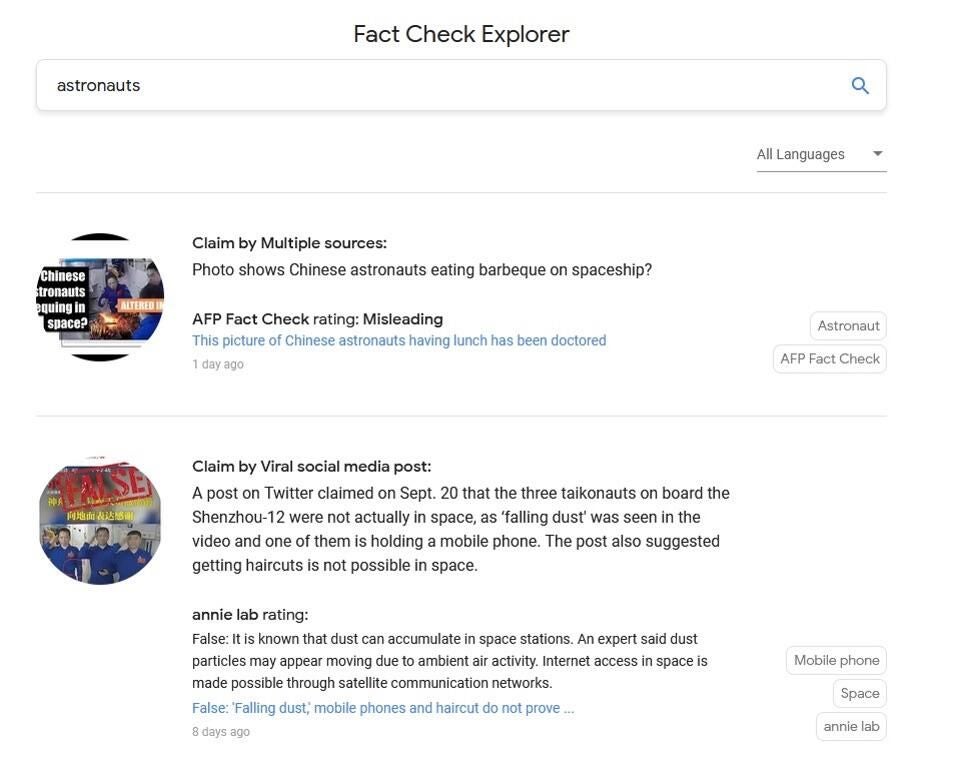
- Use fact checkers like Google Fact Check Tools (Figure A).
Figure A
Use specialized tools to verify those facts
Images and videos
- In the case of a picture or video, where was it taken? Is the photo an original one, or has it been used before?
- If the picture contains specific words, don’t hesitate to google them.
- Use reverse image search engines like Google Images, TinEye or Yandex to find previous use of the same image. They might reveal that picture was used years ago for something completely different. Reveye plugin for Chrome is a helpful tool since it allows you to search through several reverse search engines with a click.
- Use tools that let you reverse-search videos as well as photos. InVID verification plugin for Chrome and Firefox is one popular and helpful free tool for this.
- Check carefully for details: If a logo is used, is it the usual one for the publisher? Is it located in the usual position? Does the title appear in the same font as usual? Any detail can be important and help reveal that a video or picture has been modified/forged.
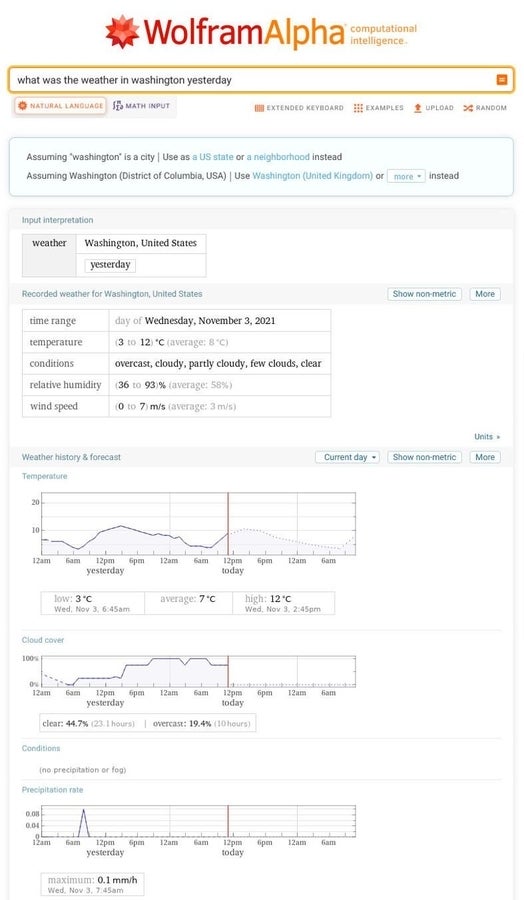
- Suncalc.org can show you the angle of the sun on any given day anywhere in the world, so you can check against the exact time a video or photo was taken. To further verify the weather according to a date, WolframAlpha can show precise data if you ask it what the weather was like on a particular day at a precise place (Figure B).
Figure B
Information author
- Look at the accounts used by the author. Can they be correlated to other activities online? Can they be tied to other accounts?
- Do a reverse image search on the author’s avatar/picture to find potential additional material online that might help determine whether the profile is aiming for misinformation or spreading fake information.
- Check the contact information. Does it exist elsewhere?
- Does the person have a presence on professional social networks like LinkedIn?
- Use social media-dedicated tools to get a wider view of the author. For example, if you need to investigate a Twitter account, Twitonomy can be really helpful by providing statistics and more data on the poster.
The content
- Is the content exhibited the usual way, with the same logos/titles?
- Does the content have spelling/grammar mistakes?
- Can all the important facts be verified easily?
- Are numbers and statistics provided without troubling details, like a poster from the U.S. writing all distances in kilometers or all amounts of money in Euros?
A great number of tools are available online to dig more into fact checking and verify the authenticity of data. Bellingcat maintains an Online Investigation Toolkit page that lists a lot of these tools and services. While some are easy to use, others need a bit of technical knowledge and are more appropriate for information professionals. First Draft also maintains such a page, and the Verification Handbook for disinformation and media manipulation is a good resource.
Deepfakes
Deepfakes are images, videos or audio data that are so cleverly altered by artificial intelligence generative adversarial networks to look like someone else that it’s hard to tell they’re not real. Fake content has existed for many years, but deepfakes take it one step further by leveraging machine learning and AI.
SEE: Deepfake reality check: AI avatars set to transform business and education outreach (TechRepublic)
Microsoft and other companies are currently working on systems that can tell if a video or photo has been tampered with—or not. These systems, instead of proving that a content has been tampered with, will prove that a content has not been altered.
How social media information can impact companies
False news and misinformation can lead companies working in competitive fields to modify their plans, alter their roadmaps, and change the release date of their products. It can also cause customer loss or have a strong financial impact.
As an example, the case of a 62-year old Scottish trader shows how easy it can be to manipulate stocks. The trader created Twitter accounts looking like real Twitter accounts of well-known securities research firms, before starting to tweet about two particular companies. He suggested in several tweets that one of the companies was under federal investigation, making its share price fall by 28% before the Nasdaq temporarily halted trading. He then produced the same kind of tweets to target another small company, whose share price dropped by 16%. Several tweets from a few Twitter accounts affected shareholders, who lost more than $1.6 million.
Other cases have shown that distributing misinformation and fake news to manipulate companies, customers, investors and shareholders is becoming increasingly common.
Conclusion
It takes different levels of expertise to get evidence that determines whether information is true; however, most of the misinformation spread on social media is easy to spot with the techniques and advice discussed in this article. If you find what you believe is fake news, you can help stop its spread; for instance, you can report misinformation about the coronavirus to the World Health Organization.
Disclosure: I work for Trend Micro, but the views expressed in this article are mine.