


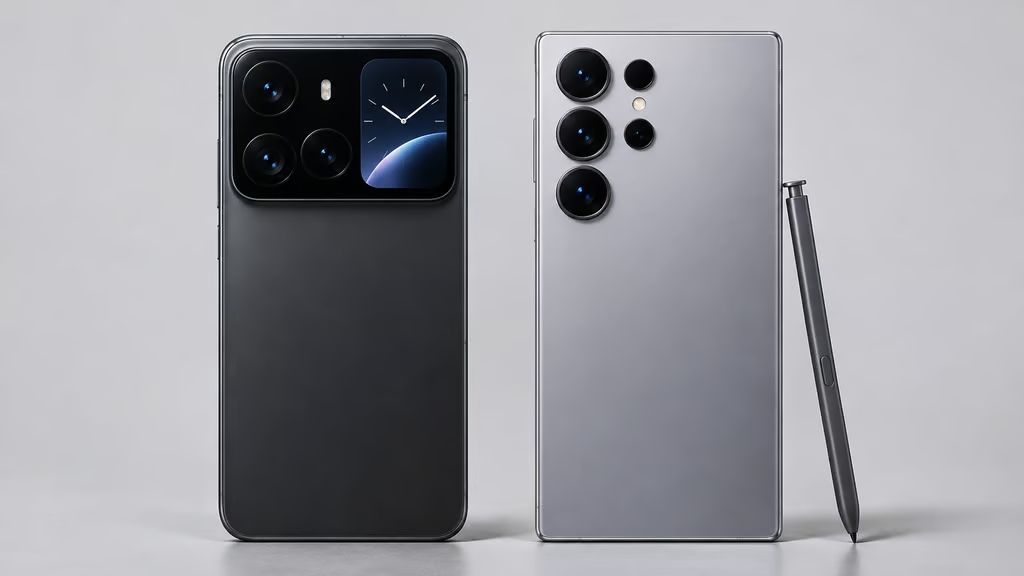
Xiaomi’s latest flagship has a bigger battery, a newer processor, and a second screen on the back. But are those enough to make it a better buy than Samsung’s Galaxy S26 Ultra?
The Xiaomi 18 Pro Max debuted in China in September with an 8,500mAh battery, dual 200-megapixel rear cameras, and Qualcomm’s Snapdragon 8 Elite Extreme Gen 6 processor. Samsung’s Galaxy S26 Ultra, released in March, offers an integrated S Pen, four rear cameras, and seven years of promised software support.
With Xiaomi confirming a global rollout for November 2026, buyers have another premium Android option to consider. The decision comes down to which features matter most and whether Xiaomi’s international models retain the hardware advantages of their Chinese counterparts.
- Xiaomi 18 Pro Max vs Galaxy S26 Ultra: Specs compared
- Performance: Xiaomi has the newer Snapdragon processor
- Cameras: Xiaomi’s higher resolution faces Samsung’s zoom versatility
- Battery and charging: Xiaomi’s biggest advantage
- Display and productivity: Rear screen or S Pen?
- Software and security: Samsung offers clearer long-term support
- Price and availability: Xiaomi’s global launch could change the equation
- Xiaomi 18 Pro Max vs Galaxy S26 Ultra: Which should you buy?
- Final verdict: Samsung is the safer buy for now
Xiaomi 18 Pro Max vs Galaxy S26 Ultra: Specs compared
Both smartphones feature 6.9-inch AMOLED displays, 120Hz adaptive refresh rates, and 200MP main cameras. However, they differ significantly in battery capacity, camera configuration, and productivity features.
| Feature | Xiaomi 18 Pro Max (China) | Samsung Galaxy S26 Ultra |
|---|---|---|
| Main display | 6.9-inch AMOLED | 6.9-inch Dynamic AMOLED 2X |
| Refresh rate | Up to 120Hz | Up to 120Hz |
| Processor | Snapdragon 8 Elite Extreme Gen 6 (2nm) | Snapdragon 8 Elite Gen 5 for Galaxy (3nm) |
| RAM | 12GB or 16GB | 12GB or 16GB |
| Storage | 256GB, 512GB, 1TB | 256GB, 512GB, 1TB |
| Main camera | 200MP | 200MP |
| Ultrawide | 50MP | 50MP |
| Telephoto | 200MP, 3.2x optical zoom | 50MP, 5x; 10MP, 3x optical zoom |
| Front camera | 50MP | 12MP |
| Battery | 8,500mAh | 5,000mAh |
| Wired charging | Up to 100W | Up to 60W |
| Wireless charging | Up to 50W | Up to 25W |
| Secondary display | 2.9-inch rear AMOLED | None |
| Operating system at launch | HyperOS 4, based on Android 17 | One UI 8.5, based on Android 16 |
| Built-in stylus | No | S Pen |
| Starting price | 6,999 yuan (China launch) | $1,399.99 (current US list price) |
Sources: Xiaomi’s official product page and Samsung’s Galaxy S26 announcement. Xiaomi specifications apply to the Chinese model; international configurations may differ. Samsung’s listed starting price excludes temporary discounts.
Performance: Xiaomi has the newer Snapdragon processor
The Xiaomi 18 Pro Max runs on Qualcomm’s Snapdragon 8 Elite Extreme Gen 6, a 2nm processor with clock speeds reaching 5GHz. Samsung uses the earlier Snapdragon 8 Elite Gen 5 for Galaxy, built on a 3nm process.
Xiaomi’s processor represents a generational upgrade, with Qualcomm introducing architectural improvements targeting performance, graphics, and AI workloads. Xiaomi also uses an upgraded cooling system designed to maintain performance during extended gaming sessions.
The Extreme chip includes additional capabilities for supported gaming and on-device AI workloads. These differences could make Xiaomi attractive to users running demanding games or intensive applications.
However, processor specifications do not tell the whole story. Actual speed depends on thermal management, software optimization, and how well applications use the available hardware. Independent testing is needed to establish how the phones compare under sustained workloads.
For everyday tasks such as email, browsing, video calls, and document editing, both devices offer high-end processing hardware. Buyers who do not regularly push their phones to their limits may see less benefit from Xiaomi’s newer chip.
Cameras: Xiaomi’s higher resolution faces Samsung’s zoom versatility
Xiaomi equips the 18 Pro Max with a 200MP main camera and a 200MP periscope telephoto lens with 3.2x optical zoom. A 50MP ultrawide camera completes its rear setup.
According to Xiaomi’s official specifications, the main camera uses a 1/1.28-inch sensor and LOFIC technology designed to preserve detail in scenes with bright highlights and dark shadows. The Leica-branded system also includes portrait and image-processing features.
Samsung’s Galaxy S26 Ultra uses a 200MP main camera, 50MP ultrawide camera, and two dedicated telephoto lenses offering 3x and 5x optical zoom.
The main difference is flexibility. Xiaomi’s 200MP telephoto sensor provides substantial image data for processing and cropping, while Samsung offers two distinct optical zoom options.
Samsung’s native 5x optical zoom also provides greater magnification than Xiaomi’s 3.2x lens. However, megapixel counts and optical zoom levels alone cannot determine which camera delivers sharper images.
For buyers who frequently photograph distant subjects, Samsung’s additional telephoto lens may be useful. Xiaomi’s high-resolution telephoto sensor could appeal to users who prioritize cropping flexibility and portrait photography.
Both manufacturers also promote AI-assisted imaging features, although image quality, stabilization, and low-light performance require direct comparison.
Neither phone can be declared the better camera system based on specifications alone.
Battery and charging: Xiaomi’s biggest advantage
Battery capacity is Xiaomi’s most significant hardware advantage.
The Chinese Xiaomi 18 Pro Max has an 8,500mAh silicon-carbon battery, compared with the Galaxy S26 Ultra’s 5,000mAh battery. It also supports up to 100W wired and 50W wireless charging, while Samsung supports up to 60W wired and 25W wireless charging.
Xiaomi therefore offers 70% more rated battery capacity on paper, along with higher maximum charging power.
That difference could matter to users who spend long periods away from power outlets or rely heavily on navigation, video recording, and other demanding applications.
However, battery capacity does not translate directly into equivalent gains in operating time. Processor efficiency, display settings, network conditions, and background processes all influence endurance.
There is also an important regional caveat.
Xiaomi has not confirmed that every international 18 Pro Max will retain the Chinese model’s 8,500mAh battery. Reports suggest some overseas configurations could have smaller batteries, making the final regional specifications particularly important.
A larger battery may give Xiaomi an advantage, but buyers should verify the exact model sold in their country before treating that specification as a deciding factor.
Display and productivity: Rear screen or S Pen?
Both devices offer large AMOLED displays suitable for watching videos, multitasking, and working with documents.
Xiaomi’s distinguishing feature is a 2.9-inch rear display built into the camera module. It can show selected notifications, widgets, and application functions while serving as a preview screen for selfies taken with the main cameras.
Samsung takes a different approach with its integrated S Pen, which supports handwritten notes, annotations, and precise on-screen interactions.
For content creators, Xiaomi’s rear screen may be particularly useful when recording videos or taking photographs without relying on the front-facing camera.
For professionals who review PDFs, annotate screenshots, or take handwritten notes, Samsung’s stylus offers a more directly productivity-focused feature.
Both manufacturers also emphasize privacy features, although their implementations differ.
Samsung’s Privacy Display can limit visibility from certain angles, helping protect sensitive information from nearby observers. Xiaomi offers privacy controls through HyperOS, although their availability and behavior may differ by market and software version.
These protections can be useful in public spaces, but they do not replace device encryption, access controls, or other established security measures.
Software and security: Samsung offers clearer long-term support
Hardware specifications matter less if a phone cannot reliably receive security updates or support essential applications over time.
Samsung promises seven generations of operating system upgrades and seven years of security updates for the Galaxy S26 series. That gives buyers a documented support commitment extending beyond the typical replacement cycle for many smartphones.
Xiaomi’s 18 Pro Max runs HyperOS 4, based on Android 17, with AI-assisted features and integration across supported Xiaomi devices. However, the company has not yet confirmed all international feature availability and software support terms for the phone.
That uncertainty matters for organizations planning to deploy devices over several years, especially as more than 1 billion older Android phones face security risks from outdated software, according to previous TechRepublic reporting.
Samsung also offers its Knox security and enterprise-management ecosystem, which can support device enrollment, security policies, and remote administration.
Businesses considering Xiaomi should check whether the international model meets their mobile-device-management requirements, application compatibility needs, and security update policies.
For IT teams, Samsung currently offers the more clearly documented enterprise support proposition. Xiaomi may still be suitable for business use, but its regional policies and management compatibility need verification.
Price and availability: Xiaomi’s global launch could change the equation
The Xiaomi 18 Pro Max launched in China at 6,999 yuan for the 12GB RAM and 256GB storage configuration, with higher-capacity models costing more.
Samsung’s Galaxy S26 Ultra launched in the United States at $1,299.99. Following an October price increase, its 256GB model carries a $1,399.99 US list price.
However, Samsung’s official US store currently advertises a $250 instant discount, reducing the unlocked 256GB model to $1,149.99 before taxes and other applicable charges. Promotional prices can change and may vary by configuration.
Comparing those figures directly would be misleading because they represent different markets, taxes, distribution arrangements, and warranty conditions.
Xiaomi confirmed plans for a global launch in November, with rollout preparations underway in several Southeast Asian markets. As Singapore, Malaysia, and Thailand prepare for the Xiaomi 18 Pro series, regional pricing, configurations, and sales dates remain important details for prospective buyers.
Official availability is particularly important for those concerned about warranty service, repair support, cellular compatibility, and locally supported software.
Importing a Chinese model may offer earlier access, but potential savings should be weighed against those limitations.
Until Xiaomi confirms final international prices and specifications, Samsung remains the more straightforward option for buyers who need a phone immediately.
Xiaomi 18 Pro Max vs Galaxy S26 Ultra: Which should you buy?
The two devices offer different strengths, making the decision relatively straightforward for buyers with clear priorities.
Choose the Xiaomi 18 Pro Max if:
- Battery capacity and faster charging are your main priorities.
- You want the latest Snapdragon processor for demanding applications.
- You value high-resolution telephoto photography and a rear camera-preview screen.
- You are willing to wait for confirmed international pricing, specifications, and availability.
Choose the Samsung Galaxy S26 Ultra if:
- You regularly use a stylus for notes, annotations, or productivity.
- You want a documented seven-year software support commitment.
- You prefer dedicated 3x and 5x optical zoom cameras.
- You need established enterprise-management features and official local support.
- You want a premium Android phone that is already available.
Beyond Samsung, the Xiaomi 18 Pro Max also faces competition from the OPPO Find X10 Pro Max, with both devices competing on camera capabilities, battery capacity, and pricing. These differences give buyers more options depending on which features matter most.
Final verdict: Samsung is the safer buy for now
The Xiaomi 18 Pro Max has several notable hardware advantages on paper, particularly its larger Chinese-market battery, faster charging, newer processor, and rear display.
Samsung’s Galaxy S26 Ultra offers a different kind of value through its integrated S Pen, versatile zoom cameras, established software support commitment, and business-management ecosystem.
For buyers purchasing a phone today, Samsung is the more predictable choice. Xiaomi becomes more compelling for those who prioritize battery capacity and performance, provided its international model retains those strengths at a competitive price.
The final comparison will depend on Xiaomi’s regional specifications, pricing, and independent testing. Until then, buyers should weigh the features they will actually use against the support and total cost of owning either device.
Other news: Motorola is preparing to unveil its Signature 27 flagship on November 5, featuring a 200MP periscope camera, a claimed 12,000-nit OLED display, and Qualcomm’s Snapdragon 8 Elite Extreme Gen 6 processor, although pricing and battery specifications remain unconfirmed.