


What if a self-driving car’s street smarts could teach a robotic arm how to grab a coffee mug without knocking it over?
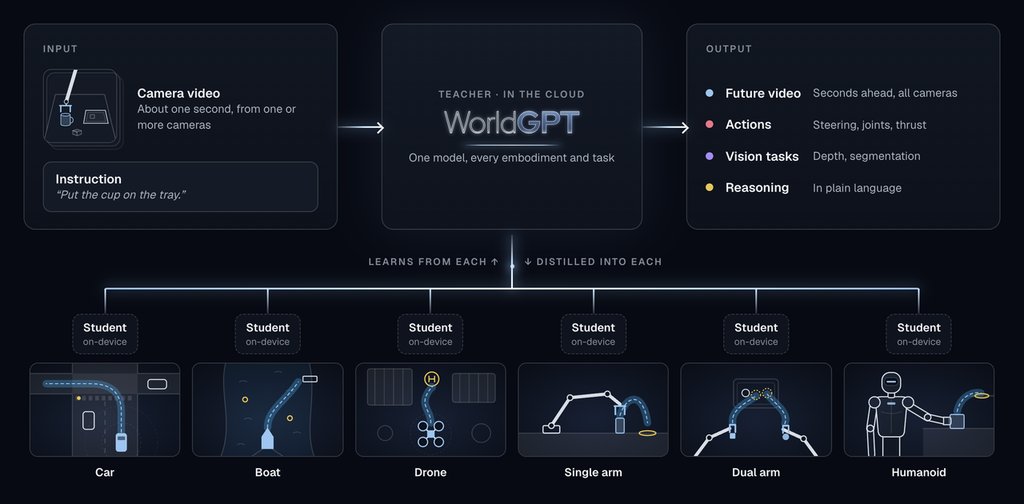
Chinese electric vehicle maker XPENG described WorldGPT in a Nov. 24 announcement from Guangzhou, China. The physical AI model is designed to learn from six machine types: cars, boats, drones, single-arm robots, dual-arm robots and humanoid robots.
Part of XPENG’s Turing World Model family, WorldGPT combines visual understanding, reasoning, prediction and action planning in one system. According to the company, the model can take camera footage and a text instruction, generate video of how the scene might unfold and plan a response. Generating video and planning actions also go together in Nvidia’s GR00T 2 robot training model, which learns from footage of people and robots performing tasks.
How shared learning works
WorldGPT uses camera images as a common learning interface. A car and a robotic arm have different controls, but both need to understand distances, recognize objects and anticipate movement.
XPENG trains one large model in the cloud on data from different machines. The idea is to pass what it learns to smaller models designed to run directly on each machine. XPENG says this could reduce the amount of new training data developers need when adding a machine.
The project demos start with about one second of real camera footage. WorldGPT then generates the next few seconds and overlays its planned movements. The project page plays those clips alongside the real recordings so viewers can compare the prediction with what happened.
What XPENG’s benchmarks measured
XPENG reports 12 first-place results across public benchmarks in autonomous driving, robotics, visual understanding and video generation as of Nov. 12.
| Evaluation area | XPENG-reported result |
|---|---|
| Autonomous driving | First place in four evaluations |
| Robotic manipulation | 95.2% average success across 50 simulated single-arm tasks in Meta-World MT50 |
| Visual understanding | First on CV-Bench and two BLINK subtasks |
| Video generation | Highest overall VBench 2.0 score |
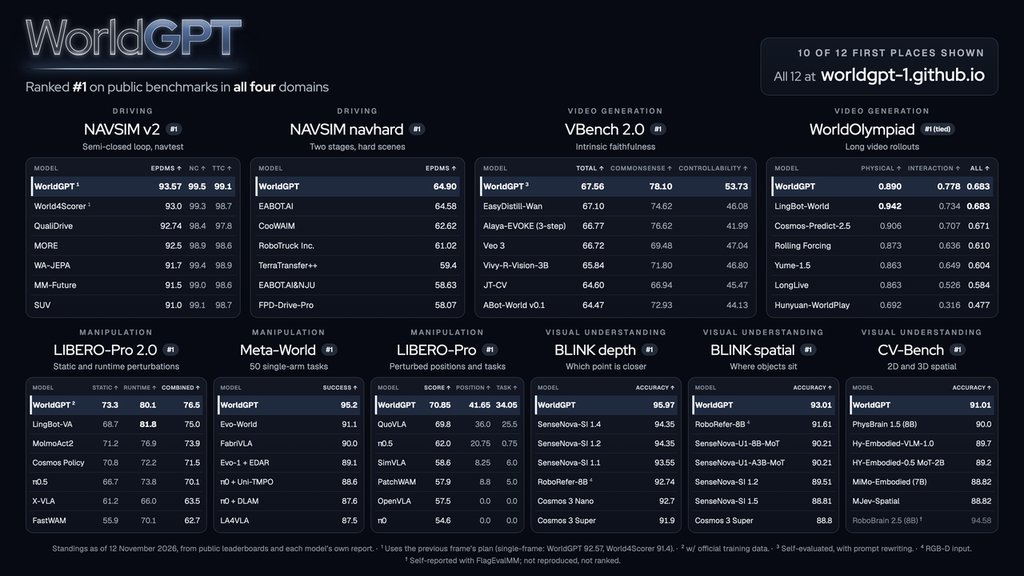
However, the results need context. The project website acknowledges that benchmark comparisons do not control for training data. VBench 2.0 is also marked as self-evaluated with prompt rewriting. A technical report is still forthcoming, limiting independent assessment of the model’s capabilities.
What to check before a robotics pilot
For teams buying or deploying robots, the potential payoff is less work teaching each machine a new job. XPENG’s announcement gives no timetable for deploying the smaller on-device models. The immediate decision for buyers is what proof to ask for when a vendor says its robots can reuse skills learned elsewhere.
Start with a task your team already tracks. A retailer evaluating a shelf-scanning robot could have it scan the same aisle before opening and again during a busy shift. Ask the vendor to show:
- Setup time. How many examples from your store did the robot need before its first usable scan?
- Performance on site. How many shelves did it scan correctly, and how often did staff have to intervene when a display moved or shoppers blocked the aisle?
- On-device limits. Which functions keep working if the robot loses its connection?
The jump from simulation to physical hardware is where training claims need a second check. Compare those pilot results with your current workflow before budgeting for more locations.
Read more: Compare how Tesla, Figure AI, and Agility Robotics are preparing humanoid robots for factory and warehouse work.