
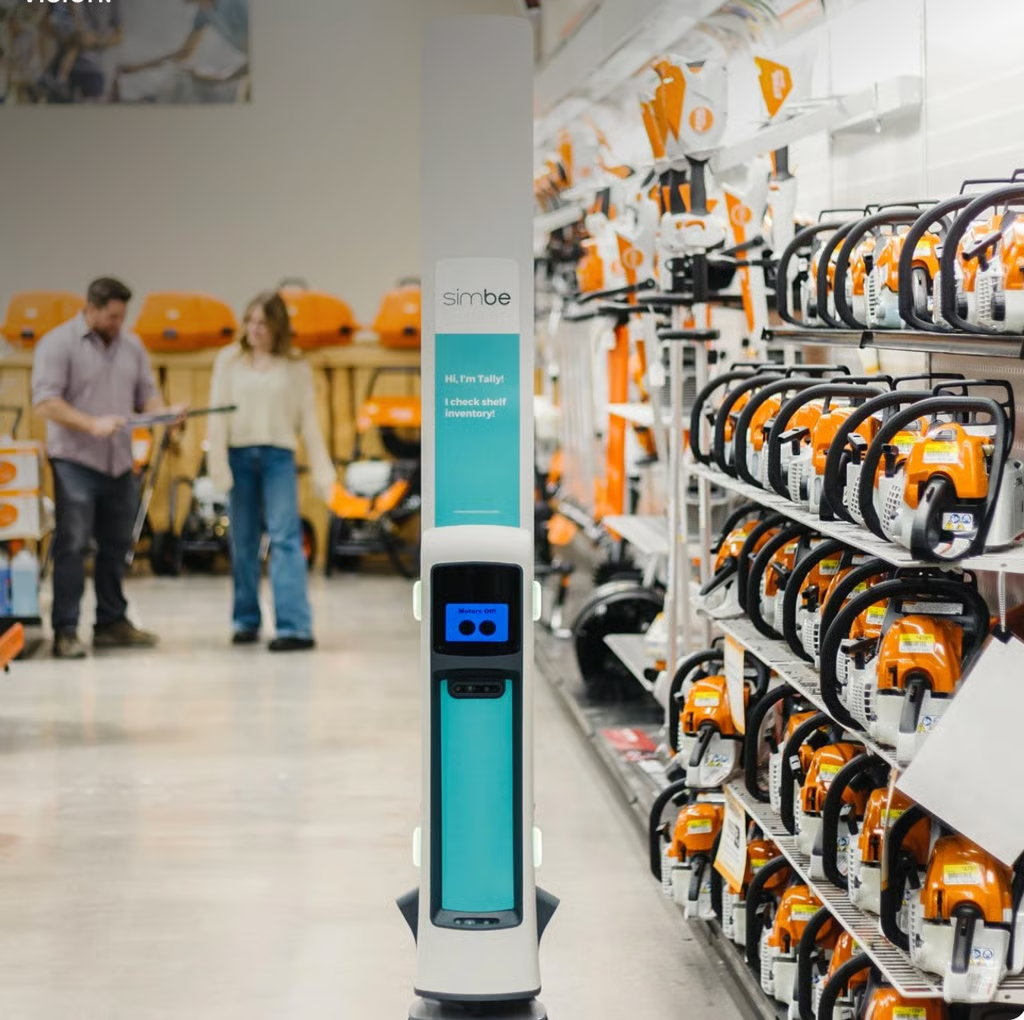


Simbe now has more than 3,000 autonomous retail units under contract as the company expands Tally beyond shelf scanning.
Simbe Robotics announced on Sept. 21 that it had passed the 3,000-unit mark, which it described as the largest commercially committed fleet of autonomous shelf-intelligence systems. The company did not specify how many contracted units are currently deployed.
For retail technology leaders, the milestone shows how physical AI can move from limited pilots into broader operations. It also raises practical questions about system integration, data quality and maintaining autonomous hardware across hundreds of stores.
Simbe said its technology combines autonomous robots, computer vision, RFID, handheld sensing and fixed sensors to collect information about inventory, product locations, prices, promotions and merchandising conditions.
The company has deployments across more than 75 retail banners in nearly a dozen countries, according to Simbe.
From shelf scans to store intelligence
Tally remains central to that strategy. According to Simbe’s product information, the robot can autonomously scan store aisles for out-of-stock products, pricing errors and misplaced merchandise before delivering prioritized tasks to store employees.
The system has also accumulated substantial operating data. Simbe reports 45 billion shelf photos analyzed, 18 billion price tags scanned and 5 million hours of fully autonomous operation across its deployments.
That scale gives Simbe something that is difficult to reproduce with a small robotics pilot: years of data showing how conditions inside real stores change over time.
“Retailers are increasingly deploying physical intelligence across the enterprise,” Deborah Weinswig, founder and CEO of Coresight Research, said in Simbe’s announcement. She said trusted shelf-level data is becoming foundational to store operations, digital commerce, merchandising and supply chain decisions.
The bigger robotics opportunity
The 3,000-unit milestone points to a practical direction for physical AI: robots do not necessarily need to perform complex human tasks to become valuable. In retail, repeatedly collecting accurate information about thousands of shelves can itself become an important automation layer.
Simbe says more than 90% of surveyed store managers working alongside Tally reported that the technology improved their jobs, although the announcement did not disclose the survey’s sample size or methodology. Simbe also says Tally is certified to UL 3300, a safety standard covering service, communication, information, education and entertainment robots.
Still, scaling robots across stores presents operational challenges that do not appear in controlled demonstrations, including navigating crowded aisles and maintaining reliable performance across different retail environments.
“What works once in a lab doesn’t often work in the real world, and it’s brutally hard to build robotics that operate reliably across thousands of stores for the world’s largest retailers,” Aidan Madigan-Curtis, a partner at Eclipse, said in the announcement.
What this means for retail workers and shoppers
Simbe positions Tally as a tool that shifts employees away from manual shelf audits rather than as a replacement for store staff. The robot flags shelf issues and converts them into prioritized tasks, although its effect on staffing will depend on how individual retailers deploy it.
Looking ahead, Simbe faces a larger hurdle than merely expanding its robot fleet. The business aims to link data from its robots and additional sensors directly into software platforms, AI tools, and daily operating procedures, transforming physical stores into digitally managed environments.
For shoppers, the technology could result in more accurate prices and fewer out-of-stock products, provided retailers act on the issues Tally identifies.
Simbe’s next challenge is integrating information from robots and other sensors with retailers’ inventory, merchandising and task-management systems. For technology leaders, the value will depend less on how much data Tally collects than on whether stores can turn those findings into faster decisions and measurable operational savings.
Read more: Amazon’s decision to shelve its Blue Jay warehouse robot illustrates the operational difficulties companies can face when moving robotics systems from development into everyday use.