


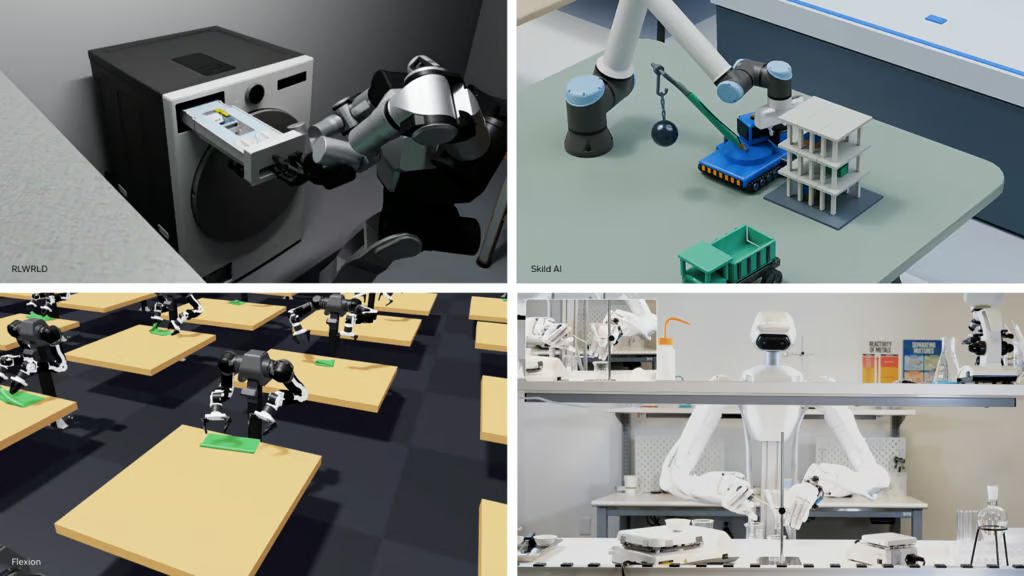
Teaching a robot a new job could start with footage of a person doing it, reducing the need to collect demonstrations on the machine itself.
Nvidia introduced GR00T 2 on Nov. 9 at the Conference on Robot Learning (CoRL) in Austin, Texas. The world action model learns from human videos and robot demonstrations, potentially reducing the task-specific training needed for manufacturing automation. Nvidia’s research page lists code availability for December.
Built on Nvidia Cosmos, GR00T 2 predicts future video and robot actions together, learning how movements change its surroundings. It is designed to work across robotic arms, dexterous hands and humanoids.
Its training data includes 402,730 hours of first-person human video, 10,184 hours of handheld-gripper demonstrations and 23,500 hours of robot teleoperation data. Nvidia is also releasing 100,000 hours of human video and associated motion data through its Human-1M-100K dataset under a license permitting commercial and noncommercial use.
In tests involving 50 manipulation tasks, Nvidia reported:
- 40 tasks completed at least once without task-specific demonstrations on the target robot.
- 71% average success with one demonstration per task.
- 95% average success with five demonstrations per task.
The five-demonstration approach required less than three minutes of robot data per task and approximately 30 minutes of fine-tuning on an Nvidia RTX 5090. However, Nvidia’s technical paper says the 50-task evaluation set was selected from tasks that reached at least 80% success after five demonstrations. The results therefore do not establish equivalent performance across arbitrary new tasks.
Simulation helps robots practice precision
Nvidia also introduced Isaac Lab 3.0, an open-source framework for training robots in simulated environments. Its integration with the Newton physics engine allows researchers to model complex interactions involving cables, cloth and robotic hands.
Nvidia reports that Isaac Lab 3.0 with Newton achieved up to 2.5 times the training throughput of Isaac Lab 2.3 with PhysX in a vision-based dexterous manipulation benchmark.
Another project, AlphaNIST, trained one policy to perform 20 assembly tasks involving millimeter-scale components. It achieved 98.2% training success, compared with 81.4% for separate task-specific policies, while using approximately one thirty-ninth as much GPU time. These results come from simulation and do not establish equivalent performance on physical robots.
What businesses should test before adopting GR00T 2
Nvidia says Foxconn is applying GR00T 2 to server manufacturing automation, Siemens is evaluating it for industrial applications, and Nexuni is testing robotic laundry handling. The announcement does not provide deployment scale, production performance or cost savings for these projects.
For manufacturers, the potential benefit is less time collecting robot demonstrations when introducing a new task. That could make it easier to adapt automation to changing products or components. The research does not yet establish how much a business would save after accounting for integration, testing and ongoing supervision.
The reported 30-minute fine-tuning time also covers one adaptation step, rather than the full process of preparing a robot for production. IT and operations teams should assess the complete workflow:
- Task reliability: Test representative parts, lighting, object positions and failure conditions. Record how often workers must intervene.
- Throughput: Measure completed work per hour, including retries and recovery time, rather than success rate alone.
- Integration and computing costs: Confirm compatibility with the intended robot, cameras and control software, then budget for data collection, computing and engineering support. As with local AI workloads on laptops, hardware capacity alone does not establish application compatibility.
- Operational ownership: Assign responsibility for model updates, performance monitoring and approval of changes to robot behavior.
A useful first pilot would target one repeatable task with a measurable baseline. Compare training effort, cycle time and intervention rates with the existing process before expanding to more complex work.
Read more: Better training is only part of making robots useful; Amazon’s renewed home-robot effort shows why reliable tasks, pricing and long-term support also matter.