Images: ReadNotify's tracking service - TechRepublic

Images: ReadNotify’s tracking service

  • Screenshot

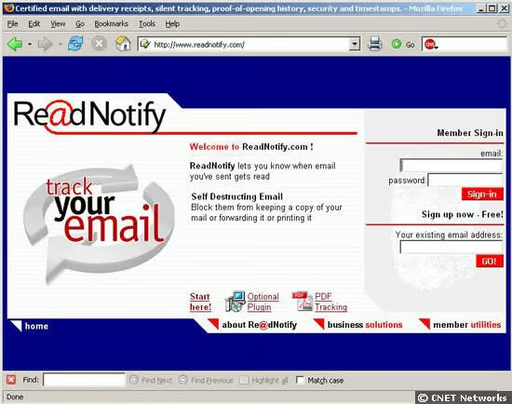
    During congressional hearings, Hewlett-Packard investigator Fred Adler specified how the company bugged the e-mail it sent to CNET News.com reporter Dawn Kawamoto. HP used the services of \r\nReadNotify.com, one of several online companies that let people plant bugs in e-mail messages and files. This is a screenshot of the \r\nReadNotify home page.

    ReadNotify.com
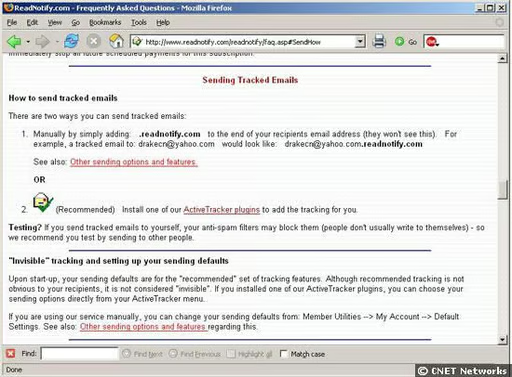
  • This is a screenshot of the ReadNotify page that instructs users how to send a bugged e-mail. Users of the service register their e-mail \r\naddresses with ReadNotify and then simply append “.readnotify.com” to any e-mail address they send mail to if they wish the message to be \r\ntracked. Recipients won’t see this, but could tell from the e-mail headers that the message was relayed.\r\n

    \r\nReadNotify also offers plug-ins for various e-mail clients, including Web-based e-mail, to make bugging a message easier.

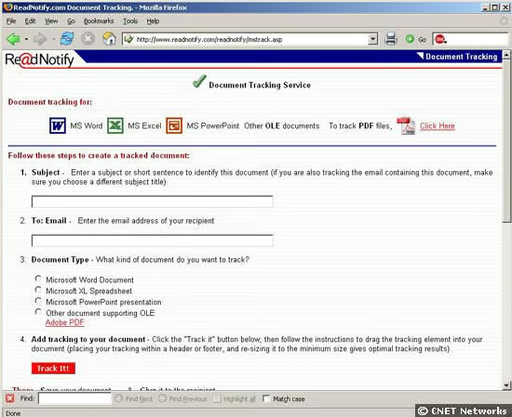
  • Paying users of ReadNotify.com get the ability to add bugs to files, such as Office and PDF documents. This is a screenshot of the ReadNotify \r\nWeb page that will generate a document with an image. This image, a green check mark, can simply be dragged-and-dropped into the document \r\nthat needs to be traced. The check mark becomes transparent after it is dropped.

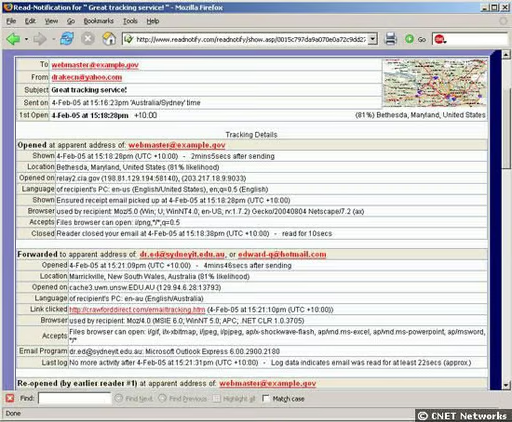
  • ReadNotify.com offers a detailed report of what happens with tracked e-mail messages or documents. The report includes details on \r\nwhen, where, on what type of PC, and for how long the traced information was viewed. It even includes a small map of where the individual who \r\nopened the mail or file is likely located, based on the Internet Protocol address of the computer.\r\n

    \r\nAdditionally, if a message is forwarded, the report states the probable e-mail address of the individual it was sent on to. It also displays if a message is reopened by anyone.

1 of 4
BD

Bill Detwiler is the Editor for Technical Content and Ecosystem at Celonis. He is the former Editor in Chief of TechRepublic and previous host of TechRepublic's Dynamic Developer podcast and Cracking Open, CNET and TechRepublic's popular online show. Previously, Bill was an IT manager in the social research and energy industries. He has bachelor's and master's degrees from the University of Louisville, where he has also lectured on computer crime and crime prevention.