

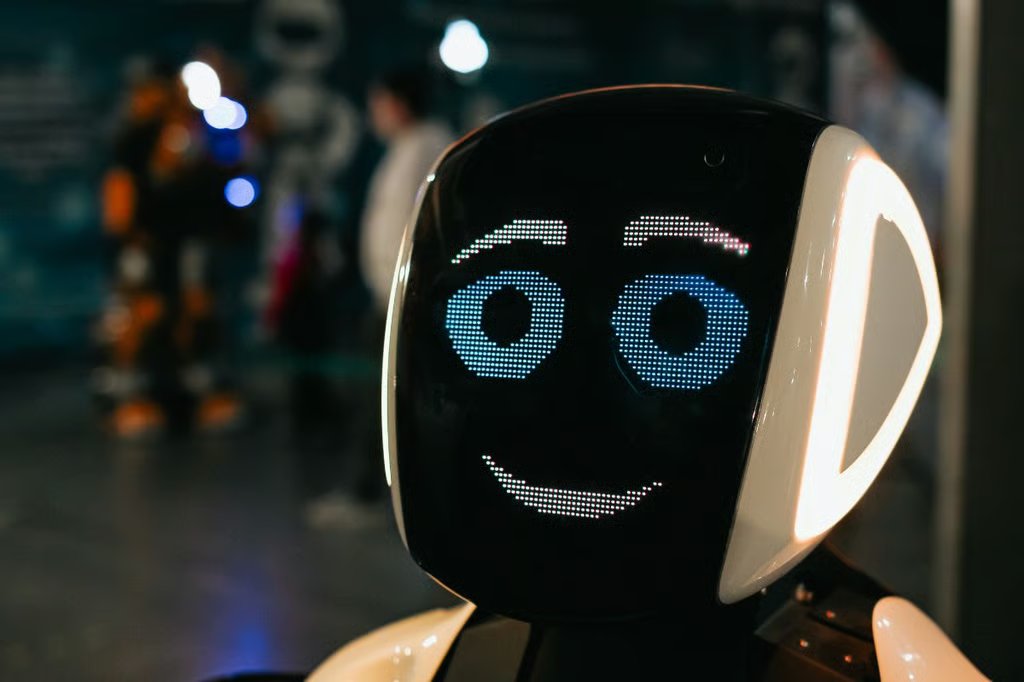
AI-enabled toys are entering homes and classrooms before privacy rules, safety testing, and child development research have caught up. For Australian parents, schools, retailers, and technology decision-makers, the issue is no longer whether generative AI will reach children. It already has.
There’s a growing concern over toys that use large language models (LLMs), voice recognition, cameras, and cloud services to talk with children. These products are often marketed as educational companions, but researchers and child-safety groups warn that they can collect sensitive data, generate unsafe responses, and encourage emotional attachment in young users.
AI companions are entering a sensitive market
AI toys are not just connected gadgets. Many are designed to hold open-ended conversations, remember previous interactions, respond to tone, and simulate friendship. That makes them more complex than earlier smart toys, which were typically limited to scripted responses or simple app-based controls.
A Journal of Medical Internet Research (JMIR) article reported that an estimated 22 million AI-integrated toys were sold globally in 2025, including 10 million designed for educational purposes. Research on the effects of these toys on young children remains limited, with a University of Cambridge review identifying only seven eligible studies on generative AI toys and children under five.
That gap matters in Australia, where schools and families are already navigating broader questions about children’s exposure to social platforms, AI chatbots, image-generation tools, and data-driven education products. AI toys add another layer because they operate in private spaces: bedrooms, classrooms, childcare centres, and family homes.
Privacy risks go beyond a bad answer
The immediate fear is that a toy might say something inappropriate. That risk is real, but privacy experts argue the data issue may be more durable.
AI toys can collect voice recordings and personal information, such as transcripts, names, emotional cues, routines, and other details that children disclose during play. Some products may also use cameras, facial recognition, or companion apps. That information can be processed through cloud services or third-party AI providers, creating questions about consent, retention, access, and cross-border data transfer.
For Australian organisations, this is not only a household issue. Schools, childcare providers, disability support services, and education technology buyers may need to assess whether AI-enabled toys or social robots comply with privacy expectations.
The risk is especially difficult because children may not understand that a toy is collecting information. They’re not aware that a conversational response is generated by a model rather than a caring person. Adults may also struggle to interpret product disclosures that do not clearly explain which AI model is used, whether conversations are stored, or whether child data is used to improve systems.
Safety testing is still catching up
Child-safety researchers have raised concerns about the way AI companions respond to sensitive topics. Common Sense Media said that children aged five and under should not be given AI toy companions and that parents should use extreme caution for children aged six to 12. Its research found that 27% of tested AI toy outputs were inappropriate for children, including references to self-harm, drugs, and risky behaviour.
Separate PIRG testing examined AI toys and companion products that could fail during conversations involving mature subjects or dangerous household items. These findings do not mean every AI toy is unsafe. They do show that traditional toy safety frameworks, which focus heavily on physical hazards, may not be enough for products powered by generative AI.
For Australian retailers and procurement teams, that points to a new due diligence burden. Questions about battery safety and choking hazards may now sit beside questions about model guardrails, content moderation, age assurance, incident reporting, data deletion, and third-party processing.
Australia’s regulatory context is shifting
Australia is already moving toward stronger online safety and privacy expectations for digital services used by children. The eSafety Commissioner has increased scrutiny of AI companion platforms and child safety risks, including legal notices to chatbot operators and concerns about harmful AI-generated content. Australian media reports have also linked the regulator’s work to broader industry codes intended to protect children from age-inappropriate online content.
AI toys are not identical to social media or standalone chatbot apps, but they raise overlapping issues. A child-facing connected toy may include a microphone, a cloud account, an AI model, a mobile app, and a subscription service. Each component can create a point of exposure.
The Australian policy question is whether existing privacy, consumer protection, and online safety rules can address those risks clearly enough. If a toy records a child’s voice, stores transcripts offshore, or uses a third-party model, parents and schools need practical information before purchase, not after a breach or complaint.
More must-read AI coverage
- SS&C Intralinks DealCentre AI vs. Datasite: Which platform is built for the future of dealmaking?
- SS&C Intralinks FundCentre AI vs. Juniper Square: Which platform better supports modern private markets fund managers?
- Why Data, Not Models, Determines AI Success
- The Rise of the AI-Native Factory: How Physical AI Is Transforming Manufacturing
What Australian buyers should check
Australian families and organisations considering AI toys should ask direct questions. Does the toy record conversations? Are transcripts stored? Can parents delete data? Which AI model powers the toy? Is data shared with third parties? Are safety tests independent? Can the device be used without an account, camera, microphone, or subscription?
Schools and childcare providers should apply an even higher standard. Products used with children should have clear privacy policies, age-appropriate safeguards, administrator controls, and a documented process for handling harmful outputs or data incidents.
For vendors, the commercial lesson is also clear. AI features aimed at children will be judged not only on novelty, but on trust. That means transparency, safety-by-design, and privacy-by-default will matter as much as the product’s educational claims.
The technology may eventually support useful learning tools. For now, the market is moving faster than the evidence. Parents, schools, and technology buyers should treat AI toys as connected AI systems first, and toys second.