



An exposed database containing 24 billion credential records is drawing worldwide attention. But for Australian enterprises, the discovery highlights a growing challenge: protecting increasingly digital businesses in a world where compromised accounts remain one of the most effective entry points for attackers.
According to researchers at Cybernews, the records totaled 8.3 TB and were found on June 12, revealing a massive collection sourced from infostealer malware logs, breach compilations, and other datasets commonly circulated within cybercrime communities. Although the database was taken offline shortly after it was found, the exposure offers a rare look at the volume of account data now circulating across underground ecosystems.
The discovery comes as Australian organizations ramp up investments in cloud platforms, remote work infrastructure, and digital services. While many of the records are likely duplicated, outdated, or no longer valid, the dataset illustrates the scale of information available to threat actors seeking ways into enterprise environments.
Infostealer tops the charts
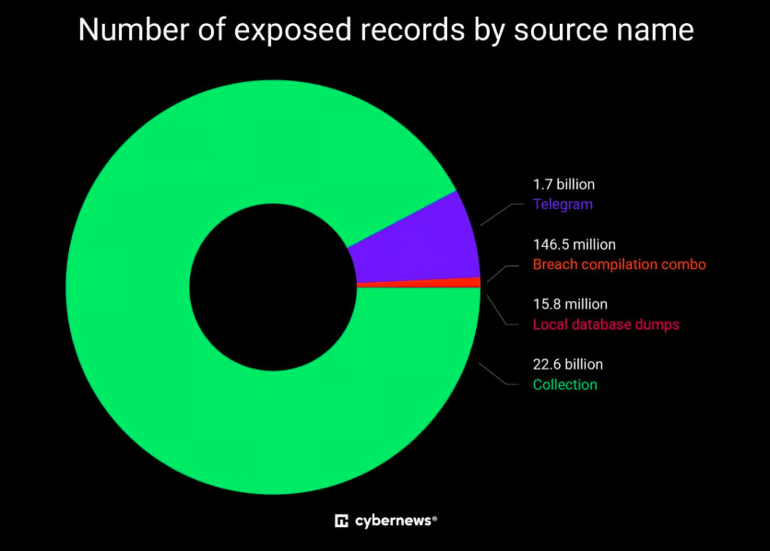
The most significant detail is not the size of the database but its origins.
Much of the information came from infostealer malware, which is designed to harvest credentials, browser information, session cookies, and other sensitive data directly from infected devices. Rather than attacking corporate infrastructure directly, these malware families often target employees and contractors, quietly collecting information that can later be used to access workplace systems.
That trend is particularly relevant for Australian businesses with geographically dispersed teams and hybrid work arrangements. A compromised laptop used outside the office can become the starting point for broader security incidents, especially when employees have access to multiple business applications and services.
Researchers also found that many records included the URLs associated with the credentials. That context makes the data significantly more useful, allowing threat actors to quickly identify which services may be worth targeting rather than relying on trial and error.
Why this matters in a cloud-first economy
Australian businesses are increasingly dependent on cloud platforms to run day-to-day operations. Email, collaboration tools, customer management systems, finance platforms, and internal workflows are now commonly delivered through online services rather than on-premises infrastructure.
As a result, a compromised account can have consequences far beyond a single login. Access to one service can often reveal information about business processes, suppliers, customers, or connected applications. In environments built around convenience and accessibility, the value of legitimate user access continues to increase.
For enterprise leaders, the incident serves as a reminder that business resilience is increasingly tied to how effectively access to critical systems is managed and secured.
A bigger concern for smaller businesses
According to the Australian Small Business and Family Enterprise, in 2025, the country had 2,656,469 small businesses. Together, these businesses with fewer than 20 employees account for over 98% of the country’s total enterprises.
Despite their small size, small and medium businesses (SMBs) are increasingly adopting technology, especially tools that support productivity gains, given their small workforce. However, when viewed through the lens of security, these SMBs stand little chance of withstanding cyberattacks.
Plus, they are more vulnerable to password-based attacks because they lack dedicated methods of separating work from personal workflows. A good example is an SMB owner who uses a single device for both business and personal affairs.
For these SMBs, a report like this carries more significance than it may seem.
Must-read security coverage
- UK Police Convicts Pair in £5.5 Billion Bitcoin Launder Case
- Blackpoint Cyber vs. Arctic Wolf: Which MDR Solution is Right for You?
- How GitHub Is Securing the Software Supply Chain
- 8 Best Enterprise Password Managers
What Australian enterprises should do
Large credential collections create a different problem from traditional data breaches.
Instead of responding to a single intrusion, security teams must consider whether exposed accounts remain active across hundreds of services, devices, and business functions. Determining that impact can be particularly difficult when credentials originate from malware infections that may have occurred months earlier. However, with proper auditing, teams can easily identify and remediate credential leaks.
Additionally, discoveries like this highlight the importance of investing in threat intelligence for firms. While this isn’t a regulatory requirement, it allows enterprises to quickly detect and respond to data breaches relevant to them before the data falls further into the wrong hands.
Enterprises seeking cybersecurity assistance should also liaise with the Australian Signals Directorate (ASD) for further guidance.