


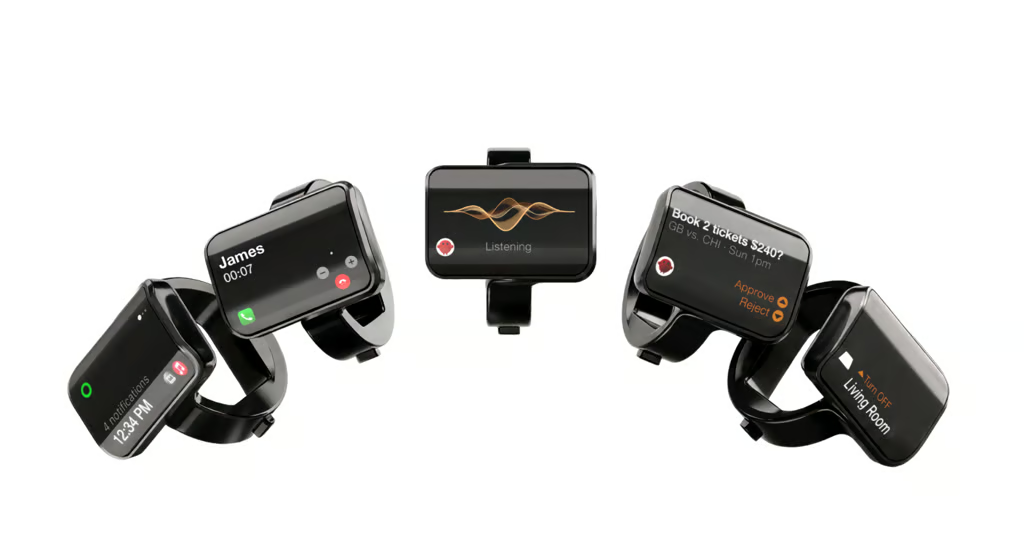
Your AI agent has a question, and now your finger can answer it.
Startup Aina unveiled the Aina Ring on Nov. 5, a wearable equipped with an OLED screen and a thumb-operated controller for approving suggested actions. Preorders start at $399 against a $499 list price, with shipments expected in early 2027. Delivery availability depends on the destination.
For professionals, the appeal is handling quick approvals and meeting controls without reaching for a phone. Whether that convenience justifies another device depends on compatibility, reliable execution, and how clearly the ring explains what users are approving.
The mechanics of the ring
According to Aina’s FAQ, the ring requires an iPhone running iOS 18 or later, while its Mac features require macOS 15 or later. The company says its software learns routines from information such as location and calendar activity to suggest relevant actions. Android and Windows are not supported.
Aina lists the following specifications and capabilities:
| Feature | Hardware & functionality |
|---|---|
| Chassis & display | Titanium body with an onboard OLED screen for visual task confirmation |
| Mechanical shifter | Four-direction thumb controller to accept, dismiss, or navigate options |
| Audio | Integrated speaker and microphone for phone calls and agent conversations |
| Battery life | Company-rated at up to 18 hours per charge |
| Ecosystem | iOS and macOS support at launch; integration with agents like Muse and Instinct |
Core functions include:
- Aina Cues: Aina says its software learns routines and displays one suggested action at a time, such as booking a regular ride or opening a meeting on a Mac. A thumb flick approves the suggestion.
- Aina Remote: Aina says contextual controls let users manage music playback with thumb gestures. Separate Mac meeting controls provide shortcuts such as muting and unmuting calls.
- Aina Voice: Wearers hold the center button to dictate notes or issue voice prompts, bringing their hand to their ear to hear responses over the ring’s speaker.
A new philosophy for dedicated AI hardware
Aina positions the ring as a companion to an iPhone and Mac, combining quick approvals with voice input, calls, and contextual controls.
“We are seeing a major shift in how we operate with things—agents are able to do so much, and everything is waiting on us,” Aina founder Apoorv Shankar said, according to WIRED. “I don’t have an easy way to approve—we’re going to see that a lot more once we see what the potential of proactive AI is.”
What IT teams should check before buying
Aina’s proposed convenience is straightforward: fewer trips to a phone or desktop screen for routine actions. Whether that translates into fewer interruptions depends on how relevant its suggestions are and how reliably connected services complete each task.
Before buying devices for work, teams should establish which functions support their existing tools and which require a separately connected AI agent. Understanding how AI tool calling connects agents to external services helps distinguish a suggested action from an integration that can execute it. A demonstration of booking a ride does not establish compatibility with a company’s travel platform, approval rules, or expense process.
| Check | What to establish |
|---|---|
| Compatibility | Whether employees have supported iPhones and Macs and whether their work applications support the intended functions |
| Permissions | Which calendars, accounts, and services the software or connected agents can access |
| Approval detail | Whether users can inspect the recipient, amount, or other consequential details before authorizing an action |
| Action records | Whether the connected service records what was approved and whether the task completed |
| Everyday usability | Whether prompts, charging requirements, and voice controls suit the employee’s working environment |
Aina says routine learning happens on users’ own devices and saved voice notes remain on the paired device. Those claims do not establish how every connected service handles information; IT teams should review each integration before allowing access to business accounts.
An initial pilot could focus on meeting controls and reminders, measuring missed commands, irrelevant prompts, and completed actions. Workflows involving external messages, sensitive information, or spending would require closer assessment of permissions, approval details, and AI guardrails that validate actions before execution.
The buying decision should turn on demonstrated usefulness in those workflows. A quicker approval only helps when employees can understand the proposed action and verify the result.
Read more: Before giving AI agents permission to act, explore how to assign ownership, control access, and preserve accountability across business workflows.