


Europe wants more control over the infrastructure behind AI, and Alibaba Cloud wants a bigger role in that market.
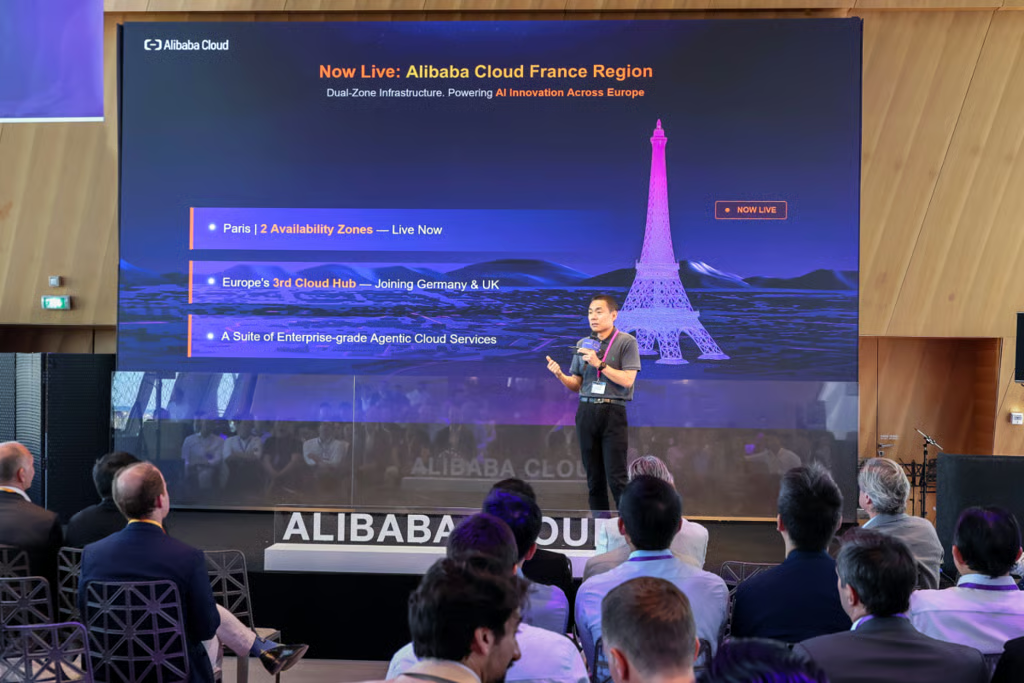
The company has launched its first cloud region in France, adding two availability zones in Paris for European businesses weighing local cloud hosting, data sovereignty, and AI infrastructure needs.
The expansion gives European companies another regional cloud option as regulators focus on data sovereignty, cybersecurity, and resilience. It also positions Alibaba Cloud to deliver enterprise agentic AI services to European customers later this year.
Alibaba Cloud adds two availability zones in France
Alibaba Cloud announced that its new France cloud region is fully operational, adding two availability zones in Paris. The company said the region will support enterprise cloud services, including elastic computing, storage, containerization, networking, security, databases, and developer tools.
“The expansion of our cloud infrastructure into France reinforces our ongoing commitment to empowering European businesses with sovereign, secure, and intelligent solutions,” said Dr. Feifei Li, chief technology officer and president of international business at Alibaba Cloud.
The South China Morning Post (SCMP) reported that Alibaba Cloud launched the facilities as Europe places more emphasis on data sovereignty and locally hosted infrastructure.
The Paris hub is Alibaba Cloud’s third European hub, joining existing infrastructure in Germany and the UK. The company said the new region expands its global footprint to 105 availability zones across 32 regions.
For enterprise technology teams, region placement affects more than performance. A local cloud region can influence latency, compliance planning, disaster recovery design, application architecture, and procurement decisions for European operations.
Europe’s sovereignty push shapes the launch
Alibaba Cloud framed the France region around data privacy, cybersecurity, resilience, and sovereignty. The company noted that the infrastructure was built with European regulatory frameworks and standards in mind.
The timing aligns with broader European policy moves.
SCMP highlighted that the European Commission published a tech sovereignty package on June 3 to strengthen the bloc’s digital independence and AI position. The bloc’s Cloud and AI Development Act also identified limited data center capacity as a risk to Europe’s digital transformation.
For CIOs and cloud architects, this creates a practical question: how much infrastructure should remain within Europe, and which vendors can meet both technical and regulatory expectations?
Alibaba Cloud’s France launch gives buyers another option, although procurement teams will still need to assess governance, security controls, contractual terms, and cross-border data policies.
Agentic AI services are coming next
Alibaba Cloud also plans to introduce agentic AI services in Europe in the second half of 2026. The planned lineup includes AgentRun, STAROps, ACS Agent Sandbox, Agent Security Center, AI Security Guardrails 2.0, and Agentic SOC.
“This expansion, alongside the introduction of our agentic AI services to Europe, aligns with our broader strategy to bring our full-stack AI+Cloud ecosystem to global customers as we enter the agentic era,” Li said.
The tools are designed to support enterprise AI agents from development and debugging through deployment, operations, and security. Alibaba Cloud highlighted that ACS Agent Sandbox will provide hardware-level security isolation and help lower operating costs for AI agents, while Agentic SOC will support automated threat response and closed-loop auditing.
That security layer matters as companies move from AI pilots to agents that can take actions across systems. Enterprise teams will need stronger controls for supply chain transparency, runtime risk, model interactions, permissions, and auditability.
Alibaba Cloud has served European markets since 2016, but the France launch gives it a more direct foothold in one of Europe’s largest enterprise markets.
For buyers, the bigger question is whether Alibaba Cloud can turn local infrastructure, AI services, and sovereignty messaging into a credible alternative to the cloud providers already competing for European workloads.
Read how Mistral’s $830 million debt financing could strengthen Europe’s Nvidia-powered AI infrastructure push.