
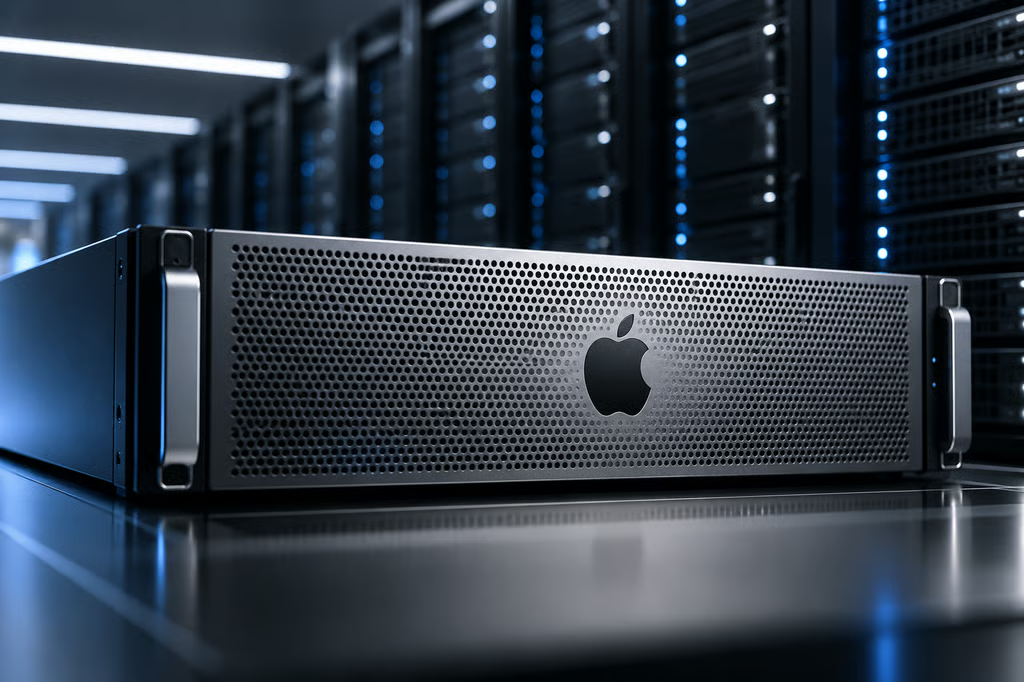


Apple is reportedly developing an enterprise AI server built around future M8 Ultra chips, potentially bringing the company back into the dedicated server market more than 18 years after it discontinued Xserve.
The reported target is 2029. Apple has not confirmed the project or disclosed a product name, pricing, support details, or how the hardware would be sold.
According to The Information, Apple is considering systems with either two or four M8 Ultra chips. The company only introduced the M6 chip in August, putting the reported server several generations beyond hardware available today.
Apple’s M8 Ultra server plans
Demand for Macs in AI development may be part of the backdrop. OpenAI has purchased tens of thousands of Mac mini and Mac Studio systems for AI agent development, while Anthropic has reportedly rented Mac minis through Amazon Web Services.
The Verge reported that AI demand has contributed to shortages of some Mac mini and Mac Studio models.
The project reportedly began about a year ago with backing from John Ternus, then Apple’s hardware engineering chief. Ternus became Apple CEO on September 1.
If Apple brings the server to market, it would mark a return to dedicated enterprise hardware. Ars Technica noted that Apple stopped selling Xserve in January 2011.
Apple’s current M5 Ultra offers a rough reference point. Apple’s M5 Ultra announcement says the chip supports up to 512GB of unified memory and 1.2TB/s of memory bandwidth.
One major unknown is how memory would work across multiple M8 Ultra chips. Current reporting does not establish whether the processors could access one shared memory pool or whether memory would remain tied to each chip.
Apple has also discussed using Nvidia technology to connect the chips, according to The Information. NVLink Fusion is reportedly one option under consideration, although the report cautioned that Apple could still cancel the project or proceed without Nvidia’s networking technology.
Where the server fits in Apple’s AI strategy
The reported project would move Apple beyond simply using Macs for AI workloads and toward hardware built specifically for large-scale inference.
That could matter because today’s Mac Studio systems were designed as high-end workstations, not data-center servers. A purpose-built system could give Apple more control over how multiple chips, memory, networking, cooling, and software work together.
Apple is not relying exclusively on its own silicon, either. Its Machine Learning Research team says AFM 3 Cloud Pro runs on Nvidia GPUs in Google Cloud as part of an extension to Private Cloud Compute developed with Google and Nvidia.
That makes Nvidia’s possible involvement in the M8 Ultra server less surprising. Apple could use its own processors for AI compute while relying on Nvidia technology to connect chips and scale workloads.
The current M5 Ultra also shows both the appeal and the limits of Apple’s approach. Its 512GB memory ceiling gives it far more local model capacity than many conventional GPUs, but its 1.2TB/s memory bandwidth remains well below the 4.8TB/s Nvidia lists for the H200.
Those figures do not predict M8 Ultra performance, but they help explain what Apple may be trying to solve with a dedicated server rather than simply adding more Mac Studios.
For now, the M8 Ultra server remains an unconfirmed 2029 project. The more important question is whether Apple is preparing to turn Apple silicon from a workstation platform into a larger part of its AI infrastructure stack.
Also read: Mac Studio alternatives compares five current options for professional graphics, local AI workloads, and repairability.