


If the leaked designs are accurate, Apple might soon give its most affordable smartphones more stamina than its flagships, turning traditional hardware tiering completely on its head.
Using similar chassis layouts and battery designs could simplify manufacturing and reduce the number of components needed across different models. However, the leaked diagrams don’t establish whether Apple expects meaningful production savings.
The company could still distinguish the two devices through their displays, camera systems, and other hardware features. According to the leak, the standard iPhone 18 may offer a 120Hz display and dual rear cameras, while the iPhone 18e could retain a 60Hz panel and a single rear camera.
Both handsets are expected to arrive in the spring of 2027, launching alongside a second-generation iPhone Air.
Shared architecture and leaked specs
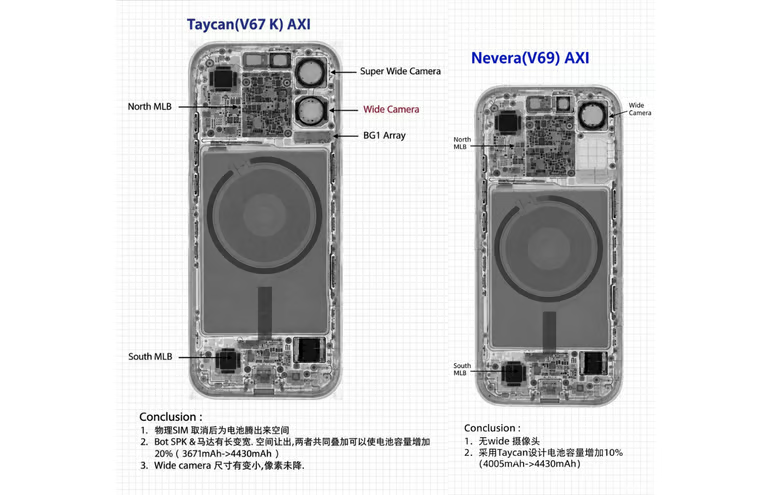
The radiographic diagrams, carrying internal codenames “Taycan” for the standard model and “Nevera” for the budget tier, reveal matching logic board layouts, MagSafe coils, and steel-encased battery designs.
Space for the larger capacity was reportedly freed by removing the physical SIM tray and redesigning the bottom speaker and haptic engine into wider footprints.
Based on the leaked diagrams and accompanying claims, the two phones could share several internal components while retaining differences in display and camera hardware. None of these specifications has been confirmed by Apple.
| Feature | Standard iPhone 18 | Budget iPhone 18e |
|---|---|---|
| Battery capacity | 4,430 mAh (~20% increase) | 4,430 mAh (~11% increase) |
| Display | 6.3-inch OLED, 120Hz LTPO | 6.3-inch OLED, 60Hz |
| Rear cameras | Dual 48MP (Main + Ultra-Wide) | Single 48MP (Main) |
| Chipset | 2nm Apple A20 | 2nm Apple A20 (Likely binned) |
| Display cutout | Dynamic Island | Dynamic Island |
While the two models share core dimensions and chassis geometry, Apple separates them through cameras and panels. The iPhone 18e fills the missing ultra-wide camera chamber with a spacer insert, caps screen refresh rates at 60Hz, and may omit the U2 ultra-wideband chip.
Supply chain efficiency over strict segmentation
Standardizing battery packs, displays, and structural motherboards represents a calculated shift in how Cupertino scales entry-level hardware. Rather than building distinct, down-binned architectures for its budget tier, Apple is applying unified modularity to streamline factory tooling, lower bill-of-materials costs, and simplify automated assembly lines.
Historically, Apple kept non-Pro models intentionally constrained to drive buyers toward higher-margin flagships.
However, as mobile silicon advances to TSMC’s 2nm node and thermal demands grow from on-device AI workloads, keeping distinct form factors for four or five separate phones becomes cost-prohibitive.
By using modular chassis blanks, Apple preserves product tiering via software toggles and component omissions while letting lower-tier devices inherit premium manufacturing economies of scale.
What this means for enterprise buyers and everyday users
For frontline workers, corporate fleets, and power users, the hardware convergence could make the entry-tier iPhone an endurance champion:
- Real-world longevity: Pairing a 4,430 mAh pack with a static 60Hz display and a 2nm A20 chip should yield superior battery life compared to high-refresh Pro models that run intensive GPU pipelines.
- Simplified fleet management: Identical screen dimensions and port locations ease enterprise case procurement and universal peripheral support.
- eSIM bottlenecks: Because internal volume was gained by scrapping the SIM tray, international travelers and distributed field teams must prepare for fully digital cellular provisioning.
Apple hasn’t confirmed the leaked specifications, and the final designs could change before launch. Even if the reported battery capacities prove accurate, real-world testing will be needed to determine whether the cheaper models actually last longer than their Pro counterparts.
For buyers, the more interesting possibility is that battery capacity may become less of a reason to choose a premium iPhone. Whether Apple follows through remains to be seen.
In other news: Oppo’s next camera powerhouse may never make it off the drawing board. The company has reportedly suspended development of the Find X10 Ultra, a flagship rumored to feature an ambitious dual-periscope camera system and an 8,000 mAh battery.