
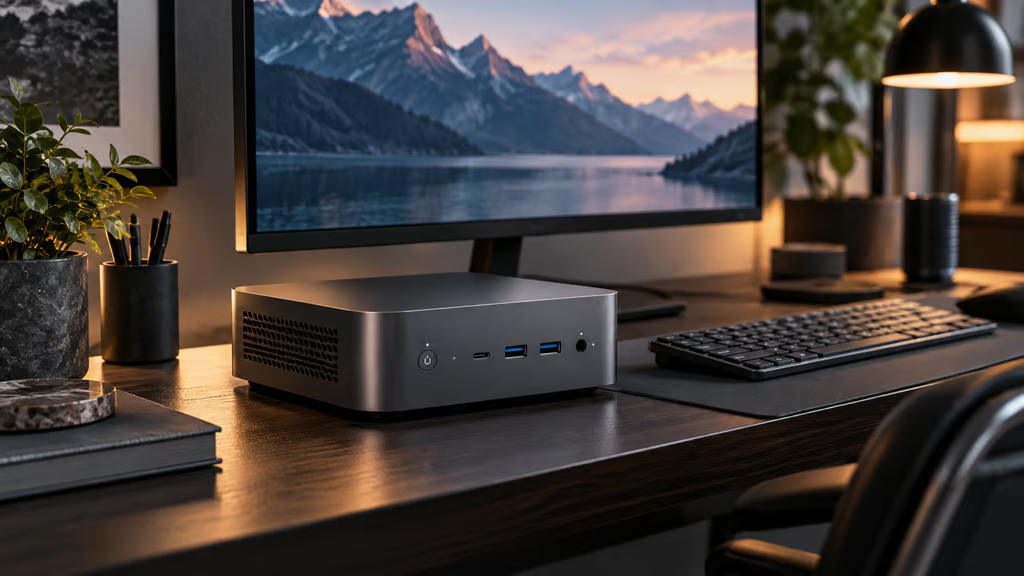


Apple’s new M6 Mac mini starts at $899, with the first units arriving September 22.
Windows buyers have several compact alternatives that trade Apple’s tightly integrated hardware for different combinations of upgradeable memory, additional storage, USB4, OCuLink, and broader port selection.
The five picks here range from relatively affordable Ryzen systems to premium AI-focused mini PCs, so the best fit depends less on matching the Mac mini spec for spec and more on the workload and expansion options you actually need.
Best Mac mini alternatives compared
| Model | Current pricing | Processor | Memory/storage reviewed or sold |
|---|---|---|---|
| ASUS NUC 15 Pro+ | From $615 as a kit; configured systems vary by retailer | Up to Core Ultra 9 285H | Configurable RAM and NVMe storage |
| GEEKOM A9 Max 2026 Edition | From $1,299 configured | Ryzen AI 9 HX 370 or HX 470 | 32GB RAM, 1TB or 2TB SSD |
| MINISFORUM AI X1 Pro-470 | $1,327 for 32GB/1TB | Ryzen AI 9 HX 470 | 32GB RAM, 1TB SSD |
| Beelink SER9 Pro | $699 for 24GB/1TB | Ryzen 7 H 255 | 24GB RAM, 1TB SSD |
| GMKtec M6 Ultra | $459.99 for 16GB/512GB | Ryzen 5 7640HS | 16GB RAM, 512GB SSD |
Prices were accurate at the time of publication and may change with promotions. ASUS foregrounds kit pricing on its US site, so its $615 starting price isn’t directly comparable with the configured systems in the other rows.
How we chose these Mac mini alternatives
We compared current US pricing and availability, official specifications, and independent reviews from outlets including Notebookcheck, Tom’s Hardware, TechRadar, and Windows Central.
Where available, independent performance, thermal, noise, and real-world testing took priority over manufacturer benchmark claims.
We prioritized:
- Current availability: Each exact model had to be orderable in the US at publication, rather than announced, discontinued, or marked as coming soon.
- Ready-to-use cost: Configured systems were used where reliable current pricing was available. Kit and barebone prices are identified rather than presented as complete-PC prices.
- Performance: Independent CPU, graphics, thermal, and real-world testing carried more weight than manufacturer benchmark claims.
- Upgradeability: Replaceable RAM, multiple SSD slots, OCuLink, USB4, and accessible internals can make a Windows mini PC more flexible over several years.
- Connectivity: Display outputs, Ethernet, Wi-Fi, USB4, Thunderbolt, and peripheral support were considered for desk and office deployments.
- Workload fit: Office work, creative applications, development, local AI, virtualization, and light gaming don’t place the same demands on a compact PC.
Teams planning heavier local AI workloads should pay particular attention to memory configuration and GPU bandwidth. Those factors can change performance substantially even when two machines use similar processors.
ASUS NUC 15 Pro+
The ASUS NUC 15 Pro+ is the most business-oriented system here. ASUS sells Core Ultra 5, 7, and 9 versions and lists kit and complete-system SKUs through US retailers.
Its connectivity includes two Thunderbolt 4 ports, two HDMI 2.1 outputs, 2.5Gb Ethernet, Wi-Fi 7, and multiple USB-A ports. RAM is replaceable, and the chassis provides M.2 2280 and M.2 2242 storage slots.
In Notebookcheck’s testing of the Core Ultra 9 285H version, the system delivered strong productivity performance, with good connectivity and easy internal access. Fan noise became clearly audible under heavier loads.
ASUS says the NUC can drive four 4K displays, making it especially flexible for fixed desk setups using multiple screens or portable monitors.
GEEKOM A9 Max 2026 Edition
The GEEKOM A9 Max 2026 Edition starts at $1,299 on GEEKOM’s US store and comes configured with Windows 11 Pro. Buyers can choose Ryzen AI 9 HX 370 or HX 470 versions with 32GB of DDR5 memory and 1TB or 2TB of storage.
The port selection includes dual USB4, dual HDMI 2.1, dual 2.5Gb Ethernet, Wi-Fi 7, Bluetooth 5.4, and an SD card reader. Both RAM and storage can be expanded.
In TechRadar’s review of the HX 470 version, the A9 Max delivered strong office, creative, and local AI performance, alongside solid build quality and extensive connectivity. The system became audible under heavier workloads and carries a substantial price premium over cheaper mini PCs.
It’s best suited to users combining normal Windows productivity with heavier creative or local AI workloads.
MINISFORUM AI X1 Pro-470
The MINISFORUM AI X1 Pro-470 costs $1,327 in its 32GB RAM and 1TB SSD configuration. The cheaper $759 option is barebone and shouldn’t be compared directly with complete systems.
Expansion is its strongest feature. The machine provides three M.2 slots, two USB4 ports, OCuLink for an external GPU, dual 2.5Gb Ethernet, Wi-Fi 7, and support for four displays.
In Tom’s Hardware testing of the 32GB/1TB configuration, the review unit arrived with a single 32GB memory module. Performance improved substantially after a second matching module enabled dual-channel memory. The system otherwise remained cool and quiet during sustained testing.
RAM configuration is therefore worth checking before ordering, particularly for graphics-heavy work or a local Windows AI agent that will rely heavily on local hardware.
Beelink SER9 Pro
The Beelink SER9 Pro costs $699 with a Ryzen 7 H 255, 24GB of LPDDR5X memory, and a 1TB SSD.
The RAM is soldered, which limits long-term memory upgrades, but storage can be expanded through two M.2 slots. USB4, HDMI, DisplayPort, 2.5Gb Ethernet, built-in speakers, and an integrated microphone array round out the hardware.
Notebookcheck’s SER9 Pro testing found strong general application performance from the Ryzen 7 H 255, while its Radeon 780M remained capable for light gaming and GPU workloads. The standard SER9 with Ryzen AI 9 HX 370 was substantially faster, so the Pro name doesn’t indicate that it outperforms every other SER9 configuration.
At $699, the SER9 Pro is the closest of these five to the Mac mini’s price without dropping into entry-level hardware.
GMKtec M6 Ultra
The GMKtec M6 Ultra is the budget option. GMKtec’s store starts at $269.99 for a barebone chassis, while a ready-to-run 16GB/512GB configuration was listed at $459.99 at publication.
It uses a six-core Ryzen 5 7640HS with Radeon 760M graphics and includes dual 2.5Gb Ethernet, USB4, HDMI, DisplayPort, two DDR5 SO-DIMM slots, and two M.2 storage slots.
In Notebookcheck’s M6 Ultra review, the system delivered strong value for its price, alongside USB4 and broad expansion options. Its cooling was less polished, with clearly audible fan noise under load.
Dual Ethernet and two storage bays also make it useful for home labs, lightweight servers, and networking projects.
Which Mac mini alternative should you buy?
| Best for | Pick | Reason |
|---|---|---|
| Business desktops | ASUS NUC 15 Pro+ | Strong connectivity, Intel platform options, easy upgrades, and broad retailer availability |
| Creative and AI workloads | GEEKOM A9 Max 2026 Edition | Ryzen AI 9 performance, replaceable memory, dual USB4, and dual 2.5GbE |
| Expansion and eGPU use | MINISFORUM AI X1 Pro-470 | OCuLink, three M.2 slots, dual USB4, and extensive internal expansion |
| Compact everyday performance | Beelink SER9 Pro | Strong productivity performance at a lower configured price |
| Budget and home-lab use | GMKtec M6 Ultra | Low configured cost, dual Ethernet, replaceable RAM, and two SSD slots |
The Windows options are strongest when upgradeability, port selection, or x86 software compatibility takes priority.
Apple’s M6 Mac mini remains smaller and starts at $899, but several of these PCs offer replaceable memory or storage and connections that are harder to add later.
Also read: Our guide to Mac Studio alternatives compares larger Windows systems for users who need more performance than a mini PC can comfortably provide.