


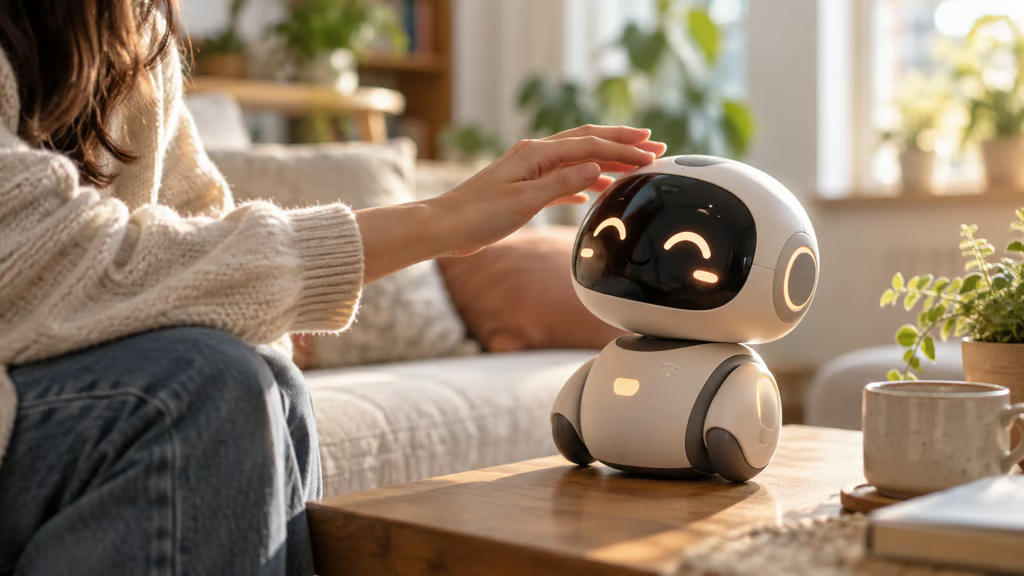
Robot companions now come in very different shapes. Mirumi hangs from a bag and reacts to people nearby, Moflin learns from the way its owner interacts with it, Loona drives around the house, Ropet KAMOMO behaves like a plush AI pet, and Eilik sits on a desk responding to touch and movement.
Moflin is our best overall pick if you want something that feels more like a pet than an assistant. Loona offers the most movement and connected features, while Mirumi, Ropet, and Eilik each suit a more specific kind of buyer.
Best robot companions at a glance
| Robot | Price | Type | Camera | Rated battery | Best for |
|---|---|---|---|---|---|
| Casio Moflin | $429 | Plush companion | No | About 5 hours | Best overall |
| Loona Petbot Premium | $499 | Wheeled robot | 720p RGB | About 2 hours | Best mobile companion |
| Mirumi | $149.99 | Bag charm | No | About 8 hours | Best wearable companion |
| Ropet KAMOMO | From $299 | Plush desktop pet | Yes | About 2.5–3.5 hours | Best customizable AI pet |
| Eilik | $139.99 | Desktop robot | No | About 1.5 hours | Best budget pick |
Prices were checked Oct. 6, 2026. Promotions and availability can change.
How we compared
We compared current manufacturer pricing, movement, sensors, cameras and microphones, battery life, offline use, privacy controls, and the way each robot interacts with its owner.
Not every robot here uses AI in the same way. Moflin and Ropet use AI to change how they respond over time, while Loona adds connected conversation features. Mirumi is much simpler and reacts to sounds and touch without conversational AI.
The recommendations focus on what each robot actually does, how much it costs, and what living with it is likely to involve.
1. Casio Moflin: Best overall robot companion
Casio Moflin is built around interaction rather than conversation. The furry 260g robot reacts when you hold it, stroke it, move it, or speak nearby, and Casio says its adaptive AI gradually changes its behavior based on those interactions.
Moflin does not answer questions or understand spoken sentences. Its microphone recognizes voice characteristics so it can become familiar with frequent speakers, while touch sensors, a light sensor, accelerometer, and gyroscope help it react to its surroundings.
Casio rates battery life at about five hours, with a full recharge taking roughly three and a half hours.
Privacy is one of Moflin’s advantages over camera-equipped companions. It has no camera, and Casio says it does not record or understand conversations. Voice characteristics are converted into non-identifiable data and stored locally.
Data can be uploaded through the optional MofLife app if the owner chooses. The app lets users name Moflin, check its emotional state and interaction history, adjust the volume, monitor battery life, and install software updates.
At $429 in the US, Moflin is expensive for a robot that cannot move around a room or hold a conversation. Its appeal comes from its pet-like reactions rather than a long list of functions.
Choose Moflin if: You want a responsive companion that changes with repeated interaction without putting a camera in your home.
2. Loona Petbot: Best mobile robot companion
The Loona Petbot is the most capable robot here if movement is a priority.
Loona drives around on wheels and uses a 3D time-of-flight sensor, 720p RGB camera, touch sensor, accelerometer, gyroscope, and four-microphone array. KEYi says it can recognize faces and gestures, respond to voice commands, play games, and use GPT-powered features for conversation.
The current Loona Petbot Premium bundle costs $499 and includes the robot, charging dock, and game prop kit. KEYi also sells a $699 Space Edition.
Battery life is shorter than most of the stationary options. KEYi rates Loona for about two hours of continuous play, although the robot can return to its charging dock on its own.
The camera and microphones also mean buyers should be more comfortable with a connected device in the home. KEYi says Loona performs as much processing on the robot as possible, while Wi-Fi powers its online features.
Loona is the closest of these five to the familiar idea of a robot pet. It moves around, follows people, reacts to its surroundings, and plays games instead of staying in one place.
It is still far removed from the larger humanoid robots being developed for work and household tasks, but it offers much more physical movement than the other companions here.
Choose Loona if: You want a robot that can move around the house and do more than sit, react, or make sounds.
3. Mirumi: Best wearable robot companion
Mirumi is the most unusual robot on this list.
Yukai Engineering designed the 155g companion to wrap its arms around a bag strap. It reacts to sounds and voices, turns its head toward activity, responds when its head is touched, and sometimes looks away when someone approaches.
There is no camera and no conversational AI. Yukai Engineering says Mirumi is not equipped with AI or language recognition. It simply uses sound and touch sensing with programmed movements designed to give it a small, pet-like personality.
Battery life is rated at about eight hours, with roughly two hours needed for a full charge.
Mirumi was sold in the US for $149.99 in gray, ivory, and pink, with the first US preorders scheduled to ship in October. The US allocation is currently sold out, so buyers will need to wait for more stock.
That makes availability its biggest drawback right now.
Mirumi also works very differently from the home robots here. It is designed to leave the house attached to a bag rather than sitting on a desk or roaming a room.
Its design overlaps with the growing market for wearable AI hardware in how it is carried, but Mirumi itself is deliberately simpler. It does not answer questions, run apps, or record video.
Choose Mirumi if: You want a small companion robot you can carry around and are willing to wait for US stock to return.
4. Ropet KAMOMO: Best customizable AI pet
Ropet KAMOMO combines a soft exterior with a camera, microphone, touch interaction, and local AI processing.
The current US and Canada store lists KAMOMO Basic at $299 without a charging base and KAMOMO Pro at $349 during its current promotion.
KAMOMO recognizes faces and gestures, reacts to touch, changes its behavior over time, and can be customized with different fur, masks, clothing, and digital eyes.
Ropet says normal image and audio processing happens on the device and KAMOMO can work fully offline. Everyday camera and microphone data is not uploaded to a server.
One optional feature, Dream Sketch, can send an image to a cloud AI service to turn it into artwork. Ropet says users must switch the feature on themselves and images are encrypted before upload.
Battery life is rated at about 2.5 to 3.5 hours. KAMOMO can also remain plugged in while it is being used.
KAMOMO is a better fit than Loona if customization matters more than movement. It stays in one place, but owners can change its appearance much more extensively.
Choose Ropet KAMOMO if: You want a plush AI pet with offline operation and plenty of ways to change how it looks.
5. Eilik: Best budget robot companion
At $139.99, Eilik is the cheapest robot on this list.
The small desktop companion uses an OLED screen for facial expressions and reacts when it is touched, picked up, shaken, or placed near another Eilik. Multiple Eiliks can recognize and interact with one another.
Eilik works without Wi-Fi or an internet connection. Its standard hardware does not include the camera found in the optional AI Station.
Battery life is rated at roughly 1.5 hours, and charging takes about an hour over USB-C.
The $99 AI Station adds a camera, gesture-based games, and AI conversation features. It is sold separately from Eilik.
That puts the combined price at about $239 before any other accessories, but buyers can start with the basic offline robot and add the AI features later.
Eilik is best treated as an expressive desktop companion rather than a mobile robot or plush pet. It is inexpensive, small, and works without another always-connected device running in the background.
Choose Eilik if: You want an inexpensive desktop companion and do not need mobility or built-in conversational AI.
Which robot companion should you buy?
Choose Moflin for the most convincing pet-like experience. Its adaptive behavior, soft design, camera-free hardware, and local processing make it the easiest recommendation for someone who wants companionship rather than an assistant.
Choose Loona if movement and features matter most. It costs more and relies more heavily on connectivity, but none of the other four can roam around a room and interact in the same way.
Choose Mirumi if portability is the point. It is the only robot here designed to leave the house attached to a bag, although the $149.99 US version is currently sold out.
Choose Ropet KAMOMO if you want customization and offline AI. The different fur, masks, clothing, and expressions make it much more personal than a fixed desktop design.
Choose Eilik if you want to spend the least. Its basic robot costs $139.99, works without Wi-Fi, and can gain conversational AI later through the separate AI Station.
Portable assistants are also moving beyond robot companions. Meta’s Muse Charm puts cameras, 5G, and a personal AI agent into a pocket-size device designed for everyday use.
Also read: OpenAI and Meta are taking different approaches to persistent personal assistants with Dots and Muse.